'Pillion': Always on the Back Seat
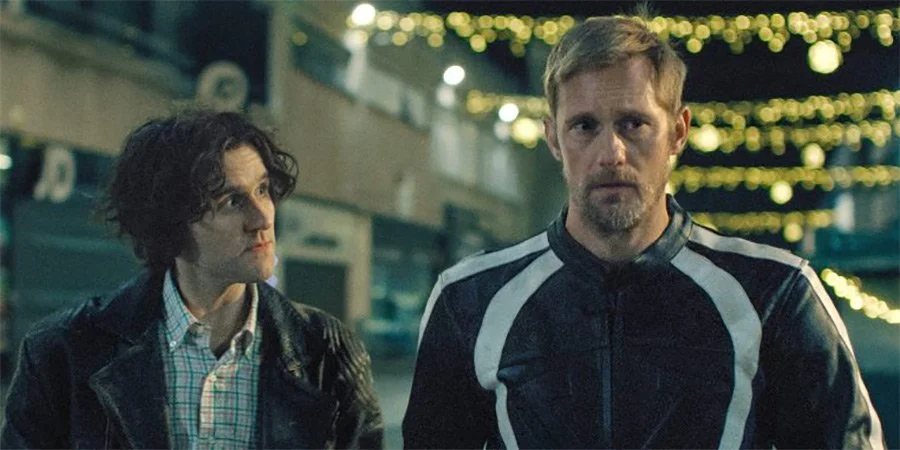
Harry Lighton's debut feature, based on Adam Mars-Jones's short story "Box Hill," follows Colin (Harry Melling), a 35-year-old traffic warden who still lives with his parents. He enters an intense BDSM relationship with Ray (Alexander Skarsgård), a motorcycle-riding dominant who sets strict rules and expects obedience. The film, which has been nominated for three BAFTAs, including Adapted Screenplay, Outstanding British Film, and Outstanding Debut, shows this world with real understanding and avoids sensationalism. Still, despite its careful observation, something about the film doesn't quite work.

Colin is passive from the first frame. His mother arranges his dates. His father drives him places. His job involves following rules someone else made. When Ray appears - impossibly handsome, radiating authority - Colin doesn't pursue him so much as make himself available to be collected. This is psychologically recognisable; plenty of people seek identity through others rather than building their own. But recognisable isn't the same as dramatically compelling. We watch Colin shave his head, wear a collar, and learn to cook omelettes to Ray's specifications. These feel like costume changes rather than character development. The Colin who approaches a new dominant man, Darren (Anthony Welsh), at a football pitch in the final scenes seems functionally identical to the Colin who fumbled through his awkward date in the opening.
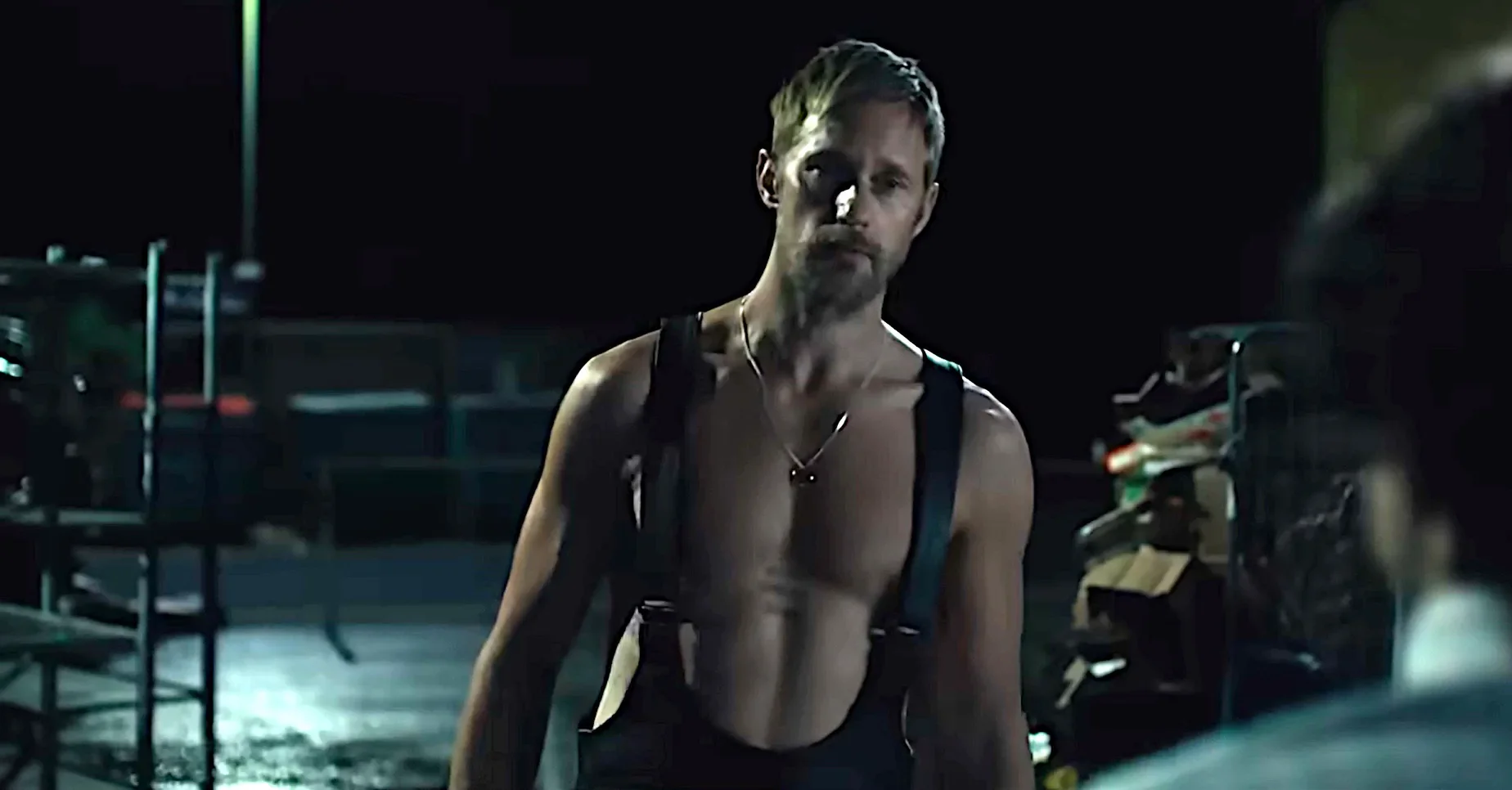
The Ray/Colin dynamic is rendered with uncomfortable honesty - the boot-licking, the sleeping on the floor, the rationed affection. Alexander Skarsgård plays Ray as genuinely unknowable, his "discretion" creating real mystery. But mystery in a lover differs from mystery in a dramatic catalyst. For Colin to grow, Ray would need to demand something beyond compliance: an opinion, a preference, a moment of genuine will. Instead, Ray's rules create a comfortable cage, and Colin adapts to captivity rather than fighting it. The single moment of rebellion - stealing Ray's motorcycle - is electrifying precisely because Colin finally does something. But watch how quickly the film retreats: he loses his nerve at the traffic lights, makes a cautious U-turn, and returns "well within the speed limit." The screenplay gives Colin wings, then immediately clips them.
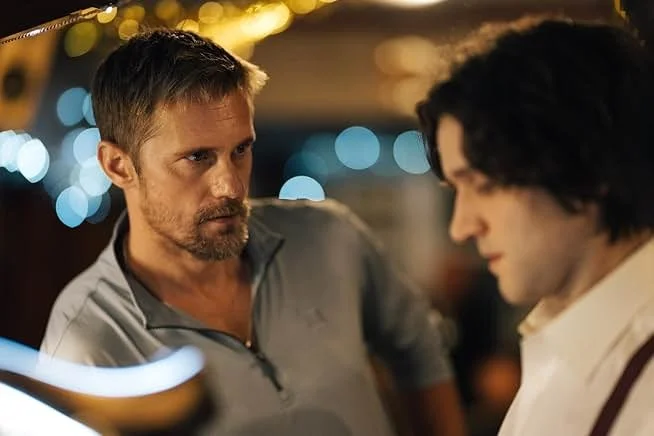
Colin's mother, Peggy (Lesley Sharp), sees Ray clearly. "He won't make you happy," she tells her son. Her directness at the disastrous family dinner - calling Ray a "cunt" to his face - is bracingly honest. And she's dying, which should lend her words the weight of a final testament. Yet Colin hears without listening. After her funeral, he asks Ray if love might eventually come. When Ray confirms it won't ("I think love's a Disney concept. But I like having you around. I like you a lot sometimes"), Colin simply... accepts this. Nods. Continues. A dying mother's warning should penetrate defences. Here, it bounces off.

The film takes its time establishing Colin's submersion into Ray's world - the rituals, the biker gatherings, the hierarchy of pillions and their masters. This section has texture and authenticity. But when the crisis arrives (Ray's abrupt disappearance), the resolution feels rushed. Colin searches, gives up, writes a dating profile ("your wish is my command"), and meets Darren. We're asked to accept this as an ending when it feels like a restart. The problem isn't the lack of a happy conclusion - plenty of strong films end in ambiguity. The problem is that nothing has accumulated. Colin hasn't gained insight or shed illusions. He's simply found a new dominant man to orbit. His one stated boundary - "I require one day off a week" - reads less like growth than contract negotiation.
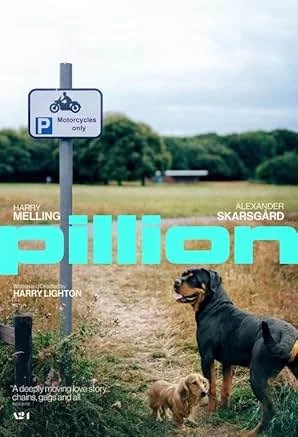
Perhaps this repetition is precisely the point. Maybe Lighton intends a clear-eyed portrait of how people replay patterns rather than break them - a refusal of false hope, a statement that the gravitational pull of early wounds can be inescapable. If so, Pillion joins a tradition of films about stuckness. This is valid territory. But it places pressure on execution: we need to feel the tragedy of repetition, not just observe it. We need to glimpse what Colin could become to feel the weight of what he doesn't.
Pillion announces a distinctive voice. The unflinching portrayal of queer sexuality, the ear for awkward silences, the eye for subcultural detail - these serve the material well. The film is often amusing and frequently excruciating in ways that feel earned. But we leave having witnessed something true about loneliness rather than having experienced it alongside Colin. He doesn't wrestle with his situation; he submits to it. And submission, however honestly portrayed, makes for a smaller emotional experience than this promising material might have delivered.
Fair Use/Fair Dealing Notice
Film stills from Pillion (2025, directed by Harry Lighton) are copyright of Element Pictures, BBC Film, and co-production partners, and are used here for criticism and commentary under fair dealing (UK) and fair use (US) provisions.

Andrew Higgs is getting his new book, The Alchemy of Screen Acting: Building a Sustainable Career in 21 Steps, ready for publication. Subscribers to Substack receive practical insights on screen acting and career development, and will be the first to know when the book becomes available. Subscribe for free using the link above.