CATEGORY 10: MINDSET AND PERSONAL DEVELOPMENT
Growth mindset essential for overcoming marketing resistance
Mindset: The New Psychology of Success by Carol S. Dweck, Robinson, 2017 (revised edition)
Carol Dweck's three decades of psychological research distinguish two fundamental belief systems shaping achievement: fixed mindset (intelligence and abilities are innate, unchangeable traits) versus growth mindset (abilities develop through effort, practice, and learning from failure). The distinction emerged when Dweck observed children's responses to difficult puzzles. Confronted with hard problems, one ten-year-old pulled up his chair, rubbed his hands together, and exclaimed, "I love a challenge!" Another said with authority, "I was hoping this would be informative!" These children understood that human qualities could be cultivated—they weren't failing, they were learning.
Dweck's research reveals how profoundly mindset affects outcomes. Fixed-mindset individuals avoid challenges that might expose limitations, interpret setbacks as evidence of inadequacy, and plateau early. Brain-wave studies show them paying attention only when told whether answers are right or wrong—when presented with information that could help them learn, no interest registers. Growth-mindset individuals embrace challenges as learning opportunities, persist through obstacles, and achieve higher levels through sustained effort. Their brain waves show intense attention to information that could stretch their knowledge—for them, learning is a priority.
The transformative word "yet" reframes failure from a permanent verdict to a temporary state requiring further development. Dweck describes graduate students arriving at Columbia with perfect test scores and recommendations from eminent scholars. One day makes some feel like complete impostors: "They look at the faculty with our long list of publications. 'Oh my God, I can't do that.' They look at the advanced students who are submitting articles for publication and writing grant proposals. 'Oh my God, I can't do that.' They know how to take tests and get A's, but they don't know how to do this—yet. They forget the yet."
For actors, Dweck's research directly challenges the industry's toxic "you either have it, or you don't" mythology. When talent-focused thinking dominates, casting becomes validation of innate worth—rejection transforms from professional feedback into existential threat. Growth mindset reframes the entire journey: marketing skills aren't "selling out" but learnable competencies; screen technique isn't betraying stage training but acquiring new capabilities; career building isn't waiting to be discovered but systematic skill development. The word "yet" becomes transformative: "I don't have an agent yet," "I haven't booked work yet." Dweck's research validates that sustained deliberate practice creates professional competency regardless of starting talent level—directly contradicting the paralysing belief that success requires innate gifts.
Applications span education, sports, business, and relationships. Michael Jordan—"Superman," "God in person," "Jesus in tennis shoes"—rejected notions of natural talent: "I was shocked with the level of intensity my coming back to the game created... People were praising me like I was a religious cult or something. That was very embarrassing. I'm a human being like everyone else." Jordan knew he'd worked hard developing his abilities. He was cut from high school varsity, not recruited by his preferred college, not drafted by the first two NBA teams—at that point, he was "only Michael Jordan," not yet MICHAEL JORDAN. Chuck Yeager similarly insisted: "There is no such thing as a natural-born pilot... becoming a proficient pilot was hard work, really a lifetime's learning experience."
The 2017 revised edition addresses "false growth mindset"—creative misinterpretations of the concept—and provides detailed guidance on "The Journey to a (True) Growth Mindset." Mindsets prove changeable: simply knowing about them enables people to recognise when they're avoiding challenges, feeling labelled by failure, or getting discouraged when something requires effort—and switch into a growth mindset.
The Power of Your Subconscious Mind by Joseph Murphy, Wilder Publications, 2007
Joseph Murphy's classic self-help text explores how subconscious beliefs shape external reality. Drawing on New Thought philosophy, psychology, and religious traditions, Murphy argues the subconscious mind operates like a faithful servant—accepting whatever beliefs the conscious mind impresses upon it, then working to manifest those beliefs in lived experience. "Your subconscious mind is like soil, which will grow all kinds of seeds, good or bad," Murphy writes. The gardener plants seeds (thoughts) through habitual thinking; the subconscious grows them into circumstances, conditions, and events. This creates either a flourishing garden or poisonous weeds, depending on which seeds receive water and attention.
Murphy's "law of belief" holds that the subconscious cannot distinguish between real and vividly imagined experience, making mental rehearsal a powerful transformation tool. He demonstrates this through Enrico Caruso's stage fright incident. The operatic tenor's throat paralysed before performance—"spasms caused by intense fear, which constricted the muscles of his throat. Perspiration poured copiously down his face." Caruso shouted, "The Little Me wants to strangle the Big Me within!" Then commanded: "Get out, get out, the Big Me is going to sing!" His subconscious responded, releasing vital forces. He walked onstage and "sang gloriously and majestically, enthralling the audience." The Little Me (conscious, rational mind full of fear) surrendered to the Big Me (subconscious mind's limitless power).
Murphy provides practical reprogramming techniques. The "sleeping technique" instructs stating specific desires to the subconscious before sleep: "You can discover the miracle-working power of your subconscious by plainly stating to your subconscious before sleep that you wish a certain specific thing accomplished." Forces within release during sleep, leading to desired results. Visualisation involves creating detailed mental pictures—"imagine the end desired and feel its reality." Murphy used this before platform speaking, imagining audiences saying "I am healed," "I feel wonderful," building the idea through sustained mental imagery whilst deeply relaxed.
For actors, Murphy addresses the psychological dimension of career building. The industry's high rejection rate creates destructive subconscious programming: "I'm not good enough," "I'll never get cast," "Selling myself is degrading." These beliefs become self-fulfilling prophecies, undermining auditions and networking before they begin. Murphy's techniques offer practical methods for mental rehearsal—imagining successful auditions, confident self-presentation, and professional interactions with casting directors. More fundamentally, the book provides tools for transforming core limiting beliefs: replacing "talent alone brings success" (passive, victim consciousness) with "professional skill plus authentic self creates sustainable career" (active, empowered consciousness). The subconscious accepts whatever the conscious mind habitually thinks; changing internal mental patterns creates external life changes. Murphy's work proves most effective when combined with practical action rather than used as a substitute for doing the work.
Think and Grow Rich by Napoleon Hill, The Ralston Society, 1937
Napoleon Hill's 1937 success classic distills principles from interviewing 500+ wealthy individuals including Andrew Carnegie, Henry Ford, and Thomas Edison into thirteen steps for achievement: Desire, Faith, Auto-suggestion, Specialized Knowledge, Imagination, Organized Planning, Decision, Persistence, Power of the Master Mind, The Mystery of Sex Transmutation, The Subconscious Mind, The Brain, and The Sixth Sense. Hill's central thesis: "thoughts are things" when mixed with definiteness of purpose, persistence, and burning desire. Success begins as mental discipline before material manifestation—riches start with a state of mind.
The Edwin C. Barnes story illustrates burning desire. Barnes wanted to work WITH Edison, not for him—a crucial distinction. Arriving broke, looking "like an ordinary tramp," Barnes possessed one asset: "he had made up his mind to stand by until he succeeded." When Edison's new Dictating Machine interested no salespeople, Barnes saw an opportunity. He sold it so successfully that Edison gave him national distribution rights. "Made by Edison and installed by Barnes" became their slogan for thirty years. Barnes "literally thought himself into a partnership with the great Edison."
Hill's "three feet from gold" principle addresses persistence. R.U. Darby's uncle discovered gold ore in Colorado, invested in machinery, then quit when the vein disappeared. They sold equipment to a "junk man" for hundreds. The junk man consulted a mining engineer who calculated the vein would be found "JUST THREE FEET FROM WHERE THE DARBYS HAD STOPPED DRILLING." Millions in ore followed. Darby later became one of fewer than fifty men selling over a million dollars in life insurance annually, saying: "I stopped three feet from gold, but I will never stop because men say 'no' when I ask them to buy insurance."
The Master Mind principle emphasises surrounding yourself with allies rather than struggling alone: "two minds working together create a third invisible force." Hill defines this as the coordination of knowledge and effort between two or more people working toward a definite purpose. Henry Ford's V-8 engine exemplifies determination—engineers insisted casting eight cylinders in one block was "impossible." Ford commanded: "Stay on the job until you succeed, no matter how much time is required." After a year, "as if by a stroke of magic, the secret was discovered."
For actors, Hill provides a mindset framework for the long-haul career journey. "Definiteness of purpose" counters vague "I want to be an actor" with specific Product Identification. Persistence addresses continuing systematic effort through years of rejection. The Master Mind concept validates building a professional support group rather than solo struggle. Hill's wealth focus and 1930s language feel dated, but core principles—clarity, faith, persistence, planning, decisive action—remain sound for building sustainable careers.
Feel the Fear and Do It Anyway by Susan Jeffers, Ballantine Books, 1987
Susan Jeffers' transformative self-help classic reframes fear from an obstacle requiring elimination into an inevitable companion on any growth journey. Her central insight: everyone feels fear when facing uncertainty, but successful people act despite fear, whilst unsuccessful people wait for fear to disappear first. Through teaching her "Feel the Fear . . . and Do It Anyway" course at the New School in New York, Jeffers discovered that the inability to deal with fear isn't primarily psychological but educational—by reeducating the mind, you can accept fear as a fact of life rather than a barrier to success.
Jeffers identifies three fear levels. Level 1 comprises surface situations: those that "happen" (ageing, illness, loss) and those requiring action (making decisions, changing careers, asserting oneself, public speaking). Level 2 involves ego-based fears: rejection, success, failure, vulnerability, loss of image, and disapproval. These explain why generalised fear permeates many life areas—if you fear rejection, it affects relationships, job applications, parties, and intimacy. Level 3 reveals fear's root: "I can't handle it!" Every fear translates to this core belief: "I can't handle illness," "I can't handle making mistakes," "I can't handle being alone." This explains why fear creates paralysis—if you believe you cannot handle potential outcomes, taking action feels impossibly dangerous.
Jeffers provides practical techniques for building confidence. The key shift: replacing "I can't handle it" with "I can handle it." She teaches positive self-talk, decision-making models eliminating paralysis, reframing failure as learning, and creating "no-lose" scenarios where every outcome offers value. Fear disguises itself as procrastination, perfectionism, or rational caution. Jeffers' reframe—fear is normal, action comes first, confidence follows—breaks the waiting-to-feel-ready trap. The book addresses specific fear categories whilst demonstrating that underlying mechanisms remain identical.
For actors, this addresses psychological paralysis, preventing action despite knowing intellectually what to do. Fear of rejection stops submitting for roles; fear of visibility prevents creating showreels; fear of "selling out" blocks marketing efforts; fear of success sabotages when opportunities arrive. Jeffers' techniques help actors maintain consistent effort through the industry's inevitable rejections without interpreting each as evidence they should quit. Her "no-lose" decision model supports a growth mindset—every audition teaches something, regardless of outcome. The eternal wound (artist versus commerce tension) manifests as fear: "If I market myself, I'll lose artistic soul." Jeffers' tools help recognise this as fear disguised as principle, enabling action despite discomfort. Most valuable alongside systematic steps—Jeffers provides psychological tools for executing actions when fear screams "don't."
The War of Art: Winning the Inner Creative Battle by Steven Pressfield, Rugged Land, 2002
Steven Pressfield's compact manifesto identifies and combats creative self-sabotage through three books totalling 165 pages. Book One defines "Resistance"—the invisible internal force blocking creative work through procrastination, self-doubt, fear, and rationalisation. Pressfield catalogues Resistance's characteristics: invisible, internal, insidious, implacable, impersonal, infallible (points toward most important work), universal, never-sleeping, fueled by fear. Like a magnetised needle floating on oil, Resistance unfailingly points to true North—the calling it most wants stopped. Pressfield writes: "Henry Fonda was still throwing up before each stage performance, even when he was seventy-five"—Fear never disappears; warriors and artists fight the battle anew daily.
Book Two presents the solution: "Turning Pro." Pressfield distinguishes amateur (plays part-time, for fun, when inspired) from professional (shows up daily regardless of inspiration, full-time commitment, works through fear). The amateur loves the game but pursues it as a sideline; the professional loves it enough to dedicate their life to it. Somerset Maugham exemplifies when asked about writing schedules: "Fortunately, it strikes every morning at nine o'clock sharp." The professional understands that sitting down and starting work sets a mysterious but infallible sequence producing inspiration—build it, she will come. Professionals respect Resistance whilst refusing to let it dictate behaviour.
Book Three explores spiritual forces—muses, angels—supporting sustained creative work. Foreword by Robert McKee positions the text as a practical battle plan, noting his own Olympic-level procrastination. McKee and Pressfield differ on inspiration's source (McKee cites genetic talent; Pressfield invokes divine realm) but agree on effect: when inspiration touches talent, truth and beauty emerge. Short, punchy chapters—often single-page—employ warrior metaphors throughout.
For actors, Pressfield addresses the psychological warfare accompanying creative careers. Resistance manifests at every stage: fear stopping audition submissions, marketing resistance preventing showreel creation, perfectionism blocking networking, and success-sabotage when opportunities arrive. The industry's constant rejection requires professional resilience—showing up prepared, regardless of internal screaming to quit. Pressfield's professional versus amateur distinction proves essential: amateurs wait for inspiration; professionals create conditions allowing inspiration to arrive. His Resistance catalogue helps actors recognise self-sabotage disguised as rational caution, legitimate concerns, or principled stands. Short enough for frequent re-reading, the text provides daily motivation for maintaining systematic effort when internal resistance peaks.
Zen in the Art of Archery by Eugen Herrigel, Pantheon Books, 1953
Eugen Herrigel's philosophical memoir documents a German philosophy professor's six-year apprenticeship under Zen Master Awa Kenzo, learning traditional Japanese archery during his 1920s teaching post in Japan. The text chronicles a Western rationalist's struggle to abandon conscious control to achieve "artless art"—a technique transcending technique through spiritual discipline. D.T. Suzuki's introduction contextualises for Western readers: archery isn't practised solely for hitting targets; it trains the mind to contact ultimate reality. The archer ceases being conscious of himself as one hitting the bull's-eye; hitter and hit become one reality.
Training begins with breathing exercises, establishing a spiritual foundation before touching the bow. Master teaches drawing "spiritually" with effortless strength—finding yielding water's resilience rather than muscular force. Central paradox: releasing the arrow without consciously releasing it, letting "It" shoot rather than ego shooting. After Herrigel spends months failing to achieve proper release, he devises a technical solution: easing thumb pressure until the arrow releases "spontaneously." The Master immediately detects the deception, refuses further instruction, and explains: "Once again, you have missed the goal because you have not been able to wait without purpose in the state of highest tension."
Herrigel's Western analytical mind repeatedly frustrates progress—calculates instead of simply acting. After recommencing lessons "from the very beginning," the breakthrough finally arrives. The Master asks: "Do you now understand what I mean by 'It shoots,' 'It hits'?" Herrigel responds: "Is it 'I' who draws the bow, or is it the bow that draws me into the state of highest tension? Do I hit the goal, or does the goal hit me?" The archer aims at himself in a spiritual contest; hitting the target becomes a byproduct of self-forgetfulness.
For actors, Herrigel illuminates screen performance's core paradox: requiring technical precision (hitting marks, camera awareness) whilst appearing completely natural and unrehearsed. Camera work demands similar unconscious technical mastery, allowing spontaneous truthfulness. The Master's teaching—preparing thoroughly so performance flows without self-consciousness under pressure—addresses psychological transformation underlying craft development: shifting from ego-driven striving to disciplined preparation allowing authentic expression. Breakthrough requires abandoning goal-oriented thinking, trusting unconscious mastery emerging from repetition without attachment to results. The book's brevity (under 100 pages) makes it suitable for re-reading during career plateaus, casting droughts, or role transitions when actors need reminding to trust disciplined preparation over results-obsession—letting craft excellence emerge rather than forcing outcomes through anxious striving.
CATEGORY 11: ALCHEMY AND TRANSFORMATION
VITRIOL mandala, tria prima, seven-stage cycle - theoretical machinery
The Complete Idiot's Guide to Alchemy by Dennis William Hauck, Alpha Books, 2008
Dennis Hauck's accessible introduction demystifies alchemy for modern readers, covering both historical laboratory practice and psychological/spiritual interpretation. The book explains core alchemical concepts through clear language and practical examples, making traditionally obscure material comprehensible without sacrificing profound insights. Hauck organises transformation into the Ladder of the Planets—seven operations corresponding to visible planetary bodies from Saturn (lead) through Jupiter (tin), Mars (iron), Venus (copper), Mercury (quicksilver), Moon (silver), to Sun (gold). These operations occur across three phases: Black Phase (purification through calcination and dissolution), White Phase (separation and conjunction of essences), and Red Phase (fermentation, distillation, coagulation, and creating the Philosopher's Stone).
The book covers four classical elements—Earth, Water, Air, Fire—and demonstrates how alchemists understood laboratory work as parallel to inner transformation. The tria prima (Mercury, Salt, Sulphur) represent three primary forces present in all things. Mercury embodies transformation itself, "the principle that melds all metals and Elements together as one." Salt represents fixed, stable matter. Sulphur signifies fire, passion, energy. Hauck explains the coded language alchemists invented: the Grey Wolf (antimony) "mercilessly devours other metals like lead, tin, and copper," purifying gold; the Green Lion (iron sulfate acids) dissolves metals, represents untamed subconscious forces; the Red Lion symbolises assimilation and control of those forces.
The symbolic system operates consistently across levels. Dr John Dee's Hieroglyphic Monad—"the cypher of the Philosopher's Stone"—geometrically incorporates all planetary symbols, demonstrating how transformation principles work universally. The ouroboros (serpent eating its tail) symbolises cyclic transformation: "All Is One." Hauck demonstrates how medieval alchemists understood their quest for physical gold, mirroring the inner quest for spiritual wholeness—transforming base self into realised potential. The "Idiot's Guide" format structures complex material clearly through sidebars ("From the Alchemist," "Thoth's Tips") and systematic chapter organisation.
For actors, Hauck provides a theoretical context for transformation's invisible machinery. The actor's journey is alchemical: transforming base material ("no credits, just starting") into gold ("working professional with sustainable career"). Understanding this framework isn't necessary to benefit—transformation happens whether you grasp theory or not—but for intellectually curious actors, Hauck explains why transformation requires specific stages in specific order, why catalysts appear at particular beats, and why shortcuts fail. The seven-stage cycle operating on three levels creates the 21-step structure, with each phase presenting distinct challenges requiring different approaches.
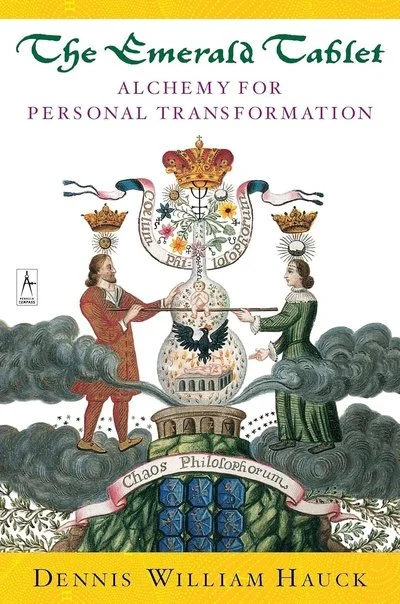
The Emerald Tablet: Alchemy of Personal Transformation by Dennis William Hauck, Penguin Arkana, 1999
Dennis Hauck's deeper exploration unpacks the legendary Emerald Tablet—a cryptic ancient text attributed to Hermes Trismegistus containing core alchemical principles compressed into thirteen statements. The book opens with Balinas, a sixteen-year-old prodigy, discovering the tablet clutched by Hermes' mummified corpse in an underground chamber beneath a marble statue. Resting in Hermes' lap glowed "a green-colored tablet" alongside four books, the last inscribed: "This is the secret of the creation and the knowledge of the causes of all things." Transformed by these truths, Balinas became Apollonius of Tyana—the greatest healer of his age—demonstrating principles learned from the tablet through silent presence alone.
Hauck structures the text around a visionary conversation with Hermes explaining the tablet's core insight: "As Above, so Below." Hermes declares: "The Above is the abode of One Mind, and the Below is the abode of One Thing." The most famous principle encodes fundamental correspondence—outer transformation mirrors inner transformation, physical reality reflects psychological reality, macrocosm corresponds to microcosm. Hermes warns: "Fear is great, for it destroys all subtle things and makes lead of gold." The transformation requires excising gold "from the crevices where it has accumulated" in wounds, releasing treasure to light's consciousness, following it upward to merge with "the greater Sun, to the place where total knowledge burns forever."
Part Two applies the "Emerald Formula" through seven operations across three phases. Black Phase (Calcination and Dissolution) destroys ego and defence mechanisms—"the Death of the Profane" burning away materialistic attachments. White Phase (Separation and Conjunction) filters essences, uniting purified components. Yellow-to-Red Phase (Fermentation, Distillation, Coagulation) taps the collective unconscious through transpersonal forces, creating the Philosopher's Stone. Hauck details Matthieu Merian's 1618 engraving incorporating all tablet truths: Sol (masculine principle) and Luna (feminine principle) chained to Clouds of Unknowing; hermaphroditic alchemist cutting chains through discernment; seven-layered central sphere mapping operations from zodiac's personal archetypes through Quintessence to perfected Mercury-Monad.
For actors, Hauck illuminates the correspondence between external career development and internal identity transformation. Visible journey (building showreel, securing agent, winning roles) mirrors invisible journey (dissolving false self-image, purifying authentic expression, integrating professional and artistic identities). Attempts to build careers through manipulation or fabricated personas fail because inner reality doesn't support outer claim—casting directors instinctively sense the mismatch. More advanced than Hauck's introductory guide, this addresses philosophical foundations beneath alchemical frameworks. Chapter 10 presents Basil Valentine's Azoth mandala—seven transformation operations arranged in a circle whose Latin captions form the acrostic VITRIOL: Visita Interiora Terrae Rectificando Invenies Occultum Lapidem ("Visit the innermost parts of the earth; by setting things right, you will find the hidden Stone"). This diagram provides the visual structure referenced in The Alchemy of Screen Acting’s alchemical framework. Particularly valuable when lived experience makes theoretical concepts viscerally real—dissolution phase dissolving naive beliefs, integration phase creating mature professional identity. The thirteen tablet statements studied alongside systematic career development create complementary transformation maps—theory illuminating practice, practice making theory tangible.

The Alchemical Actor: Consciousness, Literature and the Arts by Jane Gilmer, Brill, 2021
Australian theatre director Jane Gilmer's contemporary training manual elaborates Antonin Artaud's vision of "alchemical theatre" where actors serve as vessels for consciousness transformation. Trained in Anthroposophy and Jungian analysis, Gilmer integrates Renaissance hermetic principles with practical exercises mapping four alchemical stages onto four elements across five structural sections. Nigredo/Earth examines Artaud's manifestos—the Double, Cruelty, gesture as totemic power, essential drama, sacred mysteries. Albedo/Water explores alchemical imaginatio: prima materia, individuation, four elements, seven stages (calcination/dissolution/separation/conjunction/fermentation/distillation/coagulation), tria prima (salt/sulphur/mercury), planets/metals correspondences. Citrino/Air presents alchemical actor practices—elemental mandala, laboratory as theatre space, creative imagination techniques, dreams, Creative Word, Mandala Stage, Heart Thinking, initiation drama. Rubedo/Fire analyses Prospero's Tempest as an alchemical drama model. Quintessence synthesises the Dance of Elements.
Central thesis: actors develop consciousness through alchemical exercises, witnessing transformations in nature, practising differentiation of opposites (life/death, conscious/unconscious, masculine/feminine), working with archetypal images. Artaud's Balinese theatre inspiration becomes foundational—watching "mental alchemy which makes a gesture of a state of mind." Gesture receives particular emphasis: Artaud, Steiner, and Chekhov all position gesture as accessing unconscious realms beyond rationalistic cognition. Steiner's Creative Word training provides a practical methodology Artaud sought but couldn't articulate—reconnecting divine worlds through sound and language. Heart Thinking replaces head-based intellectualising with feeling-based knowing. Mandala Stage concept transforms performance space into a sacred laboratory for transmutation.
Gilmer grounds esoteric concepts through Carl Jung's Self-realisation psychology and Rudolf Steiner's Higher-I development. Jung's essential Self—"totality of the psyche, centre and whole circumference embracing conscious and unconscious"—provides a psychological framework. Steiner's "Birth of the Spirit Embryo" offers a spiritual dimension requiring conscious work against nature. Both approaches demand rigorous practice: contemplatively witnessing metamorphosing worlds, observing trees transforming seed-to-leaf-to-bud, identifying with the essence of change itself. Renaissance alchemists' natural magic—determining weather patterns from cloud formations, observing seasonal impacts on human behaviour—becomes a model for actor training. Everything experienced through "eyes of soul" reveals permanence, forever changing in a magnificent, life-affirming pattern.
For actors, Gilmer addresses the philosophical/spiritual framework underlying craft—understanding acting as consciousness transformation, not merely skill acquisition. Theatre becomes a sacred practice connecting Renaissance hermetic traditions. Heavily illustrated with alchemical symbols throughout, practical exercises include gesture work, meditation, creative visualisation, and elemental work. Highly esoteric presentation may alienate pragmatists seeking straightforward technique; best approached after foundational alchemy understanding. Published academic press (Brill), it assumes intellectual engagement with complex metaphysical concepts. Most valuable when career experience makes theoretical concepts viscerally real—different stages reveal different meanings upon re-reading. Integrates inner work with outer performance, positioning theatre as a spiritual laboratory for birthing new culture through consciousness development.
CATEGORY 12: JUNGIAN PSYCHOLOGY AND ARCHETYPES
Depth psychology underpinning transformation
Memories, Dreams, Reflections by C. G. Jung, Recorded with Aniela Jaffé; Pantheon Books, 1963
Jung's autobiography, recorded between 1957 and 1961 at the ages of 81-85, opens with the declaration: "My life is a story of the self-realisation of the unconscious." Not a systematic exposition but an intimate personal account tracing psychological development through dreams, visions, crises, forming the "prima materia" of scientific work.
Childhood years establish lifelong themes. Age three-four: underground temple dream—descending stone stairway behind green curtain, discovering ritual phallus enthroned, mother's voice declaring "That is the man-eater." Dream revealed a subterranean God contradicting Christian teaching, and established a secret relationship with the unconscious. Age ten: carving a manikin, painting an oblong stone, hiding both in the forbidden attic with scrolls in secret language. "Inviolable secret which must never be betrayed, for safety of my life depended on it." Later recognised as Telesphoros/Kabir archetype—collective unconscious operating before any tradition was transmitted.
Freud's collaboration/break (1907-1913) centres on the nature—Jung saw a religious/spiritual dimension, Freud reduced it to sexuality. Post-break crisis triggers transformation: "I felt totally suspended in mid-air." Question haunts: "In what myth does man live nowadays?"
Confrontation with the unconscious (1913-1919) becomes decisive. Childhood memory surfaces: building with blocks at age ten. "Painfully humiliating experience to realise there was nothing to be done except play childish games." Nevertheless, builds a stone village by the lake shore daily, finds red pyramidal stone—"this was the altar!" Building releases fantasy stream. Deliberate descent encountering autonomous psychic figures: Elijah with blind Salome, later Philemon, old man with bull's horns, kingfisher wings. "Philemon brought home crucial insight that there are things in the psyche which I do not produce, but which produce themselves." Teaches thoughts like animals in the forest, not self-generated. The active imagination technique develops.
Family provides grounding: "My family and profession remained a base to which I could always return, assuring me I was actually existing ordinary person." Without this: "I might have been torn to pieces."
Final reflection: "All my works, all my creative activity, have come from those initial fantasies and dreams which began in 1912."
For actors, autobiography validates autonomous psychic contents (archetypes) that operate independently of the ego—paralleling actors' experience, authentic characters possess autonomy beyond conscious construction. Childhood manikin ritual parallels actors' personal talismans supporting creative work. Split between outer/inner personality, Jung experienced mirrors actors inhabiting multiple identities—everyday self versus creative/archetypal self accessed in performance. Confrontation with the unconscious validates dark-night experiences as potentially transformative. Dense, philosophical, personal—requires patient reading after foundational Jungian texts.
Man and His Symbols by C. G. Jung, Marie-Louise von Franz, Joseph L. Henderson, Aniela Jaffé, Jolande Jacobi, Aldus Books, 1964
Jung's final major work, written 1959-1961, was specifically for the general public following a successful BBC interview. It was published in 1964, shortly after Jung's death at age eighty-six. The book has a unique origin: Jung initially refused but dreamed of addressing a multitude who understood him, which he interpreted as an unconscious directive to reach a wider audience. This collaborative effort saw Jung write the opening chapter, "Approaching the Unconscious" (ninety-plus pages establishing foundations), whilst von Franz contributed "The Process of Individuation," Henderson "Ancient Myths and Modern Man," Jaffé "Symbolism in the Visual Arts," and Jacobi a clinical case study. John Freeman (the BBC interviewer) served as an "intelligibility filter" ensuring accessibility.
Core concepts are systematically explained without jargon. The unconscious is not the Freudian "subconscious" (repressed desires) but a vital realm equal to consciousness, communicating through symbols. Archetypes are universal thought-patterns from the collective unconscious—not inherited representations but tendencies forming representations: hero, great mother, wise old man, shadow, anima/animus. Dreams compensate one-sided conscious attitudes, restoring psychological balance. The shadow contains repressed and disowned personality aspects requiring integration. Individuation is a lifelong process whereby the conscious and unconscious learn to coexist, creating psychological wholeness. Psychological types include extraversion and introversion, with four functions (thinking, feeling, sensation, intuition). Numinosity describes the emotional charge that makes symbols psychically real, not mere concepts.
The central thesis is that symbols bridge the conscious and unconscious, possessing both image and emotion simultaneously. Dreams require individual interpretation—there is no universal dictionary. The modern crisis is that rationalism has severed our connection to the symbolic and numinous. Jung declares that the "gods fled into the unconscious," and the loss of religious symbols has created a spiritual vacuum.
Von Franz's individuation chapter traces psychological development through fairy-tale patterns. Henderson's mythology chapter connects ancient hero myths (the Winnebago cycles: Trickster, Hare, Red Horn, Twins) to contemporary dream imagery. Jaffé's visual arts chapter demonstrates symbolic themes across cultures. The book is extensively illustrated throughout with photographs, artwork, and cross-cultural comparisons that make the concepts concrete.
The accessible prose distinguishes this from the dense Collected Works. Written in a conversational tone for intelligent lay readers without a psychology background, it consumed Jung's final year and was published posthumously, representing the culmination of his lifetime's work distilled for general understanding.
For actors, this provides an essential introductory text for the Jungian concepts underlying The Alchemy of Screen Acting framework. The compensation concept is crucial—the unconscious correcting one-sided attitudes parallels actors balancing external ambition with internal work. Shadow integration is essential for creating authentic performances—accessing repressed aspects prevents both grandiosity and self-doubt. Individuation as a lifelong process mirrors The Alchemy of Screen Acting's recognition that the twenty-one steps aren't a linear achievement but spiral development, revisiting themes throughout a career. The numinosity concept is vital—symbols must be emotionally experienced, not intellectually understood, paralleling how actors must emotionally access archetypes, not merely analyse them. The accessible style means actors can actually read this before tackling specialised texts.
Jung's Map of the Soul: An Introduction by Murray Stein, Open Court, 1998
Murray Stein's accessible introduction organises Jung's eighteen-volume Collected Works into a coherent map using Jung's own metaphor: the psyche is territory, the theory is a map describing it. Written by a Jungian analyst for intelligent lay readers, the book provides a systematic entry into Jung's complete psychological theory.
The structure descends through psychological layers, beginning with the ego and persona (the social mask), descending through the personal unconscious containing the shadow (rejected aspects) and complexes (emotionally charged unconscious patterns), continuing into the collective unconscious where universal archetypes dwell, including anima and animus (contrasexual inner figures) and the Self (totality and organising centre).
Stein emphasises Jung's dual identity as both an empirical scientist testing hypotheses and a visionary thinker whose insights originated from dreams and direct experience. Jung was "a Christopher Columbus of the inner world," whilst working scientifically, he was also "a visionary in the tradition of Meister Eckhart, Boehme, Blake, and Emerson." Stein quotes Jung's students recalling how, when criticised for inconsistency, Jung responded: "I have my eye on the central fire, and I am trying to put some mirrors around it to show it to others."
The book explains Jung's methodology, including amplification (using myth, religion, and culture to interpret psychological phenomena), dream analysis, and active imagination. Each chapter focuses on one theme, quoting specific passages from Jung's writings to demonstrate essential coherence. Stein presents individuation as a lifelong journey toward wholeness, integrating unconscious contents with consciousness.
Stein contextualises Jung historically, covering psychiatric training under Bleuler, the collaboration and break with Freud, and the development of analytical psychology. He acknowledges that Jung's work is both scientifically rigorous and artistically imaginative. The author writes that Jung's map "is gorgeous, not only abstract. Here one can find mermaids and dragons, heroes and evil characters."
For actors, this book provides an essential foundation for understanding the psychological architecture underlying The Alchemy of Screen Acting. Jung's individuation journey directly parallels the twenty-one-step Actor's Journey—both describe transformation from unconscious identification through shadow integration toward wholeness. Understanding archetypes is essential for character creation, as actors embody universal patterns audiences recognise unconsciously. Active imagination applies directly to character development. Jung's emphasis on direct experience mirrors the actor's craft, which requires embodied knowledge. The acting profession demands authentic self-knowledge—the camera reads unconscious material that actors haven't integrated.
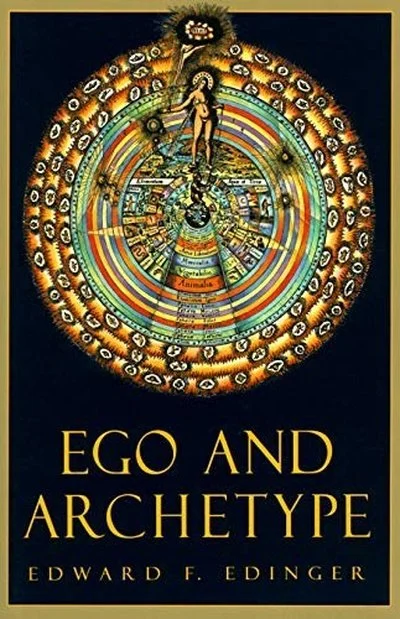
Ego and Archetype: Individuation and the Religious Function of the Psyche by Edward F. Edinger, Putnam, 1972
Edward Edinger's foundational Jungian text explores the relationship between ego (conscious personality) and Self (the archetype of wholeness and totality), drawing on mythology, religion, and clinical practice to illuminate psychological transformation. The book provides a systematic examination of individuation—the lifelong process of becoming oneself authentically.
Edinger's central concept is the ego-Self axis, the vital connecting link between ego and Self that ensures psychic integrity. The book traces how this axis develops through alternating cycles of ego-Self separation and reunion, forming a spiral of psychological growth. Using diagrams and mythological examples, Edinger demonstrates how the ego-Self relationship passes through distinct stages, each bringing specific challenges.
Two primary dysfunctions arise when the ego-Self axis becomes distorted. Inflation occurs when the ego identifies with the Self, arrogating to itself qualities of something larger—the person experiences himself as deity, leading to grandiosity and unconscious assumptions of omnipotence. Alienation represents the opposite extreme, when the ego becomes separated from the Self, resulting in meaninglessness and despair. The book examines both conditions through biblical narratives (Adam and Eve, Prometheus, Job), Greek tragedy, and clinical material.
Edinger illuminates the religious function of the psyche—our innate need for meaning, wholeness, and connection to something larger than ego-consciousness. Psychological development requires conscious engagement with archetypal patterns rather than unconscious identification or defensive rejection. The individuated ego maintains connection to the Self whilst recognising its own limitations.
The book's three parts address individuation and developmental stages, individuation as a way of life (examining Christ as a paradigm of the individuated ego), and symbols of the goal (including the Blood of Christ and the Philosophers' Stone). Throughout, Edinger demonstrates how alchemical symbolism provides maps for psychological transformation.
For actors, this provides a theoretical foundation for understanding the invisible transformation operating beneath The Alchemy of Screen Acting's practical career development. The actor's eternal wound—needing to sell yourself to practise your art—represents an ego-Self split between authentic expression and commercial necessity. The twenty-one-step journey addresses this split by transforming identity from "I am an artist" (ego-identified) through "I am a product" (alienating realisation) towards "I am a professional creative" (integrated wholeness). Edinger's framework explains why actors experience resistance to marketing themselves (ego protecting against inflation), why early success can be destructive (premature identification with Self), and why sustainable careers require genuine individuation rather than persona-building.
The Hero Within: Six Archetypes We Live By by Carol S. Pearson, HarperOne, 1986 (revised 1998)
Carol Pearson's accessible archetypal framework identifies six fundamental patterns shaping human experience and psychological development. Unlike Campbell's monomyth focuses on the external heroic journey, Pearson examines internal transformation through archetypal stages that individuals move through across a lifetime. Each archetype represents a distinct worldview, set of challenges, and gifts that help navigate the maturation process.
The six archetypes form a developmental sequence. The Innocent embodies trust, optimism, and faith in life's goodness, beginning in childhood's Garden of Eden state. The Orphan emerges through disappointment and loss, teaching survival skills, realism, and resilience. The Wanderer seeks independence and self-discovery, exploring new territories and finding one's authentic path. The Warrior develops courage, discipline, and goal-oriented action, learning to face dragons and prove worth. The Altruist (originally termed Martyr in earlier editions) discovers meaning through generosity, compassion, and commitment to something greater than oneself. Finally, the Magician achieves transformative power and integration, capable of changing both inner and outer kingdoms.
Pearson emphasises that these archetypes are not fixed personality types but dynamic inner allies available throughout life. Different archetypes activate depending on circumstances and developmental needs. The book explains how understanding archetypal patterns helps people recognise recurring story lines in their lives, make conscious choices rather than unconscious repetitions, achieve balance when feeling overwhelmed, and understand others' fundamentally different worldviews. Pearson uses everyday examples, showing how someone operating from Orphan consciousness (abandoned, cynical, survival-focused) makes fundamentally different choices than someone in Warrior mode (goal-oriented, boundary-defending, disciplined).
The revised edition includes exercises for awakening dormant archetypes and addresses how these patterns operate in families, workplaces, and relationships. Pearson demonstrates that archetypal possession—being taken over by an archetype's shadow side—explains destructive behaviours, whilst conscious engagement with archetypes provides psychological inoculation against their negative manifestations.
For actors, Pearson provides immediately usable character analysis tools. Understanding which archetype dominates a character's psychology helps actors find authentic behavioural choices and emotional truth. The framework also illuminates the actor's own journey: many actors begin as Innocents, trusting talent alone, become Orphans after industry rejection, shift to Wanderers seeking their path, then Warriors building careers systematically. Pearson's accessible style makes complex Jungian concepts practical without requiring a theoretical psychology background, particularly valuable to discover your screen type, for understanding archetypal patterns and throughout script analysis when identifying character psychology.
Awakening the Heroes Within: Twelve Archetypes to Help Us Find Ourselves and Transform Our World by Carol S. Pearson, HarperOne, 1991
Carol Pearson's expanded archetypal framework doubles her original six archetypes to twelve, organising them explicitly around Campbell's Hero's Journey in three phases. This systematic structure parallels psychological development stages: the Ego journey teaches safety and success, the Soul journey brings authenticity through life's mysteries, and the Self journey expresses unique identity and freedom.
Preparation for the Journey comprises four archetypes, developing Ego strength. The Innocent embodies trust and optimism; the Orphan learns survival and resilience; the Warrior develops courage and discipline; the Caregiver discovers generosity and responsibility. These archetypes help individuals survive in the world, develop productive citizenship, and establish moral character.
The Journey itself—"Becoming Real"—engages four archetypes encountering the Soul. The Seeker leaves safety to find authentic identity; the Destroyer lets go of outgrown attachments; the Lover embraces connection and passion; the Creator births new forms and possibilities. This phase requires leaving familiar territory, confronting shadow, and embracing transformation.
The Return—"Becoming Free"—integrates experience through four archetypes expressing the Self. The Ruler creates order and takes responsibility; the Magician transforms consciousness and reality; the Sage achieves wisdom and detachment; the Fool embraces joy and spontaneity. These archetypes help individuals express their true selves whilst contributing to collective transformation.
Pearson presents each archetype as a complete worldview with gifts, challenges, developmental tasks, and shadow manifestations. Unlike her earlier work focused primarily on personal development, this book explicitly connects individual psychological growth to collective cultural transformation. Understanding archetypal patterns helps decode personal psychology, family dynamics, workplace cultures, and societal structures. The book includes exercises for awakening dormant archetypes and a comprehensive assessment tool.
The final section addresses gender, diversity, and life stages, showing how different archetypes naturally predominate at different developmental periods and how cultural conditioning affects which archetypes individuals feel permitted to express.
For actors, the twelve-archetype system provides richer character analysis than the original six. The expanded framework captures subtler distinctions—Creator versus Destroyer both involve transformation but through opposite means; Ruler versus Magician both wield power but with different consciousness. The three-phase organisation helps actors track character development across story arcs. Understanding which archetype dominates helps actors find behavioural specificity and emotional truth. The framework also illuminates actors' own journeys through The Alchemy of Screen Acting—the three phases directly parallel the book’s structure (Preparation, Journey, Return), helping actors recognise when they're operating from Orphan survival mode, shifting to Warrior discipline, crossing into Seeker authenticity, and ultimately integrating Magician consciousness.
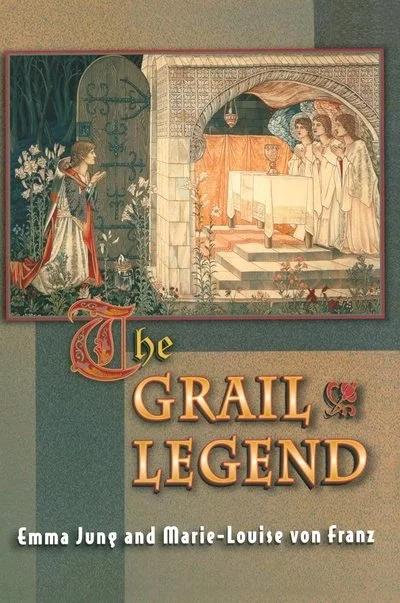
The Grail Legend by Emma Jung and Marie-Louise von Franz, translated by Andrea Dykes, Putnam, 1970
This profound Jungian analysis examines medieval Grail romances—particularly the Perceval/Parzival cycle—as archetypal maps of psychological transformation. Emma Jung (Carl Jung's wife and collaborator) and Marie-Louise von Franz (Jung's most important student) decode the symbolic language embedded in these romance narratives.
The authors demonstrate how the Grail represents the Self (archetypal wholeness), whilst the Wounded Fisher King embodies split consciousness, unable to access healing. The Wasteland reflects psychological sterility when the ego separates from the Self, and Perceval, the innocent fool, must undergo initiation to restore fertility. The legend encodes the individuation process—moving from naive unconsciousness through devastating failure to conscious return and integration.
The book traces Perceval's journey meticulously. At his first visit to the Grail Castle, he fails to ask the healing question, remaining paralysed by unconscious identifications. Only after wandering and developing consciousness can he return and pose the question that restores the wounded king and heals the wasteland. The masculine quest must integrate the rejected feminine principle to achieve wholeness. The sword and lance, the Grail as vessel and stone, the table and carving platter—each symbol receives detailed examination, revealing layers of alchemical and Christian meaning.
The authors explore multiple textual traditions, examining Chrétien de Troyes' twelfth-century version, Robert de Boron's trilogy, Wolfram von Eschenbach's Parzival, and other medieval sources. They demonstrate connections between Grail symbolism and alchemical imagery. The figure of Merlin receives extensive treatment as a medicine man, prophet, and embodiment of the alchemical Mercurius.
Throughout, Jung and von Franz emphasise that these poetic fantasy creations illustrate unconscious psychic processes still profoundly significant, anticipating the religious problems of modern consciousness. The Grail quest remains a living myth because it addresses the fundamental human problem: integrating ego with Self, consciousness with unconscious, masculine with feminine.
For actors, this illuminates the Quest archetype at profound psychological depth. The Grail quest mirrors the actor's journey: beginning as an innocent, trusting talent alone, experiencing devastating industry rejection, undergoing initiation, and returning transformed with professional competency. The Wounded King represents the actor's split between artistic authenticity and commercial necessity—the eternal wound that The Alchemy of Screen Acting addresses. Understanding these symbolic depths enriches performance in Quest narratives whilst illuminating the actor's own transformation journey. The wounded healer theme resonates particularly: actors heal their own wounds by helping audiences experience catharsis.
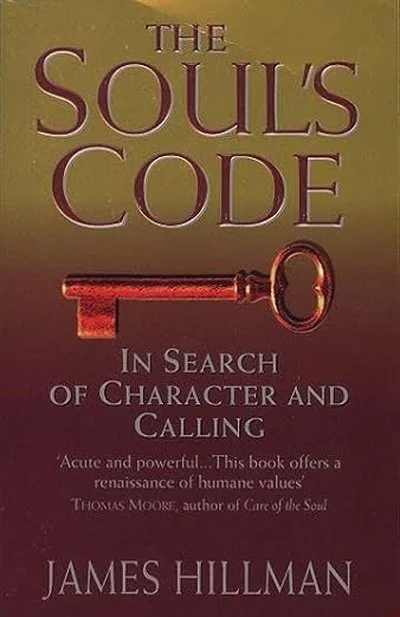
The Soul's Code: In Search of Character and Calling by James Hillman, Random House, 1996
Post-Jungian psychologist James Hillman's radical challenge to nature/nurture determinism proposes the "acorn theory"—each life is formed by a particular innate image calling it towards destiny, as the mighty oak's essence is encoded in the tiny acorn. The central concept is the daimon (Greek), genius (Roman), or guardian angel (Christian)—an invisible guiding force containing life's unique essence demanding expression.
Drawing on Plato's Myth of Er from Republic Book X, Hillman argues souls choose their daimons before birth, selecting destinies they must fulfil. He rejects viewing humans as results or victims of genetics and environment, welcoming every life aspect's necessity, treating "symptoms" as clues revealing what the daimon demands. The book employs an extensive biographical method, examining extraordinary lives from Yehudi Menuhin to Jeffrey Dahmer, demonstrating how childhood troubles reveal an innate calling rather than a pathology requiring cure.
Hillman urges readers to reexamine childhood impulses and difficulties as the daimon's early signals. The core question: "What is it, in my heart, that I must do, be, and have? And why?" The book challenges the parental fallacy—blaming parents when children arrive with their own blueprints. Major themes include fate versus fatalism, character formation, and the calling's invisible mystery.
Hillman, founder of archetypal psychology, extends Jung's work by emphasising the soul's autonomous purposes beyond the ego's understanding. The daimon remembers what belongs to your pattern and carries your destiny. Reading life backwards reveals how early obsessions perform current behaviours.
The book provides fresh perspectives on childhood disorders, viewing them less as caused by pathology than as calls. Tantrums, obstinateness, and shyness may protect the world the child comes from. Psychopathologies are authentic, given with the child as part of its gift.
For actors, this provides a foundational philosophy for understanding screen type not as a limitation but as a daimon revealing itself through physical essence. Childhood acting impulses are reframed—not escape but daimon demanding manifestation. Understanding calling as destiny requiring fulfilment offers soul-level validation for choosing to act despite practical difficulties. The book explains why actors are drawn to specific roles—the daimon recognising its territory. Particularly relevant because the camera reads whether actors inhabit their unique essence or imitate others. Essential throughout The Alchemy of Screen Acting journey, particularly when identifying screen type and learning to transcend it—transcendence means fulfilling the daimon's deeper purpose, not escaping innate nature.
Man—A Three-Brained Being: Resonant Aspects of Modern Neuroscience by Keith A. Buzzell, Fifth Press, 2007 (revised second edition)
Physician and Gurdjieff student Keith Buzzell's neuropsychological exploration integrates evolutionary biology, neuroscience, and consciousness studies to examine Gurdjieff's three-brain teaching introduced circa 1915. The core thesis proposes that human consciousness emerges from the coalescence of three evolutionarily successive "brains" or centres, each creating distinct orders of images.
The First Brain (reptilian core, R-complex) serves as the moving-instinctive centre, creating "resonant representations" of the external physical world through sensory perception, governing survival, territory, and automatic movement. The Second Brain (limbic system, mammalian brain) functions as the emotional-feeling centre, imaging internal body states and creating a sense of self-other through interoceptive awareness, mediating family behaviours, nurture, and play. The Third Brain (neocortex) provides the intellectual-thinking centre, offering a separate perspective capable of viewing the other two brains whilst enabling abstraction, language, conceptual thought, and a sense of I.
Buzzell traces the "Great Turning"—the appearance of brain life approximately 500 million years ago, enabling independent automatic motion and representing the universe's first capacity to witness itself through image creation. This evolutionary development marked a fundamental transformation.
Consciousness is defined as an expanding "bowl" of awareness containing progressively integrated images from all three centres. When centres function harmoniously, genuine consciousness emerges. When disconnected, various dysfunctions appear. The book includes diagrams illustrating brain interactions, awareness hierarchies, and consciousness expansion.
Buzzell offers a trenchant critique of modern technology, arguing that applications derived from quantum mechanics and relativity—television, computers, instant communications—operate at speeds incompatible with biological brain-development timing, creating unprecedented vulnerabilities. The final chapter addresses "intentional digestion" of images for conscious transformation, drawing parallels between physical digestion and psychological processing.
The revised second edition, published posthumously in 2007, expands chapter four and incorporates updated neurological research whilst maintaining Buzzell's integration of Gurdjieff's esoteric teachings with contemporary neuroscience.
For actors, this text provides a foundational understanding of the three intelligences—body/gut, emotion/heart, and intellect/head—underlying the creative instrument. Screen acting requires conscious integration of all three centres simultaneously: physical technique (first brain), emotional truth (second brain), and intellectual understanding (third brain). The camera reads disconnection between centres—when actors think emotion rather than feel it, or physically indicate rather than embody. Understanding three-brain structure explains why certain acting exercises work: different techniques develop different centres, whilst complete performance demands integrated function. Gurdjieff's "intentional digestion" concept parallels the actor's work, transforming life experience into usable material. Essential for understanding the instrument's architecture and diagnosing performance problems.
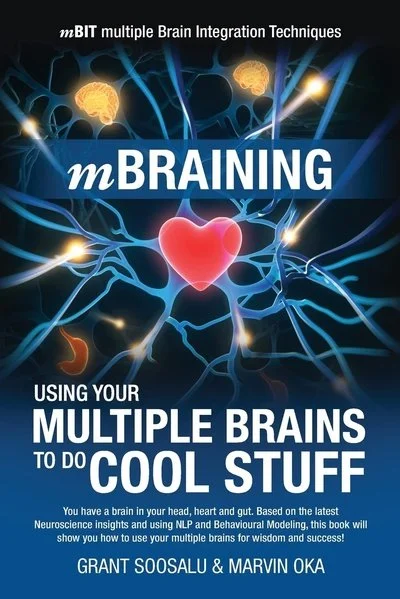
mBraining: Using Your Multiple Brains to Do Cool Stuff by Grant Soosalu and Marvin Oka, mBIT International, 2012
Behavioural modellers Grant Soosalu and Marvin Oka synthesise a decade of neuroscience research with NLP (Neuro Linguistic Programming) and Behavioural Modelling to create mBIT (multiple Brain Integration Techniques)—a practical system for integrating three distinct neural networks. Recent neuroscience has discovered complex functional brains beyond the head: the cardiac brain (heart—over 40,000 neurons) and the enteric brain (gut—over 100 million neurons). Each exhibits distinct intelligence and core competencies.
The head brain provides cognitive perception, thinking, meaning-making, and creativity. The heart brain governs emoting, values, relational affect, compassion, and courage. The gut brain manages core identity, self-preservation, mobilisation, safety, boundaries, action, and intuition. Modern science validates ancient wisdom traditions—Buddhist, Taoist, contemplative—which have recognised these intelligences for millennia.
The book's central thesis identifies a contemporary crisis: modern society operates primarily from head-based rationality, creating profound imbalance. The solution requires integrating all three brains' wisdom through specific, teachable techniques. The authors provide methods for communicating with each brain independently, aligning them hierarchically (typically gut→heart→head), and balancing their expressions.
Written in an accessible, entertaining style that deliberately avoids academic jargon, each chapter includes practical exercises readers can implement independently. The methodology draws on Cognitive Linguistics research demonstrating that language literally represents underlying neurological processes—common expressions like "trust your gut" or "follow your heart" reveal actual neural intelligence operating in those regions.
Unlike esoteric approaches to three-centred work, mBraining offers user-friendly accessibility grounded in contemporary neuroscience. The authors synthesised over six hundred research papers whilst noting that existing studies examined each brain in isolation—no research existed on integrating all three neural networks for optimal functioning. Their behavioural modelling methodology maps unconscious processes that people cannot consciously articulate, enabling practical technique development.
For actors, this text provides a superior practical resource for three-brain integration underlying the creative instrument. Screen acting demands simultaneous head (script comprehension), heart (emotional truth), and gut (instinctive physical choices) integration. The camera reads disconnection between centres—when actors think emotion rather than feel it, or physically indicate rather than embody. Understanding each brain's specific competencies enables targeted development: head brain's cognitive perception supports script analysis and character understanding; heart brain's compassion and courage support emotional authenticity; gut brain's mobilisation and boundary-setting support physical embodiment and industry navigation. The book provides specific techniques actors can practise independently, making it more immediately applicable than philosophical or evolutionary approaches. See: https://mbrainingtheworld.com/

Shakespeare's Wisdom in As You Like It by Peter Dawkins, Foreword by Mark Rylance, I.C. Media Productions, 1998
Peter Dawkins' groundbreaking analysis reveals profound Renaissance Neoplatonic, Hermetic, and Cabalistic wisdom encoded in Shakespeare's As You Like It. Published in 1998 as the first in Dawkins' "Wisdom of Shakespeare" series, the book demonstrates how Shakespeare teaches through entertainment, following ancient tradition. Dawkins traces philosophical lineage from Marsilio Ficino and Pico della Mirandola's Renaissance Neoplatonism—which synthesised Hermetic, Platonic, Pythagorean, Orphic, Cabalistic, and Christian teachings—through to Shakespeare's dramatisations.
The book systematically unpacks multiple interpretive layers: surface romantic comedy, historical commentary, psychological soul journey, and initiatory wisdom teaching. The central framework employs the Hebraic Tree of Life from Christian Cabala, mapping characters to specific sephiroth and showing how the play's structure mirrors cycles of initiation found in ancient mystery schools. The Forest of Arden becomes an archetypal wilderness where initiatory transformation occurs—leaving the corrupt "city" (ordinary consciousness), undergoing trials in the "forest" (heightened awareness), achieving wisdom through love, and returning transformed. Rosalind functions as an initiating magician, consciously guiding others through their transformations.
Dawkins demonstrates that Renaissance Neoplatonism suffuses Shakespeare's work, blending diverse wisdom traditions into a unified philosophical vision. Understanding this Neoplatonic foundation is essential to understanding Shakespeare. The book examines Shakespeare's extensive biblical knowledge, showing how the plays function as dramatised commentaries informed by Cabalistic philosophy and Hermetic wisdom.
Mark Rylance's foreword validates practical theatrical value, noting how Dawkins' ideas have significantly increased his understanding and enjoyment of Shakespeare. Rylance describes the approach as mercurial, constantly reshaping as times change.
For actors, Dawkins provides a sophisticated esoteric framework transforming surface characterisation into archetypal depth. Understanding Rosalind as an initiating magician rather than merely a clever romantic heroine helps actors access genuine transformative power. Recognising Duke Senior's forest community as a mystery school clarifies the spiritual dimension beneath the political surface. The Tree of Life mapping shows each character's function in cosmic and psychological schema—actors understand not just individual psychology but archetypal role within a larger pattern. The Hermetic principle "As above, so below" helps actors play both specific individual and archetypal functions simultaneously.
Dawkins has written five books in the "Wisdom of Shakespeare" series: As You Like It (1998), The Merchant of Venice (1998), Julius Caesar (1999), The Tempest (2000), and Twelfth Night (2002), all with forewords by Mark Rylance. These texts apply the same methodology to different plays and are recommended reading for actors appearing in productions of these works.
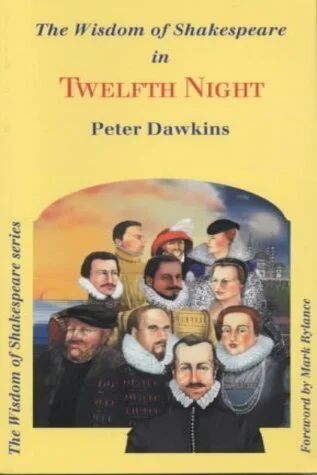
Twelfth Night: The Wisdom of Shakespeare by Peter Dawkins, Foreword by Mark Rylance, Francis Bacon Research Trust, 2002
Dawkins' esoteric reading reveals Cabalistic and Alchemical structures underlying Shakespeare's comedy of twins. Written for the 400th anniversary of the play's first recorded Middle Temple Hall performance in 2002, the book features Mark Rylance's foreword connecting the play to Persian poetry, French chivalric amor and Sufi traditions—patterns disarming religious division through celebrating divine masculine and feminine principles.
The central thesis proposes double twinship. Viola and Sebastian represent higher polarity, embodying divine Mercury's feminine Holy Spirit and masculine Logos. The sea-captains form the lower earthly polarity. The Gemini myth provides an archetypal framework: Castor and Pollux as immortal-mortal spear-shakers protecting travellers by sea. Twin Pillars symbolism maps characters according to traditional polarities. The right-hand pillar is associated with compassion, emotion and will. The left-hand pillar represents discernment, intellect and reason.
The madness theme reveals initiatory stages. Fool, madman and drowned man represent three degrees culminating in psychological death. Malvolio's imprisonment in darkness dramatises inner blindness. Feste declares, "There is no darkness but ignorance." Sir Toby's drunken wisdom accidentally proclaims Unity—the highest teaching—contrasting devil with faith whilst declaring "it's all one."
Feste's closing song structures four life stages through the alchemical wheel: boyhood as earth, youth as water, marriage as air, and old age as fire. The refrain "Hey, ho, the wind and the rain" frames spirit against matter, heaven against earth. Orsino's opening emphasises creative breath; Feste's finale emphasises rain—Twin Pillars mirroring the Bible's structure from Genesis (creation's beginning) to Revelation (apocalyptic end).
Characters map onto the Cabalistic Tree of Life. Viola embodies goodwill, whilst Malvolio—Latin mal volo meaning "ill will"—represents its inversion. His yellow cross-gartered stockings reference Capricorn's lustful goat-devil. Throughout the play explores revealed versus concealed, truth versus illusion, daylight versus candlelight's theatrical masks.
Dawkins provides a gateway into profound wisdom teachings embedded within performance's entertainment.
CATEGORY 13: HERO'S JOURNEY AND MYTHOLOGY
Campbell's monomyth validating three-phase transformation structure
The Hero with a Thousand Faces by Joseph Campbell, Bollingen Foundation/Pantheon Books, 1949
Joseph Campbell's 1949 masterwork establishes the "monomyth"—the single archetypal narrative pattern underlying world mythology—through exhaustive comparative analysis drawing from Greek, Hindu, Buddhist, Christian, Native American, and countless other traditions. Campbell argues that beneath infinite cultural variations lies one constant story, though his language reflects the dated and problematic racial attitudes of his era. His achievement lies in demonstrating universality through precise structural analysis reinforced by hundreds of specific examples, from the Buddha's quest beneath the Bo Tree to Psyche's descent into the underworld, from Prometheus stealing fire to King Muchukunda's awakening after aeons of sleep.
The famous formulation captures the pattern's essence: a hero ventures from the world of common day into supernatural wonder, encounters fabulous forces, wins decisive victory, and returns with power to bestow boons. This tripartite structure—Departure, Initiation, Return—unfolds through seventeen stages including the Call to Adventure (often triggered by "blunders" revealing suppressed desires), Refusal of the Call, Supernatural Aid from mentors, Crossing the First Threshold into the unknown, the Belly of the Whale representing complete immersion, Road of Trials testing the initiate, Meeting with the Goddess embodying creative integration, Atonement with the Father reconciling with authority, and ultimately Freedom to Live. Campbell's psychological interpretation, drawing heavily on Freud and particularly Jung, reveals the external adventure as a symbolic map of internal transformation: the hero's journey represents ego death, encounter with the shadow, and individuation towards wholeness. The tyrant-monster embodies ego-inflation; the labyrinth represents descent into the unconscious; Ariadne's thread symbolises guidance enabling navigation of dangerous psychological terrain.
Campbell's prose moves between scholarly rigour and mythic grandeur, as when quoting Jonathan Edwards' fire-and-brimstone sermon on divine wrath ("The God that holds you over the Pit of Hell, much as one holds a Spider or some loathsome Insect over the Fire") to illustrate the "ogre aspect of the father." His epilogue addresses modernity's crisis directly: "Dead are all the gods," Nietzsche proclaimed, yet the hero-deed remains vital—no longer discovering external truths but integrating conscious and unconscious to achieve maturity through contemporary conditions.
For actors, this text provides a theoretical foundation for understanding character transformation as an initiatory journey rather than plot progression. Every role potentially offers an encounter with archetypal dimensions—goddess, shadow, threshold guardian, mentor. Campbell's emphasis on the hero's obligation to return and serve the community resonates powerfully: transformation without contribution remains incomplete. The book demands patient reading; its density rewards multiple encounters as lived experience deepens understanding.
The Writer's Journey: Mythic Structure for Writers by Christopher Vogler, Michael Wiese Productions, 1998 (Third Edition 2007)
Christopher Vogler's screenwriting manual originated as a seven-page Disney memo distilling Campbell's monomyth into practical story structure. Working as a story analyst at Walt Disney Company, Vogler crafted "A Practical Guide to The Hero with a Thousand Faces" using film examples. That memo circulated through Hollywood, becoming "the stuff of Hollywood legend." The book expanded this framework into twelve accessible stages: Ordinary World, Call to Adventure, Refusal of the Call, Meeting the Mentor, Crossing the First Threshold, Tests/Allies/Enemies, Approach to the Inmost Cave, Ordeal, Reward, The Road Back, Resurrection, and Return with the Elixir.
Vogler's crucial insight, developed whilst working on Disney fairy tale adaptations, transformed how archetypes function in storytelling. Rather than rigid character types, he describes archetypes as flexible masks characters wear temporarily to serve specific dramatic functions. This observation, drawn from Vladimir Propp's morphology of Russian folktales, liberates character design: a single character might enter as Herald, then shift masks to function as Trickster, Mentor, and Shadow. In An Officer and a Gentleman, Louis Gossett Jr.'s drill sergeant wears both Mentor and Shadow masks simultaneously, guiding Richard Gere through Navy training whilst testing him to destruction. James Bond's weapons master, "Q", exemplifies the Mentor who plants information, demonstrating gadgets the bored 007 ignores until they become lifesavers.
Vogler humanises villains through vulnerability and complexity. He cites Graham Greene's technique: the hero approaches to kill a villain, only to discover the poor fellow has a head cold or is reading a letter from his little daughter. Suddenly, the villain isn't merely a fly to be swatted but a real, frail human being. Killing him becomes a genuine moral choice requiring conscious decision rather than a thoughtless reflex. Most Shadows perceive themselves as heroes of their own myths—Hitler's sincere conviction that he was right enabled his atrocities. The book's examples span from classical mythology (Daedalus advising Icarus not to fly too close to the sun) to contemporary blockbusters, demonstrating the monomyth's universality.
For actors, Vogler provides essential vocabulary for understanding character function beyond surface psychology. When casting directors describe "the mentor who refuses the call" or "the shapeshifter whose loyalty is ambiguous," they deploy Vogler's framework. Recognising whether one embodies Mentor, Trickster, or Shadow energy clarifies dramatic purpose. These archetypal functions reveal why characters exist—the Mentor equips the hero, the Threshold Guardian tests commitment, the Shadow embodies what must be confronted.
The Heroine's Journey: Woman's Quest for Wholeness by Maureen Murdock, Shambhala Publications, 1990
Maureen Murdock's groundbreaking work emerged from a 1981 conversation with Joseph Campbell that left her stunned. When she asked about women's journey, Campbell responded that women "don't need to make the journey"—they are "the place that people are trying to get to." This answer profoundly dissatisfied Murdock, a licensed family therapist working with women aged thirty to fifty who had embraced the masculine heroic quest yet experienced only "sterility, emptiness, and dismemberment, even a sense of betrayal." These women didn't want to embody Penelope, "waiting patiently, endlessly weaving and unweaving." They'd climbed the ladder only to discover, as Campbell observed of mid-life crisis, that "it's against the wrong wall."
The model appeared whilst Murdock participated in family sculpting therapy. Holding her frozen position, her back went out—she could no longer sustain "bending over backwards to keep the peace." Immobilised for three days, crying about family chaos she'd shut out through overachievement, the heroine's ten-stage circular journey emerged: Separation from the Feminine, Identification with the Masculine, Road of Trials, Illusory Boon of Success, Awakening and Feelings of Spiritual Aridity, Initiation and Descent to the Goddess, Urgent Yearning to Reconnect with the Feminine, Healing the Mother/Daughter Split, Healing the Wounded Masculine, and Integration of Masculine and Feminine. This pattern describes "father's daughters"—women who identified with fathers, rejected mothers, sought masculine approval, achieved success by masculine standards, then experienced breakdown when achievement felt hollow.
Murdock's descent narrative captures the journey's darkness: "This is uncharted territory. It's dark, moist, bloody, and lonely. I look for the dismembered parts of myself." Unlike the heroic conquest of external enemies, this journey requires "coming face to face with myself." One client's words haunt: "When I look inside, I don't know who's there. The only thing I am sure of is a yearning to whole my heart." The sacred marriage—hieros gamos—integrates both aspects, allowing women to remember their true nature wholly.
For actors, Murdock illuminates how female performers face pressure to masculinise—becoming aggressive self-promoters whilst suppressing nurturing instincts—to survive in masculine-dominated professions. This creates the spiritual crisis she describes: success achieved by betraying authentic feminine values feels empty. Understanding this pattern enables conscious choices about which values to honour, avoiding self-destructive assimilation. For character work, Murdock provides a framework for female roles beyond male-defined archetypes—the woman struggling with cultural feminine rejection, the high-achiever experiencing spiritual emptiness, the painful integration of strength and compassion.
Pathways to Bliss: Mythology and Personal Transformation by Joseph Campbell, edited by David Kudler, New World Library, 2004
This posthumous compilation draws from Campbell's lectures and seminars spanning 1962-1983, focusing on mythology's "fourth function"—personal psychological transformation rather than comparative scholarship. Editor Kudler noticed Campbell's remarkable consistency across two decades: "I found that the ideas that he was expostulating at the end of the period...were indeed very much in line with those that he was continuing to explore close to the end of his life." The conversational tone and practical applications make this Campbell's most accessible work, a companion that translates Hero with a Thousand Faces' theoretical framework into lived experience.
The five sheaths (Vedantic koshas) provide the book's psychological architecture: annamaya (food/body—"food on fire"), pranamaya (breath/life), manomaya (mental/ego—where consciousness thinks "it is you"), vijñānamaya (wisdom—organic intelligence healing wounds, incorporating barbed wire into trees), and anandamaya (bliss—the transcendent kernel). Campbell illustrates using Tutankhamen's nested coffins: three quadrangular boxes (food, breath, mental), stone separation, a wooden sarcophagus inlaid with gold (wisdom sheath representing living organic form), and finally a solid gold coffin (bliss sheath). Myth's function bridges the mental sheath—trapped in concepts and temporal tasks—to the wisdom sheath connecting with transcendent energy.
The famous phrase "follow your bliss" originates here: "You'll have moments when you'll experience bliss. And when that goes away, what happens to it? Just stay with it, and there's more security in that than in finding out where the money is going to come from next year." Campbell contrasts this with career projections: "This year it's computer work; next year it's dentistry...it changes so fast." Making yourself "transparent to the transcendent"—German psychiatrist Karlfried Graf Dürckheim's phrase—means allowing life energy flow through rather than blocking it with ego concerns.
The Grail quest story captures an individual journey: knights entering the Forest Adventurous, "where it was darkest and there was no way or path"—finding unique pathways rather than following established routes. Most haunting is the shaman's call story: a woman in West Virginia heard wonderful music in the woods as a little girl, but didn't know what to do. She came to a psychiatrist in her sixties "with the feeling that she had missed a life."
For actors, this book makes Campbell's concepts directly applicable. "Follow your bliss" validates choosing acting despite practical difficulties—find what makes you truly alive. Making yourself transparent lets creative energy flow without self-consciousness blocking performance. Each actor must discover their personal myth rather than imitating others' careers.