CATEGORY 14: STORY STRUCTURE AND NARRATIVE
Understanding character's dramatic function; being story-literate for script analysis
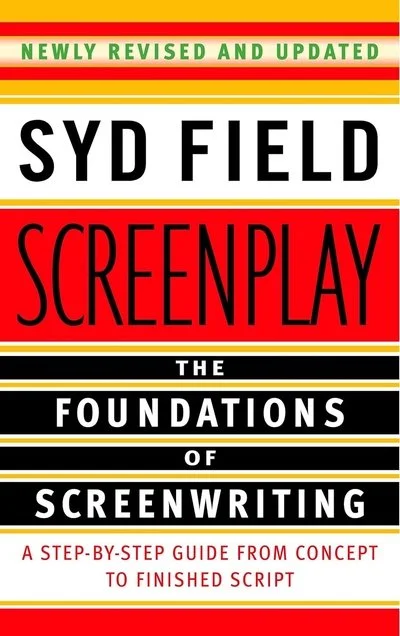
Screenplay: The Foundations of Screenwriting by Syd Field, Delta, 2005 (revised/updated edition)
Syd Field's revolutionary text established the paradigm dominating modern screenwriting—a model as fundamental as "a table is a top with four legs." Whether the table is high or low, round or square, glass or wood, the paradigm remains constant. Field's screenplay paradigm divides the standard 120-page script into three acts: Act One (Setup, pages 1-30), Act Two (Confrontation, pages 30-90), Act Three (Resolution, pages 90-120), with Plot Point I (pages 20-30) spinning the story into Act Two and Plot Point II (pages 85-90) propelling it toward resolution. These aren't arbitrary divisions—they reflect dramatic rhythm audiences instinctively expect, evolved from Aristotle's unities and refined through decades of Hollywood economics: two-hour films mean more screenings per day, generating more revenue.
Field's emphasis on the first ten pages cannot be overstated: "I cannot emphasise enough that this first ten-page unit of dramatic action is the most important part of the screenplay." Within ten minutes, audiences determine whether they like the film; their concentration falters if the opening proves vague or boring. In Chinatown, Robert Towne establishes on page one that Jake Gittes is "a sleazy private detective specialising in 'discreet investigation.'" Pages later, "Mrs Mulwray" wants to hire Gittes to find out "who my husband is having an affair with"—that question provides the dramatic premise driving the story. American Beauty opens with Lester Burnham's voice-over: "My name is Lester Burnham. I'm forty-two years old. In less than a year, I'll be dead." Within pages, we know the main character, dramatic premise, and situation.
Plot Points serve an essential purpose: Plot Point I in The Matrix occurs when Neo chooses the Red Pill and Act Two begins with his literal rebirth; Plot Point II arrives when Neo and Trinity rescue Morpheus, and he finally accepts he is "The One." In Chinatown, Plot Point II occurs when Jake discovers the real Mrs Mulwray's identity, spinning the investigation toward its tragic resolution. Field analyses classics and modern films through this lens, demonstrating how successful scripts consistently hit these structural markers.
For actors, Field provides foundational structural literacy. Understanding three-act architecture helps identify a scene's dramatic function: establishing character in Act One requires a different emotional intensity than the Act Three climax. When casting directors provide sides, Field-literate actors immediately grasp where this moment sits in the larger story arc, making informed choices about character knowledge and dramatic trajectory.
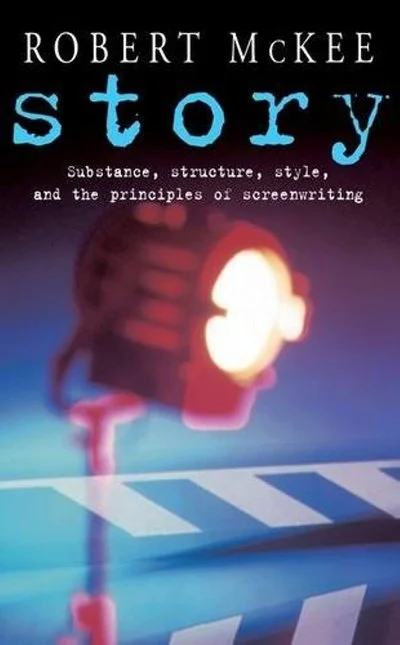
Story: Substance, Structure, Style and the Principles of Screenwriting by Robert McKee, ReganBooks/HarperCollins, 1997
Robert McKee's masterwork teaches story design from the inside out rather than formulaic plot mechanics. His opening salvo: "Story is about principles, not rules. A rule says, 'You must do it this way.' A principle says, 'This works...and has through all remembered time.'" McKee's central insight: story lives in the gap between expectation and result. The protagonist takes action based on what he believes will happen, but "the moment he takes this action, the objective realm of his inner life, personal relationships, or extra-personal world, or a combination of these, react in a way that's more powerful or different than he expected." This gap—where subjective anticipation collides with objective necessity—marks "the point where the human spirit and the world meet."
McKee dissects structure into beats, the smallest units expressing behavioural change: "A beat is an exchange of action/reaction. Beat by beat, these changing behaviours shape the turning of a scene." Story values (life/death, love/hate, hope/despair) must reverse polarity to create drama—scenes beginning in hope must end in fear. These value shifts, not mere dialogue, constitute genuine story progression. The controlling idea expresses the story's ultimate meaning as "Value plus Cause"—not just "justice triumphs" but "justice triumphs because the protagonist is more violent than the criminals" (Dirty Harry).
McKee explores three levels of conflict operating simultaneously: inner conflict (doubt, fear, desire within the character), personal conflict (with family, friends, lovers), and extra-personal conflict (with society, environment, fate). He illustrates with Kramer vs. Kramer's French toast scene: inner conflict (doubts versus male arrogance), personal conflict (hysterical son needing reassurance), extra-personal conflict (alien kitchen environment). Masterful storytelling layers all three; superficial stories play only one.
Most crucial for actors: McKee's distinction between text and subtext. "An old Hollywood expression goes: 'If the scene is about what the scene is about, you're in deep shit.'" Text means surface—what characters say and do. Subtext is "the life under that surface—thoughts and feelings both known and unknown, hidden by behaviour." In Chinatown, when Evelyn cries, "She's my sister and my daughter," her subtext pleads, "Please help me." Gittes's reply seems illogical but makes perfect sense—his subtext: "I've understood everything. I love you, and I'm going to risk my life to save you."
For actors, McKee provides X-ray vision revealing how scenes serve larger architecture, transforming performance from saying words to experiencing micro-reversals beat by beat.
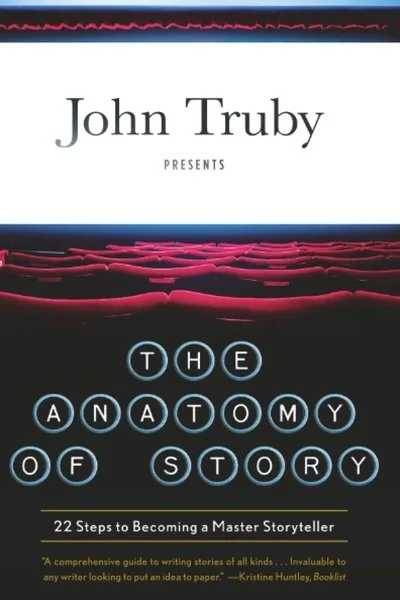
The Anatomy of Story: 22 Steps to Becoming a Master Storyteller by John Truby, Farrar, Straus and Giroux, 2007
John Truby's comprehensive system offers an organic alternative to Field's three-act paradigm. His opening salvo attacks conventional story terminology—terms like "rising action" and "denouement" prove so broad and theoretical as to be almost meaningless." Three-act structure fares worse: "hopelessly simplistic and in many ways just plain wrong." Truby argues that mechanical view of story leads to episodic storytelling—" a collection of pieces, like parts stored in a box"—where events don't connect or build steadily. Instead, an organic story grows from a character-driven premise, with plot emerging naturally from who your characters are rather than imposed structural formulas.
Truby identifies twenty-two building blocks, but emphasises flexibility: "Think of a story as an accordion." It consists of a minimum of seven essential steps (even thirty-second commercials follow these), expanded for longer forms. Feature films typically require twenty-two steps; David Copperfield contains sixty revelations. The system weaves together character web, moral argument, story world, and plot events, ensuring "your main character drives your plot."
Central to character psychology: Weakness (profound flaw ruining the hero's life), Need (what must be fulfilled within to have a better life—usually involves overcoming weaknesses), and Desire (specific external goal). Crucial distinction: Need involves overcoming internal weakness, whilst Desire is an external goal. Hero shouldn't know his need at the story's beginning—awareness comes at self-revelation after great pain or struggle. Better stories give heroes moral need beyond psychological need: "A character with a moral need is always hurting others in some way."
Ghost represents a past event still haunting the hero—an open wound often sourcing psychological and moral weakness. Ibsen called this "sailing with a corpse in the cargo." Ghost acts as an internal opponent, creating counterdesire: the hero's desire drives forward, the ghost holds back. In Hamlet, Shakespeare gives a double ghost—the uncle murdered the father, then the actual ghost demands revenge. In It's a Wonderful Life, George Bailey's ghost is his fear of what tyrannical Potter will do if he leaves.
For actors, Truby provides the deepest character-building vocabulary available. Understanding a character's Weakness (specific flaw), Need (what they must learn), and Desire (what they consciously pursue) creates authentic performance from the inside out. His emphasis on moral need—how characters hurt others through moral weakness—helps actors grasp value systems their characters represent, making choices serving the story's philosophical exploration rather than surface plot mechanics.
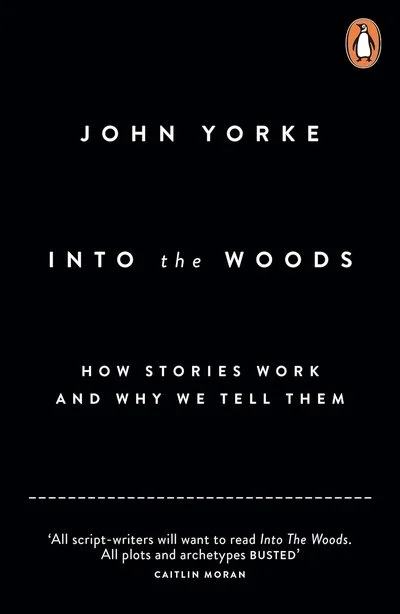
Into the Woods: A Five-Act Journey into Story by John Yorke, Overlook Press, 2015
John Yorke's sophisticated analysis argues that successful stories follow a five-act fractal structure. Drawing on thousands of examples from Greek tragedy to modern television, Yorke demonstrates that stories operate at multiple scales—each act contains its own five-act structure, each scene mirrors the whole, creating fractal self-similarity. Like Jackson Pollock's paintings, where "tiny sections of the work mimic the structure of the whole," stories replicate patterns in different magnifications: stories are built from acts, acts from scenes, scenes from beats. Each unit is constructed in three parts—fractal versions of the three-act whole.
Yorke's central insight: stories reflect how humans process change. The archetypal journey "into the woods"—discovering dark but life-giving secrets—structures every narrative. This isn't metaphor but cognitive architecture: "Drama mimics the way the brain assimilates knowledge." Neuroscientist Susan Greenfield argues that the brain grows through use and stories develop neural connections. Cognitive scientist Steven Pinker notes that the standard definition of plot mirrors the definition of intelligence. Stories aren't arbitrary constructions but externalisations of how consciousness processes experience.
Critical to Yorke's system: the midpoint. Occurring exactly halfway through Raiders of the Lost Ark (discovering the Ark in a dark cave), Titanic (iceberg collision), or E.M. Forster's A Passage to India (ambiguous cave encounter), midpoints represent "the moment something profoundly significant occurs." The protagonist gains powerful knowledge—"the 'elixir' to heal their flaw"—but doesn't yet know how to handle it correctly. Well-designed midpoints have risk/reward ratios: characters gain something vital whilst ramping up jeopardy. From this point, there's no going back—the outward journey ends, the return journey begins.
Yorke demonstrates fractal structure through Raiders' first act: protagonist (Indiana Jones), antagonist (Belloq), inciting incident (discovering the temple), desire (to retrieve the golden idol), crisis (Belloq surprises him), climax (Belloq steals the idol), resolution (Indy escapes alive). Every act contains complete story architecture—"a smaller unit repeated continually within the structure to build the larger whole." Understanding this means recognising that individual scenes follow identical patterns. The King's Speech's first act operates identically: Bertie's terrible Wembley speech, wife's pursuit of a cure, first meeting with Logue—entire movie in miniature with its own inciting incident, crisis, climax, and midpoint.
For actors, Yorke provides a profound understanding of why structure works—it mirrors cognitive processing. Three-minute audition sides follow the same pattern: establishment, complication, crisis, reversal, resolution. This awareness creates micro-structure within performance, preventing flat delivery. Understanding the midpoint—where character understanding fundamentally inverts—helps actors identify psychological pivot points within scenes.

Save the Cat! The Last Book on Screenwriting You'll Ever Need by Blake Snyder, Michael Wiese Productions, 2005
Blake Snyder's hugely influential manual breaks story structure into a practical fifteen-beat template applicable across all genres. The title refers to his opening technique: show the hero doing something likeable early—literally saving a cat in distress—making audiences root for them immediately. Snyder's approach is unashamedly commercial, focused on what works in mainstream Hollywood rather than arthouse experimentation. His voice is bracingly direct: analysing why films fail structurally and how following proven patterns ensures commercial viability.
Snyder identifies ten story genres, each with specific structural requirements: Monster in the House (Jaws, Alien, Fatal Attraction—monster plus confined space plus desperate people), Golden Fleece (Star Wars, Wizard of Oz—hero on road seeking one thing, discovers himself), Out of the Bottle (Liar Liar, Bruce Almighty—wish granted, life changes, hero must grow), Dude with a Problem (Die Hard, Titanic—innocent thrust into life-threatening situation). Each genre carries distinct conventions and audience expectations requiring different structural handling. Genre isn't limiting but liberating—it provides a framework within which originality flourishes.
Central tool: Blake Snyder Beat Sheet (BS2), fifteen structural beats occurring at specific page numbers in a standard screenplay. The Opening Image establishes a visual metaphor of the hero's pre-state. Theme Stated (page five) poses the story's central question. Catalyst (page twelve) disrupts the status quo. Break into Two (page twenty-five) launches the protagonist into a new world. Fun and Games delivers genre promise—the reason the audience bought tickets. Midpoint is either a false victory or a false defeat. All Is Lost (page seventy-five) represents the opposite of the midpoint—everything collapses. Dark Night of the Soul precedes Break into Three, where the hero, transformed, attacks the final problem.
Snyder emphasises proportional accuracy over rigid formula: these beats must hit their marks whether the screenplay runs ninety or one hundred thirty pages. Structure provides scaffolding, enabling creativity rather than constraining it. The fifteen islands create a navigable map, preventing writers and actors analysing scripts from becoming lost in chaos.
For actors, this translates story theory into immediately usable script analysis. Understanding where your scene sits in the larger arc shapes performance choices. Are you delivering Fun and Games genre promise, or embodying All Is Lost despair? Context transforms interpretation. When directors describe roles by dramatic function—" the mentor figure who delivers the midpoint revelation"—story-literate actors decode these descriptions instantly, understanding precisely which emotional territory they must inhabit. Genre literacy makes actors valuable collaborators, grasping the director's vision without extensive explanation, speaking the shared language of professional storytelling.
The Story Solution: 23 Actions All Great Heroes Must Take by Eric Edson, Michael Wiese Productions, 2011
Eric Edson's comprehensive screenwriting manual presents a revolutionary premise: successful feature films contain precisely twenty to twenty-three distinct story units he terms Hero Goal Sequences®—a trademarked system resulting from analysing hundreds of American films dating back to 1927. Professional screenwriter and Cal State Northridge professor, Edson discovered through empirical analysis what Andrew independently arrived at, expanding Campbell's Hero's Journey: optimal transformation requires approximately twenty-one distinct developmental stages. This convergence from completely different starting points—Edson analysing screenplay structure, Andrew expanding psychological/mythological actor transformation—validates fundamental pattern in human narrative comprehension.
Framework structure proves rigidly predictable: Act One always contains exactly six Hero Goal Sequences, ending with a major plot turn at sequence six. First half, Act Two contains six more sequences, midpoint arriving at sequence twelve. Second half, Act Two contains another six sequences, the second major turn occurring at sequence eighteen. Act Three contains two to five sequences (most commonly three, totalling twenty-one total), with the minimum requirement being an obligatory climactic scene plus denouement. Remarkably, "genre didn't matter. Mood and tone didn't matter." Neither length, scope, budget, setting, studio, director, nor screenwriter altered this twenty-to-twenty-three count in successful films. Pattern speaks directly to how the human mind processes a story.
Hero Goal Sequence defined: three to seven screenplay pages (typically two to four scenes) wherein the hero pursues a single short-term physical goal as a step toward ultimate victory. Sequence ends when hero discovers Fresh News—new plot information resolving current short-term goal whilst presenting next goal, thereby launching subsequent sequence. Unbroken chain of Fresh News discoveries drives dramatic intensity progressively higher, linking the entire story from beginning to end. Crucial distinction: goals must be physical/external, not merely emotional. Each sequence's goal must be unique—repetition without strong new element fails.
Edson identifies the most common failing in new screenplays: insufficient sheer story. Writers stop weaving plot threads too soon, creating thin scripts with eight-page dialogue scenes, repetitive events filling gaps. Goal Sequences solve this by specifying in advance exactly how much story is required, where plot twists should occur.
For actors, Edson provides profound validation of The Alchemy of Screen Acting’s twenty-one-step structure through independent empirical discovery. Understanding Act One always has six sequences, midpoint at twelve, Act Two climax at eighteen, which gives actors insight into where the character's arc intensifies, where major reversals occur. Fresh News concept parallels acting principle: reacting to changing circumstances rather than pre-planning emotional states—each sequence break represents the moment the character receives new information requiring adjustment.
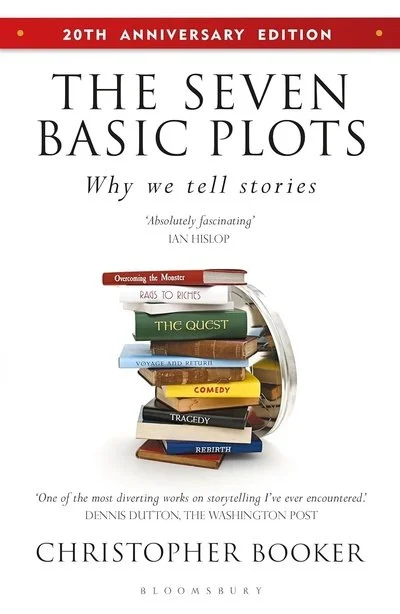
The Seven Basic Plots: Why We Tell Stories by Christopher Booker, Continuum, 2004
Christopher Booker's monumental 700-page study argues all stories follow seven archetypal patterns: Overcoming the Monster, Rags to Riches, The Quest, Voyage and Return, Comedy, Tragedy, and Rebirth. Drawing on Jungian psychology and examining thousands of examples from ancient myths to modern blockbusters, Booker reveals deep archetypal logic beneath surface narrative. His work represents thirty-four years of researching why these patterns recur across all cultures and periods, reflecting fundamental human psychological needs and developmental stages.
Part One (Seven Gateways to the Underworld) establishes each plot's structure through extensive examples. Overcoming the Monster follows the hero confronting life-threatening evil—from Perseus rescuing Andromeda to James Bond's adventures (Booker notes Bond films follow a rigid five-stage archetypal pattern: anticipation, confrontation, frustration, nightmare ordeal, miraculous escape). Rags to Riches traces obscure heroes’ rise to recognition—Cinderella, David Copperfield, and Pretty Woman. The Quest sends heroes on a perilous journey toward a distant goal—Jason's Golden Fleece, the Lord of the Rings. Voyage and Return dispatch the hero into a strange world before returning transformed—Alice in Wonderland, The Wizard of Oz. Comedy resolves confusion through recognition and union—Shakespeare's comedies, Jane Austen novels. Tragedy shows flawed heroes' self-destructive descent—Macbeth, Anna Karenina. Rebirth depicts imprisoned heroes' liberation through another's redemptive act—Beauty and the Beast, A Christmas Carol.
Part Two (Complete Happy Ending) introduces Jungian archetypal figures: Shadow (dark opponent), Anima (inspiring feminine), Wise Old Man (guiding mentor), Light Figures versus Dark Figures. Booker demonstrates how these character functions combine across plots. Perfect balance requires a hero integrating masculine and feminine values, conscious and unconscious elements. Stories working archetypally lead toward wholeness—what Jung termed individuation.
Part Three (Missing the Mark) examines how modern storytelling increasingly deviates from archetypal foundations. When ego takes over—prioritising surface entertainment over psychological truth—stories become "dark" (glamorising evil) or "sentimental" (avoiding genuine transformation). Booker traces twentieth-century obsession with sex and violence as symptomatic of disconnection from archetypal wellsprings.
Part Four (Why We Tell Stories) synthesises findings: stories exist to reconnect the ego with the deeper Self, guiding consciousness toward integration. Archetypal patterns aren't arbitrary conventions but reflect how the human psyche processes experience and growth.
For actors, Booker provides essential story literacy. Understanding which archetypal journey they're serving helps actors grasp why their character exists in the story's ecosystem. When casting directors describe roles by dramatic function—hero's mentor, blocking figure, temptress—story-literate actors decode these descriptions instantly. The Jungian framework provides vocabulary for understanding character psychology beyond individual quirks, deepening authentic choices within familiar patterns.
Dialogue: The Art of Verbal Action for Page, Stage, and Screen by Robert McKee, Twelve, 2016
Robert McKee's focused study dismantles the misconception that dialogue is mere conversation. Instead, he teaches dialogue as verbal action—characters use words as tactical weapons to achieve objectives. The book explores the gap between text (what's said) and subtext (what's meant), showing how skilled writers bury character intentions beneath surface speech. McKee's core insight: "beneath every line of character talk, the writer must create a desire, intent, and action."
McKee identifies dialogue's four functions. Exposition conveys necessary story information. Characterisation reveals personality through speech patterns—vocabulary, syntax, rhythm. Dramatic action shows characters using words to get what they want—persuading, deflecting, attacking, seducing. Thematic resonance embodies the story's deeper meaning. These functions overlap within individual lines; skilled dialogue performs multiple purposes simultaneously.
McKee distinguishes theatrical dialogue (heightened, poetic, directly confrontational—characters speak truths theatrically) from cinematic dialogue (understated, elliptical, relying on visual context—characters reveal through behaviour accompanying words). Great film dialogue works through contradiction: people lie, evade, seduce, and manipulate with words. Surface politeness masks hostility. Casual banter hides seduction. Forced cheerfulness conceals desperation. This layering provides actors with actionable choices.
The book provides diagnostic tools for recognising weak dialogue. "On the nose" writing—characters announcing exactly what they mean and feel—lacks playable subtext. Well-written dialogue contains gaps where actors create meaning through choices. Dialogue emerges from character psychology: three concentric spheres (innermost: unsayable; middle: unsaid; outer: said) create depth.
McKee's beat analysis shows how verbal action causes reaction—each line provokes a response from the scene partner or from within the character himself. Understanding this action/reaction structure helps actors find a scene's dynamic rhythm rather than delivering isolated lines.
For actors, McKee provides a Rosetta Stone for unlocking script quality and finding playable actions within dialogue. Understanding dialogue as action transforms line delivery—instead of reciting words, actors recognise each line attempts to get something from the scene partner (persuade, deflect, attack, seduce). Text/subtext distinction is crucial for screen acting, where naturalism demands layers: surface politeness masking hostility, casual banter hiding seduction, forced cheerfulness concealing desperation. McKee's framework helps actors diagnose weak scripts during auditions—exposition-heavy scenes where characters announce feelings lack playable subtext, whilst well-written scenes provide rich contradiction between words and intentions. His emphasis on listening becomes an active choice: characters listen not merely to understand but to detect weakness, find ammunition, and identify opportunity. This transforms passive reception into tactical engagement, making every moment actionable.