CATEGORY 2: SCREEN ACTING TECHNIQUE
Camera-specific skills building actor's value
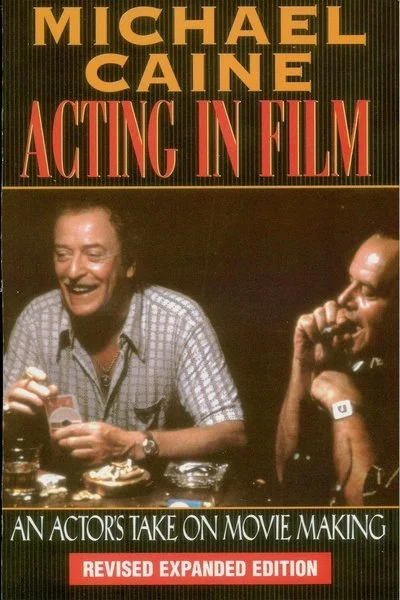
Acting in Film: An Actor's Take on Movie Making by Michael Caine (Applause Books, Revised Expanded Edition)
Two-time Oscar winner Michael Caine (Alfie, The Cider House Rules, Hannah and Her Sisters) distils decades of wisdom from eighty-plus films into an accessible masterclass originally delivered British National Film Theatre. Opening confession establishes street credibility: South London working-class background, no drama school, worked laundries, tea warehouses, pneumatic drills, washed dishes "all best restaurants"—broke at twenty-nine, literally couldn't afford a bowl of spaghetti. Self-taught through voracious reading, sheer determination transforming life. Early career typecast as "professional Cockney" until Zulu screen test—playing upper-class officer against type—broke mould forever.
Core philosophy: film acting fundamentally different language than theatre. Stage projects to the back row; the camera catches everything from inches away. Theatre actors often fail on screen because they indicate, demonstrate, and perform outwardly. Screen demands you think, listen, react—camera reads interior life. Close-up revolutionary tool: the audience sees what the character is thinking through eyes. Therefore, technical adjustments are essential—don't blink during close-ups (breaks concentration, appearing camera-shy), keep eyes alive even when silent, make stillness active, not passive.
Listening emphasis throughout. Film acting primarily reacting—the other actor's close-up is your performance opportunity. Give co-stars everything off-camera, sustain full energy every take, regardless of whether the camera is on you. Generosity pays dividends—directors notice actors who support scene partners. Famous directors referenced frequently: John Huston ("Film directors are traffic cops"), Sidney Lumet, Bob Rafelson—learning from observing masters’ work.
Practical career advice woven throughout technical instruction. Audition starts the day you're born—a crossing guard might connect you to a producer's secretary. Treat everyone professionally; a young tour bus driver signing autographs might become Mike Ovitz later. Professional conduct, punctuality, knowing lines cold, zero complaints—reputation matters more than a single brilliant performance. "If you can imagine yourself doing anything else, forget it!" Acting demands a full-time obsession, not a hobby interfering with a golf game.
Revised edition adds nineties films, updated industry insights, maintains conversational mentor-to-student tone, making technical advice digestible. Illustrated throughout with stills from Caine's films demonstrating principles discussed. Accessible entry point for actors transitioning from theatre to screen or beginning film careers. No academic theory—pure practitioner wisdom earned through decades of professional work. Caine positions himself not gospel-giver but torch-passer: "What I know today is the result of what successful actors shared with me. Just take it and run!"
Short (under 150 pages), readable, immediately applicable. Working actor's perspective rather than a theorist analysing from outside. Particularly valuable for theatre-trained actors needing to adjust technique for the camera's intimate scrutiny.
Acting for the Camera (Revised Edition) by Tony Barr with exercises by Eric Stephan Kline (HarperPerennial, 1997)
Tony Barr founded Film Actors Workshop in 1980 after realising Hollywood was "full of charlatans and con men" exploiting actors. Former actor/director himself (Armed Forces Radio, theatre background), Barr spent five years teaching traditional Stanislavsky/Method approaches before recognising "something was missing"—what worked onstage failed on screen. Systematic revision of decades of experience teaching thousands of students produced a definitive textbook praised by Ed Asner ("fast reading, easily understood"), Henry Winkler ("coherent, helpful guide"), and Deidre Hall ("clearest and most practical acting book I've ever read").
Listening as a foundation: a chapter concept dedicated, Barr considers "the most important ability for an actor." Spencer Tracy asked what's most important responded, "Acting is fine, as long as you don't get caught at it." Barr defines listening far beyond hearing dialogue—listening involves all senses: seeing, touching, feeling, intuiting emotionally, perceiving what was experienced past. "Listening involves more than what you 'hear' with your ears." Actor "hears" headache, toothache, heat, cold, other actor's feelings/mood, smell, walk, manner, and sitting. Truly listening means perceiving everything affecting you to some degree. This sensing generates authentic responses—"talent for acting is talent for listening."
Camera's intimate scrutiny changes everything. Stage projects back rows; camera catches subtlest flicker from inches away. Onstage, eight thoughts might be written into dialogue reaching back rows; on-camera, those eight thoughts are subtracted from dialogue so the camera sees the actor think/feel way through silences. Physicalizations include anything the audience detects—pause, eye movement, delaying breath instant—much as throwing a chair across the room. Film captures what you're listening to, not talking about.
Technical precision throughout, systematically addressing practical problems theatre-trained actors encounter: hitting marks, maintaining continuity, emotional consistency across multiple takes shot out sequence, cheating looks toward the camera without appearing to look camera, phone acting when scene partner absent, dealing with discontinuities where dialogue jumps, subjects requiring "complex bridges" unwritten thoughts connecting lines.
Revised edition incorporates Eric Stephan Kline's exercises—practical, classroom-tested techniques reinforcing concepts. Detailed chapters: machinery film (camera angles, lenses, editing), preparing roles, auditioning, working on set. Systematic organisation makes a book reference manual; actors return repeatedly, facing specific technical challenges. No mystique, no theory divorced from practice—pure professional instruction earned through decades directing actors, analysing what works/fails frame.
Approximately 300 pages illustrated with diagrams demonstrating camera angles, framing, and technical concepts. Accessible language, avoiding jargon. Theatre-trained actors particularly benefit—Ed Asner's foreword directly addresses them: "Although foundation good acting same in both media, you need to understand what the screen requires from you and what creative adjustments you need to make to achieve your best performance."
Secrets of Screen Acting (Fourth Edition) by Patrick Tucker (Routledge, 2023)
British director Patrick Tucker (200+ television programmes the BBC/Royal Shakespeare Company, 200+ theatre productions, Russian sitcom Latvia, feature film) delivers a "revolutionary non-Method approach" born from 40+ years of screen acting masterclasses worldwide. Fourth edition completely updated, covering self-taping auditions, CGI/green screen work, social media (TikTok, Facebook, Instagram), video games, whisper acting, typecasting—"perfectly suited for Acting for Screen university courses" and anyone appearing on screens, including Zoom, Skype, Vox Pops.
Central provocation: "The truth is not your friend." Real truth can distract rather than serve the story. Film actor holding a cup of tea naturally (navel level) disappears from a tight shot; screen actor holds cup high near face looking "very silly in real life" but "very natural and 'real'" on screen. Frame condenses time and space—"proportions of digital frame itself become measure of all things." Audience presumes everything significant appears within frame; wonderful things done outside frame "as if they had not done them!" Actors must "fit" into the rectangle.
Vocal levels match shot size, not circumstances—Tucker's most counterintuitive teaching. Miranda Richardson anecdote crystallises principle: director/sound man begged her to speak up during shoot, "she refused—she was terrible." Tucker watched the broadcast: "only one superb performance—Miranda Richardson's! She obviously knew what the director did not, that voice should match shot, not circumstances." Examples throughout: Russell Crowe/Paul Bettany in Master and Commander, Al Pacino/Robert De Niro in Heat—listener simply wouldn't hear speaker's real life, "but in screen life just fine."
Reaction time altered for screen: physical timing/placement reconceived. Keep energy/attack/consonants while reducing volume—"quite unnatural" but essential. Fast speaking doesn't mean loud; close-up actors "not actually booming lines, but hissing them." Anne Hathaway's Oscar Les Misérables: "sang as if audience inches away" keeping notes (very difficult) versus singers' usual "loud confident voices."
Technical precision systematically addressed: asking crew where cut-off point is (professional question gets professional answer—crew wants production good their way); "emotional funnel" concept putting acting into lens; cheating face toward camera without getting caught "eye-to-eye truthfulness"; understanding Rembrandt portrait principle—audience doesn't wonder what's outside frame.
Christine Ozanne's contributions to each chapter end—actress since 1958, still working film/sitcoms/commercials, providing unique insight, especially self-taped auditions. Heavily illustrated—"practically a graphics textbook"—showing examples silent era through 2020s films, demonstrating the exact points Tucker makes.
Comprehensive glossary, updated exercises addressing "whole new world screen appearances." Accessible language demystifying technical requirements. Tucker's director's perspective offers insider knowledge rarely shared with actors. Non-academic, practical, immediately applicable.
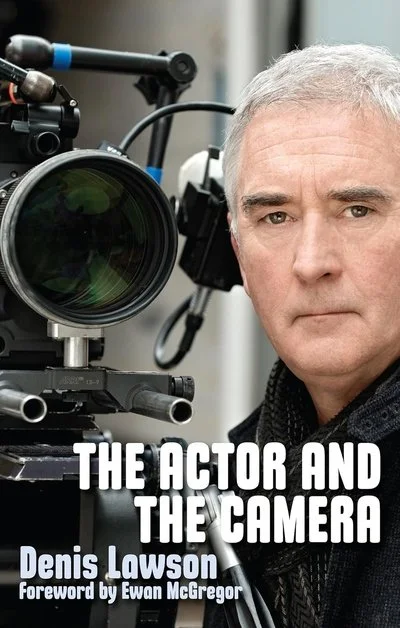
The Actor and the Camera by Denis Lawson (Nick Hern Books, 2014)
Veteran British actor's intensely practical manual born from revelatory moment on Local Hero set: standing beside camera doing off-lines (feeding dialogue to fellow actor off-camera, "hugging the lens" to keep their eye-line close), watching crew reload film, Lawson realized "I knew nothing about it, how it functioned, its inner workings: but this was where my performance was going. Down the lens. Into what?" Forty-year journey to understand film-making machinery produced a book that's a technical manual, survival guide, and love letter to collaborative process.
Core philosophy: "Classical to jazz"—stage acting like classical musicians serving score precisely; film acting like Miles Davis improvising Kind of Blue, "working off the top of their heads, flying by the seat of their collective pants." Lawson champions the shedding stage technique: speaking quieter than life, throwing lines away, not driving them through. DOP Kieran McGuigan's Ulster accent rising to a fever pitch: "Don't find the light, Denis! Love the light! LOVE THE LIGHT!!" Working in good light "sexy as fuck."
Revolutionary practical specifics: Ask for "sausage" (small sandbag) gaffer-taped to mark so toes feel it without looking down. "Rocking in" for close-ups—put feet on mark, lean out of frame, leaving one foot behind, rock back in on "Action!" eliminates worry about being off-mark. Check frame height by dropping hand down toward bottom—operator pops head out, shows on own body exactly where frame cuts.
Counterintuitive advice for British actors trained in theatre's "show must go on" discipline: "If the take goes wrong for whatever reason, stop the fucker! It's not that big a deal... Stopping is common as shit. Just do it." British impulse to carry on through distractions leaves you "full of angst about a crap take" while they're moving the camera to the next setup. Film allows retakes—use them.
First-day priority? Meet operator before director—"person with whom I will have most intimate relationships on set... who will actually record my performance, who will scrutinise it through the camera itself." Thinks of himself as "The Acting Department"—part of a unit collaborating with dedicated professionals, not a pretentious "artist" separate from the technical crew.
On Screen Acting: An Introduction to the Art of Acting for the Screen by Edward Dmytryk and Jean Porter Dmytryk (Focal Press/Routledge, 1984/2019)
Unique director-actress dialogue—Oscar-nominated director Edward Dmytryk (The Caine Mutiny, Crossfire, The Young Lions) alternates perspectives with his wife, actress Jean Porter Dmytryk, creating an intimate conversation born from 40 years working Hollywood's highest levels. Informal anecdotal style drawing from Dmytryk directing 50+ films, Porter appearing in 30+ films alongside Bogart, Rooney, Abbott and Costello. Covers complete process: interviews, auditions, readings, rehearsals, and on-set work.
Listening as a foundation: "The most important skill an actor must develop"—prerequisite for reacting, speaking dialogue, and movement. "Greatest compliment one actor can pay another: 'He gives me something!'" A camera as powerful telescope captures whether the actor is truly listening or thinking ahead to the next line. Dmytryk recommends studying Jack Lemmon's performance in Missing—"One careful viewing is worth a month of exercises. The intensity of his listening and watching is awesome."
What directors seek in interviews: Eye quality paramount—"Have you ever seen a dull-eyed movie star?" Must see the actor's eyes at all times (remove sunglasses). Also, consideration for others, taste level, vitality, and spontaneity. Cold readings discouraged—Montgomery Clift "read like a rank illiterate," yet brilliant performer; sight-reading ability doesn't indicate acting talent.
Concentration and field of attention: Must "black out" camera, director, crew—no audience exists, only fellow beings in the scene happening. Listening serves to tune out distractions: "anyone who has held quiet conversation in the midst of a babbling crowd can testify." Technical adjustments (hitting marks, feeling key light) must become instinctive, freeing complete scene involvement.
Spontaneity through repetition: Most actors need multiple takes. Maintain freshness by listening afresh each take, looking for unnoticed nuances in other actors' variations. Willie Wyler's famous approach: actors doing "something different" instinctively until "something right" appears.
Hard-won observations: Bogart taught Dmytryk that great screen acting is about "transition, that moment when one emotional state ends, and another is about to begin." Spencer Tracy's trademark ability was to "hem and haw" his way with stiffly written speech, breaking it up to transform material into naturalistic dialogue.
From Stage to Screen: A Theatre Actor's Guide to Working on Camera by Bill Britten (Bloomsbury Methuen Drama, 2015)
Former actor-turned-director Bill Britten (10 years acting, 15 years directing film/television) addresses theatre actors' retraining challenges when stage technique becomes screen liability. Foreword by Hugh Bonneville: auditioned three times for Four Weddings and a Funeral for progressively smaller roles—low-budget schedule meant "no time for basic errors." Not cast. Determined to master technical know-how so "next time they'd just have to tell me I was rubbish."
Showing versus sharing—core shift: A Man at the railway station curses the ticket machine vigorously. The moment he realises you're watching, he sighs wearily as if to say, "This is tiresome, but I'm mature enough not to let it get to me." "He was being; now he's showing." Camera as "bullshit-detector that ruthlessly exposes any falsehood." Theatre allows "really clever faking"; screen demands "spontaneous creation of truthful inner world during each take." Theatre actor's attention split between scene and audience; screen actor's attention 100% in character's reality.
Hitting marks—three techniques: (1) Peripheral vision using colored tape—challenge: mark disappears as you approach. "Glancing down? You cannot do this without the audience noticing. You may think you can, but you can't." (2) Counting paces—if dialogue finishes as you hit mark, "back-time it": start on end mark, walk forward, running lines. (3) Lining up objects—walk forward until the drainpipe disappears behind the tree.
The sausage: Canvas tube size of courgette, taped to the floor so you feel it with your foot. "Many actors let pride get in the way... really irritating for the director, using up precious time doing repeated takes because the actor is too proud to accept help. Doesn't mean you've failed—camera crew knows how hard your task is."
Overlaps: "No overlaps" means leaving a microsecond air gap between lines, even when characters interrupt. The editor needs clean dialogue to intercut. "Principal difficulty: maintaining energy and momentum of interrupting when technically you're not."
Fragmented nature: Theatre tells a story continuously. Screen assembles from "numerous tiny morsels, each lasting a few seconds, painstakingly created over weeks." Actors wait hours for brief work moments. "Amazing how eye drawn to extra who's either overacting or bored because it's fourteenth take.”
So You Want To Act on Screen? by Michael Bray (Nick Hern Books)
British director/actor Michael Bray (30 years both sides camera) provides a comprehensive screen acting manual built on Meisner's foundation: "living truthfully under imagined circumstances." Revolutionary premise establishing book's distinctiveness: stage acting linear and organic (rehearsals building toward first night), screen acting non-linear and non-organic (shot out of sequence, no shared rehearsal period, character development done alone). "In that single phrase lies the crucial difference of approach."
Six Myths Debunked: Screen acting not "smaller"—Marlon Brando: "Don't act; be." Camera doesn't magically read mind—Ingmar Bergman: "Camera doesn't reflect. It reveals." Location rarely helps—pub scenes shot in total silence, extras mime conversation, awkward positions looking "natural" on camera. Multiple takes don't ensure good performance—James Dean: "acting is 'pure concentration'"; Spencer Tracy: "The real work is done before I get there." Not "doing less"—must actively reveal/hide thoughts, providing the director with editing material. Film sets are frightening, not easier—crew camaraderie you don't share, isolation creates doubt.
Thought-driven acting—"Dead Body" exercise: Character enters kitchen happy (just received a raise), sees body on the floor. A series of specific thoughts ("What's that? A body! Are they dead? Where's the murderer?"), each creating physical action or repression manifesting in the body/face. Write inner monologue, learn it as dialogue lines—stimulates imagination, slows performance, allowing moment revelation. "Emotions are byproducts of actions"—more powerful watching someone repress crying than cry.
Preparation trilogy: PREPARATION – CONCENTRATION – RELAXATION. Aaron Sorkin on objectives: "Somebody wants something, something standing in the way of getting it." Three-reading process: (1) read uninterrupted, write first impressions; (2) rest one day, letting subconscious digest; (3) compare new notes with first. Break scenes into beginning/middle/end, identifying the moment of change. Position scenes into the timeline (film shot out of sequence). Find ways, character like you—"Being yourself is in part crucial to success." Modern casting is individually specific—no longer need protean actors playing a wide range
A Screen Acting Workshop by Mel Churcher (Nick Hern Books)
Renowned voice/acting coach Mel Churcher (40+ major films/TV productions, 20 years on-set experience) structures five progressive workshops integrating technical precision with authentic emotional access. Foreword by Jeremy Irons: "You can't lie on film, whereas you can get away with lying in theatre." The camera reveals pretending instantly. "Making a character is like making an advent calendar—in each scene, you open a window and show a bit of life from that angle."
Workshop 1—Keeping the Life: Core distinction—theatre radiates energy outward toward the audience; screen operates at the triangle's wide end, receiving the camera's "inanimate gaze." Michael Redgrave: "Why should I miss an audience? I do not miss an audience at rehearsals when a character is being created." Filing cards system for non-linear shooting: scene number top right, where you came from at top, where you're going at bottom, time/location/objective annotated. "Think hard and trust that is enough. Don't show us what you're thinking."
Workshop 2—Power of Lens: Martin Scorsese calls it "psychic strength of the lens"—the camera magnifies everything. Kuleshov effect demonstration: Hitchcock's face in close-up followed by mother/baby reads as "benign gentleman who likes babies"; same face followed by girl in bikini reads "dirty old man!" Context creates meaning. Michael Caine: "Close-up says everything. It's then that actors' learned, rehearsed behaviour becomes most obvious." Inverting Buster Keaton's "Act fast, think slowly," Churcher advises close-ups: "Think fast, act slowly." Favour the eye nearest the camera—darting between eyes looks unfocused.
Workshop 3—Physical Life: Voice as "Cinderella of film industry"—actors claiming "we'll loop it later" look disengaged on camera, energy never recoverable in the sound booth. Connected voice from abdominal-diaphragmatic breathing is essential even for naturalistic delivery. Current fashion for breathy disconnected tones, "simply a current style"—someday viewed as unnatural.
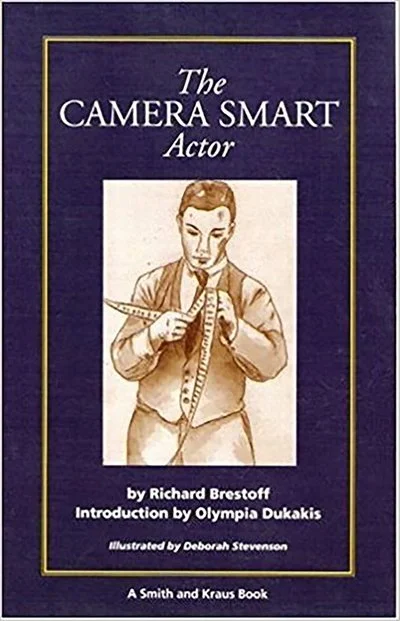
The Camera Smart Actor: A Career Resource Book by Richard Brestoff (Smith & Kraus)
Richard Brestoff's personal catastrophe establishes this book's distinctive integration of technique with career survival. Fresh from NYU with an MFA degree, he landed his first camera job on a PBS drama. After completing the master shot, exhausted from putting "everything into the shot," he changed into street clothes and headed home. Second AD knocked on the trailer door, looking "stricken." They'd only shot the master—needed coverage all day. Brestoff asked what "master" meant. "For the stage, I was a Master of Fine Arts. For the camera, I was illiterate." Seventeen years correcting that awful beginning produced this book.
Olympia Dukakis's foreword captures what camera-ignorant actors experience: the camera as an intimidating eye, seeing through to "secret hiding place, to my fears, to my inadequacies." Director Jules Dassin "saw through my sham, recognised my dread" and taught "what they never told us" about camera work—the gap this book fills.
Brestoff examines Kuleshov's famous 1923 experiment: the Russian director shot actor Ivan Mozhukhin's expressionless close-up, then intercut it with three different images (a soup bowl, a woman in a coffin, and a girl with a teddy bear). Audiences "raved about the acting," believing Mozhukhin reacted differently to each image, though his face remained identical. Pudovkin described viewers seeing "heavy pensiveness" over soup, "deep sorrow" at the coffin, "light happy smile" at the girl playing. Kuleshov concluded actors were unnecessary, advocating "typage"—using real people, not trained actors. Result: stiff, unreal performances. Brestoff's insight: "No one is just a type. Part of an actor's job is to educate industry professionals to this fact."
His "Bomb Exercise" demonstrates total concentration: the actor must disarm the "bomb" (coffee cup holder), moving extremely slowly—it's sensitive to vibration, moisture, and air movement. Video camera rolls. Actor becomes "so totally involved" he "loses all awareness of camera," forgets to "control" face, produces "realistic and unclichéd behaviour." The lesson: "If the actor feels himself dropping out of the scene, he must remind himself that the bomb is ticking away."
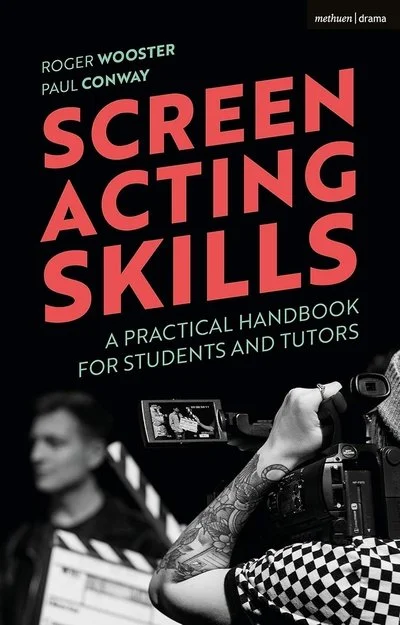
Screen Acting Skills: A Practical Handbook for Students and Professionals by Roger Wooster and Paul Conway (Methuen Drama/Bloomsbury, 2020)
Roger Wooster and Paul Conway structure their comprehensive handbook around practical exercises with dual-track sections: "To the actor" provides context and technique explanation, "To the tutor" offers teaching methodology and group management strategies. This dual approach makes the book functional both for classroom instruction and self-directed learning.
Their historical framing establishes essential context: Marshall Neilan's brutal 1950s assessment that stage actors should leave pictures because silent cinema required theatrical pantomime unsuited to naturalistic screen work. Michael Caine's surgical metaphor captures evolution: "Working in theatre is like doing surgery with a scalpel. Working in film is like surgery with a laser." Stanislavski and Nemirovich-Danchenko's 1897 eighteen-hour lunch meeting birthed The System, eventually becoming Method Acting through Lee Strasberg's Actors Studio (1947), transforming Marilyn Monroe, James Dean, and Brando into natural screen presences.
Critical pedagogical principle: students must watch the screen, not the live performance. "Observers should watch the screen and not the live action, for it is the screen performance they are there to consider." Studio setup positions monitor away from performance space, training actors to analyse recorded work objectively—Johnny Depp avoids watching his own films, believing "once the scene is done, my job is done," but Wooster and Conway insist self-assessment through playback is essential for development.
Distinctive exercises demonstrate systematic methodology: "Clint Eastwood's Chair" (named for his 2012 political rally improv)—the actor rehearses crucial line delivery to an empty chair representing an absent person, chooses an approach secretly, then the second actor fills the chair. The camera rolls for thirty seconds, capturing the first actor's delivery and the second actor's reaction. Playback analysis reveals how preparation informs spontaneity. "Getting Emotional"—actors attempt neutrality on camera while triggering specific memories (embarrassment, fear, desire, anger). Close-up reveals impossibility of true neutrality: "Because an audience is alert to interpreting what they see, even impassive, neutral physicality will be read as something."
Robert Donat's 1938 Emotion Chart (reproduced with permission from the Donat family and Manchester University) provides a revolutionary tool for tracking emotional continuity when shooting out of sequence. Actors map characters' emotional journey across the entire script, referencing the chart when scenes are shot weeks apart to maintain consistency.
Equity UK's "Creating Safe Spaces" pledge is reproduced prominently: recommended reading aloud at every project start, establishing an environment "free of fear, free of bullying and harassment of any kind" where actors can work on physically intimate scenes without exploitation. Each chapter concludes with a tongue-in-cheek motto summarising skills—Introduction's offered without irony: "Respect the work of others and celebrate difference."
Mara Wilson's counterintuitive insight: "Film acting is not very fun. Doing the same thing over and over again until you 'get it right' does not allow for very much creative freedom." Wooster and Conway embrace this reality, training actors for production's repetitive demands rather than romanticising the process.
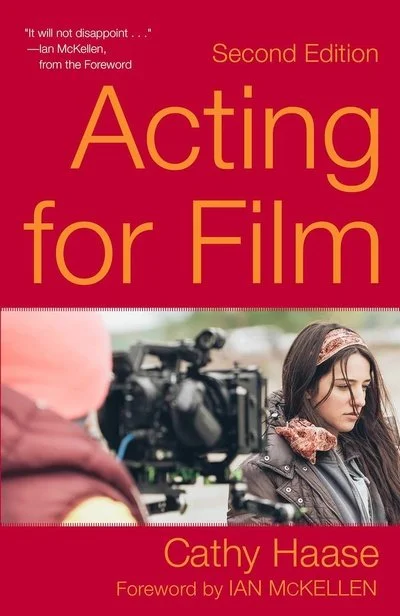
Acting for Film (Second Edition) by Cathy Haase, Foreword by Ian McKellen (Allworth Press, 2019)
Ian McKellen opens with characteristic directness: never attended drama school, learned on the job, wishes he'd had Haase's book before starting in movies to avoid "any number of clumsy choices." His assessment of the work: "commonsensical, based on your experience as actor and teacher," expressing ideas in "your speaking voice, easy to follow."
Haase's core methodology survives technological revolution unchanged: "The triumvirate of relaxation, concentration, and sense memory is still the seed." While virtual reality (VR) promises revolutionary visual capabilities, and actors have "every fibre, movement, nuance" recorded and transformed, fundamental skills remain paramount. "More important than ever for actors to remain human"—pour everything into characters despite technological mediation.
Mental Relaxation exercises build facial "muscles" for camera endurance. Twenty-minute daily practice sitting in a straight-backed chair, eyes closed, working against tension—actor's "mortal enemy." Not meditation's calm retreat but staying present, training facial muscles to withstand marathon close-up scrutiny. "Too late to start getting used to being relaxed but alive in front of the camera when you have a job."
Gibberish exercises release vocal tension while connecting to mental impulse. Webster's definitions—"rapid and inarticulate talk, unintelligible chatter"—become a gateway to unguarded expression. Move mouth, tongue, lips vigorously while connecting to thoughts, allowing sounds to "inform and surprise you." Eventually transitions into Inner Monologue—uncensored private speech, "barely audible, if at all."
Haase's on-set example from The Ballad of Little Jo captures the actor's reality: aged to the seventies with latex, a corset too tight, a sudden absurdity attack, seeing theatrical contrivance. Serious tear-filled scene imminent, she thought, "This is a really dumb thing to do with your life." Fellow actors nodded, scratched beards in character—then concentration shifted to the task, everything else went into performance. Playing old requires "tremendous relaxation" because movements are slower, and muscles hang differently.
Multi-disciplinary workshop approach integrates actors, directors, screenwriters, cinematographers, and even producers. "When everyone trains together, truly original and deep work arises." Training transcends individual skill development, becoming a collaborative understanding that benefits the entire production.
Exercise-driven structure makes the book self-study-friendly while emphasising sustained practice. Twenty minutes daily builds toward hour-long sessions as complexity increases. Technique eventually becomes second nature—those mastering smooth moment-to-moment transitions appear to be "just being themselves" when ease is actually "tribute to their artistry."
Screen Acting edited by Alan Lovell and Peter Kramer (Routledge, 1999)
An academic anthology interrogating Film Studies' neglect of acting. Lovell and Kramer's introduction diagnoses the problem: auteur theory made directors sole creative geniuses, mise-en-scène treated actors as visual objects subordinate to directorial vision, and Hitchcock's "actors are cattle" remark captured the prevailing attitude. Semiological/psychoanalytic approaches further marginalised performance by treating films as texts to be read rather than embodied events. Star studies separated celebrities from the general run of actors, assuming ineffable "star quality" rather than shared craft problems and skills.
David Mayer's essay challenges silent-era orthodoxies: existing accounts oppose excessive melodramatic gestural acting against restrained naturalism emerging around 1910. Mayer argues multiple theatrical traditions informed silent acting—gesture systems from eighteenth-century acting manuals, balletic vocabularies, music hall conventions—with extended gesturing persisting throughout the entire silent period, not disappearing in the 1910s as standard histories claim.
Cynthia Baron's studio-era research reveals 1930s-40s had conscious, systematic concern with film acting demands, driven by Stanislavsky-influenced drama coaches. Studios hired dialogue directors to work with actors through rehearsals separately from set directors. Baron argues that established ideas still dominant in contemporary acting were first practised and then broke with Method, less dramatic than standard accounts suggest. Practitioners consistently emphasised a unified mind-body instrument, exhaustive script analysis creating complete character histories, and dispassionate execution after preparation.
Sharon Carnicke examines Method as Lee Strasberg's particular reading of Stanislavsky, emphasising emotional memory, sense recall, downgrading script importance, and upgrading director-actor collaboration. Explains why this approach influenced Hollywood despite Strasberg's attempts to distance himself from movies.
Performance analysis essays examine Bette Davis’ "physicalizing" roles (Martin Shingler), frame awareness for Helen Shaver (Susan Knobloch), and voice use (Gianluca Sergi). Interviews provide practitioner perspectives: Ian Richardson discusses theatre-film-television differences, Claire Rushbrook and Ron Cook explore Mike Leigh's improvisation-based process.
Anthology reveals academic film studies slowly recognising acting's centrality while remaining primarily theoretical rather than practical. Contributors demonstrate that screen acting has evolved through conscious craft development, not mysterious talent. However, the book offers film studies context and performance analysis rather than technique acquisition—valuable for understanding why screen acting developed specific conventions, less so for developing employable skills.
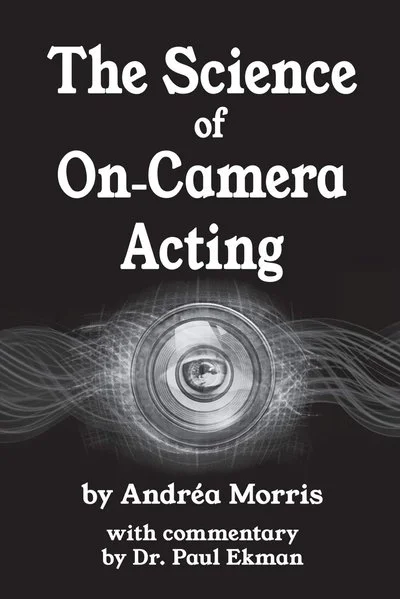
The Science of On-Camera Acting by Andréa Morris with Commentary by Dr Paul Ekman (Becoming Media, 2014)
Dr Paul Ekman—American Psychological Association's top 100 most influential psychologists of the 20th century, consultant to FBI/CIA, inspiration for TV series Lie to Me—provides a scientific foundation grounding Morris's practical methodology. Ekman's microexpression research reveals the face as an "amazingly complicated and commanding system" with a large brain area dedicated to processing facial information. His work demonstrates that genuine emotions create involuntary facial movements detectable by cameras, while fabricated emotions produce consciously controlled expressions that leak inauthenticity.
Morris's origin story frames methodology: child actress whose training made her worse ("wooden performance... fifty-foot screen for 2,630 audience members"). Took a break, studied philosophy/psychology/neuroscience, discovered communication breakdown—acting theory lagged behind scientific evidence about how brains actually work. "Method was popularised around the same time modern neuroscience was born. What we now know is light years from what we knew then."
Core critique: traditional analytic approaches overuse working memory. Working memory—conscious awareness, the seat of identity—can only hold four items simultaneously. Also, where the inner critic lives. Analytic techniques (breaking down objectives, obstacles, backstory, subtext) all draw from this limited resource, leaving no capacity for unconscious creativity. Sian Beilock: "Pressure-filled situations create an inner monologue of worries, tapping verbal brainpower, making activities relying on these same verbal resources more difficult."
Psychopath's stare example: acting students explicitly "working at listening" create "intense, relentless gaze" that clinical psychology identifies in psychopaths. Psychopaths must fake empathy through working memory—producing Robert Hare's "intense eye contact and piercing eyes"—because they cannot feel it unconsciously. Actors training themselves to consciously execute what should be reflexive create the same unsettling artificiality.
Involuntary leakage: under pressure, faces leak authentic emotions, trying to be concealed. "What's happening on your face is your work, so involuntary leakage is problematic." Trying for effect—"trying to coax something you fear won't come"—creates visible struggle undermining performance.
Ethan Hawke on Richard Linklater's Before Sunrise trilogy reveals the truth about "listening": "Actors always talk about listening..., but Rick reminds us 'you're not actually listening. You're planning what you're going to say.'"
Camera as teacher methodology: Morris developed an online audition platform in 2004 (pre-YouTube), filming herself in a tungsten-lit walk-in closet, using gaffer's tape as eyeline, recording other characters' lines in GarageBand. "Frequent filming meant even the reader became something to dispense with." Working alone proved "unavoidable and indispensable"—Daniel Coyle: world-class performers spend five times more hours practising alone than top amateurs.
Actors are unreliable narrators about the process. Juilliard graduate enthusiastically describing her technique, then on set: "No, no, I don't do any of that anymore." Jodie Foster thought The Accused performance "so poor she'd never work again"—won Best Actress Oscar. Kate Winslet felt Sense and Sensibility was "a horrible mistake"—an Oscar nomination followed.
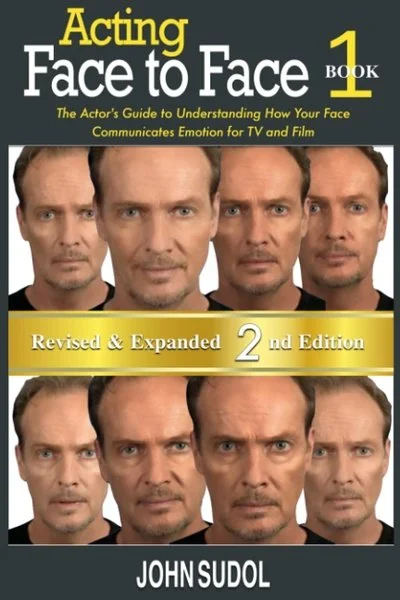
Acting - Face to Face: The Actor's Guide to Understanding How Your Face Conveys Emotion and Character by John Sudol (CreateSpace, 2015)
Sudol's origin story crystallises the gap in traditional training: auditioning for a network television guest star, a director giving "romantic language" direction, and multiple attempts failing. "Job was mine; all I had to do was give him the reaction he wanted." Yet Sudol couldn't—despite extensive training, guest star credits, and lead roles. The director wanted a specific visible thought on the face; Sudol lacked the technical vocabulary for producing it. Realisation: "I didn't know how."
Watching television with the sound off revealed working actors expressing something recognisable—but what exactly? Quest led to Paul Ekman's research in 2003. Ekman's Papua New Guinea tribes study proved seven emotions universal across cultures: surprise, fear, anger, disgust, contempt, sadness, happiness. Each emotion uses distinct muscle groups recognised worldwide.
Sudol's "Language of the Face" methodology teaches actors precise muscle mechanics. Surprise uses three groups: brows raised, eyelids raised, and mouth drops open, relaxed. Fear shares the same groups but adds tension. Contempt—only asymmetrical emotion—tightens and lifts one lip corner laterally. Each emotion has universal triggers (anger: goal obstruction, injustice), sensations (fear: breath quickens, heart races, legs feel warm), and impulses (disgust: eliminate contaminated object).
The primary colours metaphor explains emotional range: seven universal emotions blend infinitely like three primary colours mixing. More muscle groups applied equals bigger expression intensity; removing groups reduces scale. This explains how "5% actors" create recognisable, appropriate, adjustable reactions—they're consciously speaking facial language most actors use only intuitively.
Darwin's 1872 Expression of Emotions first identified universal facial expressions—a work dismissed for a century until Ekman validated it scientifically. Sudol translates neuroscience into actor training, demystifying why casting directors "know it when they see it"—they're recognising specific muscle patterns signalling authentic emotion.
Practical exercises develop facial awareness. Notice irritation's physical signature: slight muscle tension around lips, eyelid tension, brow pulling down, quickening breath, muscle contraction, neck tingling, temperature shift. Assuming emotion's facial appearance can trigger actually feeling it—a physiological pathway bypassing sense memory's limitations.
Sudol addresses what Denis Lawson calls the camera's "bullshit-detector": close-up magnifies everything, exposing when actors indicate rather than experience. Understanding facial mechanics transforms mystery into a craft requiring dedicated practice, like voice or movement training.
Script Analysis for Actors, Directors, and Designers (Fourth Edition) by James Thomas (Focal Press/Routledge, 2009)
Thomas's comprehensive textbook grounds script analysis in the formalist tradition: Aristotelian emphasis on play's internal artistic structure over external circumstances. Historical lineage runs Aristotle → Veselovsky → Stanislavsky/Nemirovich-Danchenko → Russian Formalists → New Criticism → theatre practitioners (Group Theatre's Clurman/Strasberg/Kazan, Michael Chekhov). This thinking survives because it corresponds with how actors/directors actually work—analysing plays themselves rather than abstract theories.
Action Analysis concentrates on the plot through event identification. Stanislavsky's later "system" work, codified by follower Maria Knebel (1898-1985, director/teacher studying under both Stanislavsky and Michael Chekhov). Event—something that generally would not/should not happen, changes everything, forces the character to see life differently. The Original Moscow Art Theatre's "table work" risked creative despotism—directors prepared more deeply than actors/designers, creating an imbalanced collaboration. Action analysis addresses this by giving all collaborators accessible entry through plot events.
Progressions Hierarchy structures dramatic analysis: Beats (smallest—like paragraphs introducing/developing single topic, typically six lines but vary widely); Units (Stanislavsky's bolshiye kouski or large pieces, several beats forming musical phrases, approximately one page/two minutes in realistic plays); Scenes (collections of units marked by time/place changes, miniature self-contained plays); Acts (largest structural units). Forward motion fundamental—progressions rise/crest/fall like seashore waves, maintaining interest/suspense.
Ten Categories provide a comprehensive framework: (1) Action Analysis—events driving the plot. (2) Given Circumstances—time/place/society/economics creating the world. (3) Background Story—prior events shaping the present. (4) External/Internal Action—physical versus psychological story. (5) Progressions/Structure—calculated growth ensuring dramatic effect. (6) Character—objectives/actions/conflict/values/complexity. (7) Idea—main unifying concept. (8) Dialogue—words/sentences/rhythm/poetry. (9) Tempo/Rhythm/Mood—rate/patterns/emotional quality. (10) Style—synthesis revealing play's unique essence.
Common Reading Errors addressed systematically: Affective Fallacy (impressionism), Relativist Fallacy (all interpretations equally valid), Faulty Generalization (insufficient evidence), Illicit Process (reductiveness—"Hamlet is nothing but Oedipus Complex"), Genetic Fallacy (reducing to historical sources), Half-Truth (negative debunking), Frigidity (emotional insensitivity), Imitative Fallacy (justifying poor communication), Intentional Fallacy (guessing author's intention), Biographical Fallacy (play about dramatist's life), Literal-Mindedness (demanding realistic resemblance), Secondhand Thinking (over-relying others' opinions), Over-Reliance on Stage Directions (treating notes as primary text).
Fourth edition updates substantial non-realistic plays coverage—Beckett (Waiting for Godot), Pinter (Birthday Party), Kushner (Angels in America), recognising formalist analysis traditionally focused on realistic drama, but modern repertoire requires understanding symbolic/expressionistic/absurdist works.
Though theatre-oriented, principles transfer to screen dialogue analysis. Beats/units structure scenes regardless of medium; events drive stage/screen narrative identically; character objectives are universal. Provides intellectual rigour often missing in purely practical screen acting books.
The Actor and the Target by Declan Donnellan (Nick Hern Books, 2002)
Declan Donnellan—acclaimed British director, co-founder Cheek by Jowl theatre company—opens with Howard Carter discovering Tutankhamam's tomb: asked "Can you see anything?" replies "Yes, it is wonderful." This establishes the book's revolutionary premise: acting fundamentally about seeing, not showing.
Core problem diagnosed: actor's eight variations of "I don't know what I'm doing"—what I want, who I am, where I am, how to move, what to feel, what I'm saying, what I'm playing. These "spider's legs" all connect to the same central issue: obsessive self-focus destroying spontaneity. Solution: redirect attention outward to the target.
Six Rules of the Target provide a systematic methodology: (1) There is always a target—cannot play "being" (happy/sad/angry), only transitive verbs requiring objects ("I warn Romeo"). (2) Target exists outside at a measurable distance—even recalling memories, eyes focus on external points. (3) Target exists before you need it—discovered, not invented; when asked about future plans, eyes search as if the answer already exists somewhere to be found. (4) Target always specific—Rosalind's Orlando differs from brother Oliver's Orlando. (5) Target always transforming—Orlando changes from desperate braggart to romantic hero to lost young man; the actor must respond to mutations. (6) Target always active, doing something—ask "What is the target doing to me?" not "What am I doing?"
Revolutionary insight: the word "I" is dangerous for actors—promotes self-consciousness, blocking spontaneity. "Me" is more helpful—a passive recipient of the target's actions rather than an active controller. Famous double-take analysis: audience laughs not because you change target but because target changes you (vicar without trousers—false image transforms into true image before your eyes).
Philosophical depth drawing on Zen Buddhism, phenomenology—consciousness is always "present with something," never exists in isolation. Acting cannot be taught like chemistry because it's "first nature", not "second nature"—a primitive instinct. Can only teach double negatives: how not to block natural acting reflex, how not to block natural breathing. Rather than claiming one actor is more talented than another, more accurate to say one is less blocked than another. Talent is already pumping like blood circulation—just dissolve the clot.
Theatre etymology: Greek theatron means "place for seeing." Actors are nourished/energised by what they see in the external world, not an internal dynamo. Abdicate power to target—entrust control to things you see rather than monitoring yourself. Twenty-one chapters exploring implications: blocking, imagination, character, rhythm, playing opposites, listening, and ensemble work.
Particularly influential European theatre; less known American screen acting, but principles apply universally. Dense philosophical writing requires multiple readings for full absorption. Perfect antidote to self-conscious "acting" plaguing many actors, especially beginners.
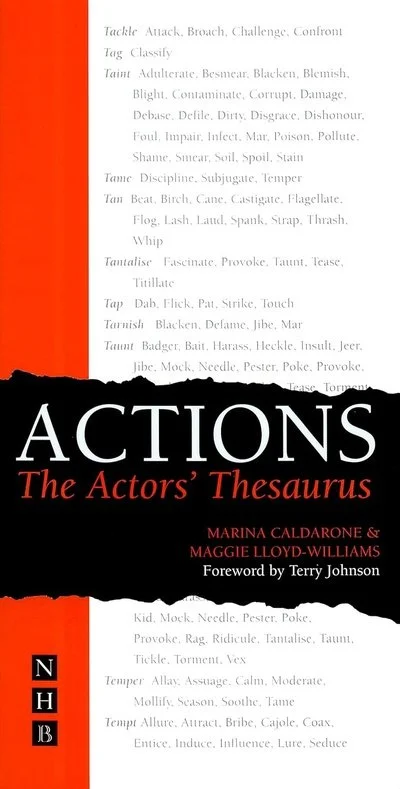
Actions: The Actors' Thesaurus by Marina Caldarone and Maggie Lloyd-Williams (Nick Hern Books, 2001/Revised 2017)
British theatre practitioners Caldarone and Lloyd-Williams provide specialised reference compiling hundreds of transitive verbs ("actions") that actors can play moment-by-moment. Core methodology: identify specific, playable verbs describing what the character actively does to the scene partner in each sentence. Revolutionary simplicity: action must pass "I [verb] you" test—"I charm you," "I seduce you," "I challenge you" all work. "I interfere with you" fails—requires a preposition, forcing greater specificity: disorientate, disrupt, muddle, upset, interrupt.
Central thesis: what characters say and mean rarely correspond. "Would you like a coffee?" could be actioned as seduce, welcome, dominate, befriend, admire, or manipulate, depending on objective/context. What appears straightforward conceals deeper impulses—objectives achieved through specific actionable tactics.
Actioning Mantra provides rhythmic discipline: "One thought. One sentence. One breath. One action." Stanislavski's cooked chicken analogy applies—breaking the scene into digestible portions rather than attempting the whole play at once. Max Stafford-Clark (eminent British director) famously spends the first weeks of rehearsals acting out text before staging anything.
Qualification technique adds complexity: inserting an adverb defines "the how of the what." "I wish you would stay" actioned as implore transforms dramatically when qualified—to implore with appropriate decorum versus to implore with disdain versus to implore with unbridled lust. Two tactics, two energies resonating in one moment.
Action Spectrum measures intensity 1-100%: playing implore at 90% intensity versus 40% creates an entirely different tactical approach.
Soliloquy work is addressed through two techniques. Externalising: imagine directing each thought to different people from the character's life—Hamlet addressing "To be or not to be" to father (defy), Claudius (challenge), Ophelia (comfort). Internalising: divide character into higher/lower self—Hamlet's scared childlike boy versus the moralising philosopher within.
Thesaurus is organised with dual navigation. Alphabetical section cross-references synonyms. Emotional Groups provide three-way choice: NURTURING (subdivides loving/encouraging/supporting), USING (disturbing/deceiving/manipulating), DAMAGING (discouraging/harming/destroying). Navigate instinctively toward a specific verb.
Sample scenes demonstrate variety—Twelfth Night played three completely different ways, changing only actions: Olivia's "Whence came you?" actioned as analyse versus captivate versus examine transforms the entire dynamic. Even pantomime (Snow White) gains specificity—a technique particularly useful for revitalising stale performances during long runs.
Revised edition removed "unactable" verbs, added colloquial options. First thesaurus specifically compiled to facilitate actors' work. Became a standard reference for UK/US training programs. Best used in ongoing consultation when seeking fresh tactical choice, not read cover-to-cover.
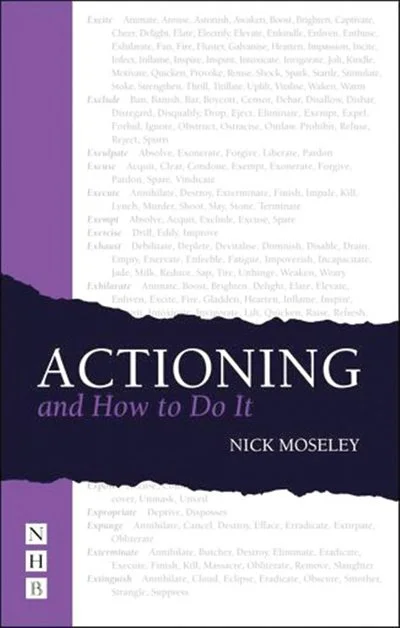
Actioning and How to Do It by Nick Moseley (Nick Hern Books, 2007)
British director/teacher Nick Moseley provides a comprehensive guide to actioning—"most firmly established early rehearsal process within British theatre." Historical origin crucial: not Stanislavskian but devised by the Joint Stock Theatre Company in the late 1970s under Bill Gaskill/Max Stafford-Clark, responding to actors' difficulty with "motivation" in political texts—David Hare's Fanshen (1975) required actors to serve the production's dialectical storyline rather than explore individualised subtextual narratives, blurring the form. Little used outside the UK.
Critical requirement: extensive given circumstances work FIRST before actioning begins—not an alternative to Stanislavsky-derived analysis but structure applied after thorough exploration. Seven essential questions provide a systematic framework: (1) Broad given circumstances (era/location/time). (2) Specific circumstances (backstories/relationships/basic contention). (3) What characters want—objectives. The scene driver has the strongest objective. (4) Obstacles—usually other characters' resistance. (5) Events changing the situation—creating new units. (6) Sub-objectives—smaller wants within units leading toward the main objective. (7) Counter-objectives—something else the character wants/wants to avoid, opposing the main objective, becoming an internal obstacle.
Strong verbs principle fundamental: "I inform" is insufficiently specific—weak verb fails to engage with contention. Strong verbs force actors to engage. Sam saying "Nothing important" could be actioned, I reassure, but given circumstances (guilt about borrowing money from ex-girlfriend Rosie) reveal action more likely, I divert, or I block. Series of actions doing the same thing with increasing intensity—"Money?" becomes I press; "How much money?" becomes I interrogate; "What money?" becomes I shake.
Moseley's unique contribution: investigating action verbs' spatial/physical dimension for staging. Problem identified: "pushing into forward space"—actors' bodies compel moving toward the target regardless of the verb's nature until stuck, crowding/eyeballing partner with nowhere left to go. The body ceases signalling anything beyond "vague and generalised forward energy." Solution: recognising verbs suggests spatial/gestural choices. I freeze—backs away. I silence—turns away, resumes searching. I question—comes round to get a better view.
Electronic age context: modern communication dispersed across multiple contexts—actors must develop "vocal and physical precision" working against cultural shifts, encouraging divided focus. Training technique inspiring actors to expand/refine capacity when "there has never been a greater need."
Critiqued as "inorganic," "straitjacketing"—Moseley argues action verbs are structured like text/blockin,g enabling freedom, not constraining it. Verbs written in pencil—may change through rehearsal as understanding deepens.
Actor's Alchemy: Finding the Gold in the Script by Bruce J. Miller (Limelight Editions, 2011)
Acting teacher Bruce J. Miller (author of The Scene Study Book, Acting Solo, The Actor as Storyteller) uses gold-mining metaphor throughout systematic thirteen-chapter methodology: Mining for Physical Action, Digging for the Story, Collecting Story Pieces, Sifting for Character, Reading the Map (Script to Gold), Following the Map (Conflict to Objectives), Objective Playing (Tool Number One), M_Ore on Objectives (clever pun), Finding Smaller Nuggets, Analysis/Action/Listening for Gold, Processing the Gold, Assaying the Gold.
Central diagnosis: training gap, actors struggle with the most. Programs teach voice, physicality, and emotional truth effectively—students work these daily. Script analysis gets short shrift—"assumed to be appropriate subjects to practice elsewhere," never adequately developed. Result: actors bring work to class, demonstrating "inability to make choices based on what the script tells them they must show or do."
Problem compounded: many actors "aliterate"—don't like reading or don't know how to read effectively. Consider script "jumping-off point for their own work rather than wellspring for all they will eventually do." Miller calls this a mistake. "Script is the actor's natural wellspring and map. It is a gold mine waiting to be discovered. If mined properly, it will make you, as an actor, very rich."
Physical action foundation: emotions unreliable—can't necessarily conjure sadness/hate/melancholy directly on any given day. Stanislavski shifted from the emotional truth approach (An Actor Prepares) to physical action theory—actors should rely on actions rather than emotions. Physical actions, "controllable and reliable", depend only on physically carrying them out. If the actor selects well, physical actions inspire/generate appropriate emotions.
Anne Frank example demonstrates the process: the actor playing Anne, thinking about Nazis and lost relatives, shouldn't try conjuring hatred directly. Instead, ask—given my circumstances (who/what/when/where), what might Anne do? Perhaps discover Hitler's picture in an old newspaper, rip it forcefully, or draw a big X with a heavy crayon, or spit at the image. These contextually appropriate physical actions—actors' invented choices based on analysis—communicate emotion reliably where trying to "feel" hatred directly might fail. "Physical action is both controllable and reliable."
Systematic approach emphasises: "Most good actors constantly use their brains to make the best dramatic choices." Only after making/exploring choices does artistic freedom come, permitting "seeming spontaneity apparent in fine acting."
Character serves script: the playwright wrote the character to help tell the story—primary function. Many actors mistakenly believe the play's story provides a framework for their artistic expression. Must adjust thinking.
Straightforward, pragmatic—'alchemy' is purely an extended metaphor for the refinement process, not spiritual transformation. Written for the stage, but the principles apply screen. Includes glossary, bibliography.
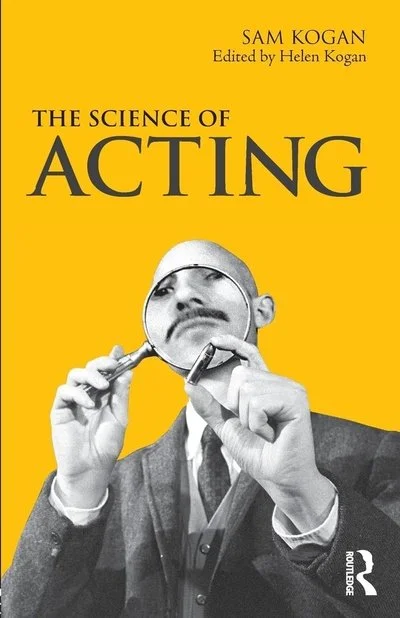
The Science of Acting by Sam Kogan, edited by Helen Kogan (Routledge, 2010)
Moscow-trained director Sam Kogan studied under Maria Knebel, a direct student of Stanislavski who worked with the master in his final months. Fleeing the Soviet Union 1970s, Kogan established The Kogan Academy of Dramatic Arts, formerly known as the Academy of Science of Acting and Directing, developing a systematic methodology integrating neuroscience and psychology. While respecting Stanislavski's systematisation, I fundamentally disagreed with the core premises. Filled Stanislavski's self-recognised "knowledge gaps" especially regarding "subconscious in origin"—questions Stanislavski admitted weren't "intellectually my business."
Model of Awareness distinguishes visible/invisible thoughts. Chamber of Visible Thinking (CVT)—"mind's eye"—holds thoughts currently seeable. Below lie invisible thoughts (observable/unobservable) determining most behaviour. Awareness is defined: "the ability to see one's own thinking." An actor must increase the CVT size approximately 200% to think the character's thoughts rather than their own rigid patterns.
Mushroom diagrams make abstract concepts concrete. Visible thought becomes stalk—"Mummy doesn't like me." Purposes (wants) form cap: Short-term ("I want to be liked"), Medium-term/Objective ("I want to belong"), Long-term ("Happiness is always being cared for"). Events form roots: People Event ("Women don't care"), Life Event ("Life's unfair"), Self Event ("I am shit"). Each thought precipitates into heaps, strengthening invisible influence.
Events are moments changing the internal state with distinctive Foreburn/Afterburn. Anticipation = Inspiration + Fear. Audition example: two weeks before (Anticipation), thinking increases gradually until walking through the door. The event occurs. Dissipation follows—decreasing intensity, but now real rather than imaginary pictures. Foreburn removes fear through aware preparation: "I imagine arriving calm, questions I'll be asked, how I'll respond." Afterburn analyses afterwards—learning for future Events.
Mindprint provides 15-component character analysis: Ultimate Communion Event (generalized impression of most secure relationship—often parent, sometimes deity or animal), Shame Events (thoughts causing most suffering must hide), Sex Events, Life Events, People Events, Ghouls/Ghosts, Auto Directives, Adjusters, Mental Statements, Guidelines, Objectives, Purposes, Self Events, Super-Purpose, Germ. First three "most important because they form the foundation of character's consciousness."
Ten Steps to Creating a Character systematises progression from script analysis through standing-up performance. Rejects "exploring character" as wasteful—actors should know from the beginning what to do. Claims repeatable, verifiable approach: "Every time students correctly use these ideas, they work."
Posthumously edited by his daughter, Helen. Illustrated throughout with diagrams. Distinctive terminology requires dedicated study—not a quick-fix technique. Appeals to scientifically-minded performers seeking concrete knowledge over intuition.
The Science and Art of Acting for the Camera: A Practical Approach to Film, Television, and Commercial Acting by John Howard Swain (Routledge/Focal Press, 2010)
Veteran actor/teacher John Howard Swain (nearly forty years of professional experience) systematically transforms instinct into repeatable craft. Central philosophy: "Science, for our purposes, isn't about formulas or equations...rather we're talking about a systemic yet flexible body of knowledge." Science enhances instinct, thereby producing art—not competing forces but complementary ones.
"Tilling the soil" metaphor runs throughout. Shortstop fields grounders hour after hour until "awkward, erratic actions become graceful, fluid movements"—the technique transforms itself into art. Mark Rylance (multi-Tony/Academy Award winner) explains his process: "I like to do all this work before, which to my mind is like turning the soil in a garden...the soil is all very turned, it's all bouncing around in my psyche." Preparation enables spontaneity—can't wing it, hoping instinct alone carries through.
Film versus stage differences are crucial for understanding. Stage actors trained, reaching "guy sitting in the last row, third balcony." Film brings everyone "metaphorically moved up to the front row"—actors adjust accordingly or are guilty of overacting. Stage images are constant; film images change quickly—"approximately every three seconds thanks to MTV." Extreme example: a stage actor might use the whole upper body conveying gesture; film shows an extreme close-up of a forefinger nudging a poker chip. The director dictates what the audience sees and size through cuts/angles.
Actor as interpreter and gatekeeper: "We're interpreters. We bring the writer and director's visions to fruition. We're also gatekeepers of emotion, torchbearers who hold up light so each member of the audience can peer into his/her own soul. Ancient Greeks created theatre as an outlet for the intense emotions citizens felt—today's audiences need the same. Can't simply report events like a newscaster—"we have to live them." Scouts/Trailblazers—if the actor doesn't go on the journey, the audience can't either.
Ten Positive Attributes technique provides a safety valve preventing one-dimensional darkness. Actress playing Debby (airline stewardess from Iowa) initially created "dark, lost, despondent person so down on herself she didn't think anyone could possibly like her." Scene dragged, unsatisfying conclusion. Finding ten positive attributes—ambitious, smart, sensitive, compassionate, inquisitive, funny, honourable, grateful, attractive, innocent—transformed the scene. "Energy in the classroom changed...students on the edge of chairs, completely wrapped up." All "bad" things written into the script by the writer creating conflict—usually left out/understated are "good" traits. Key principle: "An audience can't, and never will, root for a character who doesn't root for him-/herself."
Multiple valid approaches respected: Jeff Bridges improvises through the script; Meryl Streep does tons of homework before the cameras roll; Mel Gibson wings it without rehearsal. Process isn't restricted to set choices but is opening up to making choices.
Screen Acting: A Cognitive Approach by Dan Leberg (Edinburgh University Press, 2022)
Former professional actor (nearly twenty years) turned scholar, Dan Leberg bridges the gap between film studies' performance analysis and actual acting work. Opening anecdote crystallises the problem: enrolling in Introduction to Cinema Studies at the University of Toronto, Leberg searched the syllabus for acting lecture—found weeks on cinematography/mise-en-scène but acting relegated to a footnote. "Was all that time and energy I had spent acting actually just part of a catalyst for reawakening Lacanian mirror phases?" Critical distinction between "acting" (entire creative process) and "performance" (filmed result)—film studies traditionally analyse only the latter, treating actors as "glorified props."
The three empathetic connections framework provides conceptual vocabulary for analysing "visible" alongside "invisible" aspects of screen acting. Intrasubjective empathy: actor connects with character/self, reorganising quotidian bodymind into situational self—translation from script to body through appresentations. Intersubjective empathy: relationships among performing actors and among actors-as-characters—circular causality of responses, testing ground for malleability. Performative empathy: actor solicits anticipated audience connection—"invitation to audience to connect with character through act of performing."
Audition chapter examines preparation under precarious working conditions. Grim portrait: the vast majority of professional Canadian actors are unpaid within the given calendar year despite steady production flow; the 2007-8 ACTRA poll showed 40% unionised membership didn't work; average acting income is less than half the national average. Fundamental constraint: no matter how many auditions, only one cast. Natalie Lisinska refuses to separate "precarity of steady employment from sense of professional accomplishment." Auditions eliminate intersubjective solicitation, becoming "functionary yet reductive performance style."
Script analysis methods distinguish bottom-up versus top-down approaches. Bottom-up: extrapolating specific memories into "emotional common denominators"—Kevin McGarry, preparing PTSD veteran firing gun connects to betrayal through co-star raising turkeys she'll slaughter. Top-down: imagination, abstraction, archetype—Toronto's Professional Actors Lab uses Jungian family archetypes, identifying character transitions, connecting gendered power dynamics to imaginary familial reference points.
Includes interviews with working Canadian actors discussing practical techniques grounded in professional realities. Cognitive science—particularly empathy research explaining WHY techniques work, not just how—illuminates mechanisms underlying truthful performance. Scholarly requiring intellectual engagement but never losing sight of production culture's technical demands and economic pressures.
Academic text complements rather than replaces practical training. Strongest for analytically-minded actors seeking a deeper understanding of their own creative processes through a cognitive science lens. Read after establishing basic technique—provides a framework articulating what happens internally during preparation and execution.
Psychology for Actors: Theories and Practices for the Acting Process by Kevin Page (Routledge, 2019)
Seasoned actor/writer/theorist Kevin Page (psychology background, meditation practices, consciousness research) addresses glaring gap: while nearly all actors regularly make fundamental psychological decisions regarding roles, psychology is rarely formal part training—not standard curriculum requirement at Yale, Julliard, NYU despite master teachers acknowledging "central importance of firm and fundamental understanding of human motivation and behavior."
Core provocation: traditional actor training pedagogy—Stanislavsky and reactions—developed based on psychological understandings from the 1700s-1800s. Stanislavsky was most influenced by Denis Diderot (1713-1784) and Théodule Ribot (1839-1916), borrowing "affective memory" from Ribot. Sharon Carnicke's research reveals Stanislavsky owned six Ribot books, "read them voraciously and filled them with marginal notes", seeking to define the psychophysical continuum mind/body. Crucial point: Stanislavsky's theories are primarily based on pre-Freudian psychological concepts. Freud eventually entered American Method through Adler, Meisner, and particularly Strasberg, adapting through a psychoanalytic lens. However, "awfully lot of psychology developed since Freud's day has never been taken into account."
Maps and models metaphor provides a non-dogmatic framework. Map = representation (overview perspective) equated with psychological theory; model = representation (higher resolution, articulatable components) equated with a tool. Different maps represent different aspects same territory—a road map versus a topographical map. None meant only way envision territory; simply different ways looking inner landscape characters actors terraform inside own experience. Sometimes need a road map (vacation); sometimes flood plains/elevations map (building highway). Each valid, each particular use.
Nine-chapter structure surveys twentieth-century psychology: Brief history West (Greek philosophy through postmodern age); Freud's free association and defense mechanisms (repression, denial, projection, displacement) as character-building tools; Jung's psychological types (introvert/extrovert, thinking/feeling/sensation/intuition), archetypes (Shadow, Anima/Animus), collective unconscious; Adler's inferiority complex, compensation, lifestyle; Horney's moving toward/against/away from people, neurotic needs; Erikson's eight psychosocial development stages (trust/mistrust through integrity/despair); Maslow's hierarchy needs (physiological through self-actualization), peak experiences; Wilber's integral psychology (four quadrants, levels consciousness development); personality testing and pathology (Myers-Briggs, Enneagram, DSM-5).
Experiential methodology throughout. Exercises begin with personal exploration, followed by suggestions to repeat the same exercises regarding building/deepening a certain character. Not explicit text analysis examples—all exercises experiential, "intended to be done, not merely described." Predominantly introspective but actually quite active, involving a full engagement of personality/spirit. Page intentionally leaves many questions about personal application unanswered, hoping actors find their own answers more valuable.
Mental hygiene emphasises crucial survival skills. CareerCast 2015 list placed professional actor #6 Most Stressful Jobs in America (after police officer, before news broadcaster). Competitive, stressful daily environment—healthy, optimal mental functioning necessity, not an option. Proper self-care and mental/emotional hygiene are important both for competitive advantage and survival. "Two kinds of psychology, personal and character."
Multi-perspectival actor orientation. Scientists/psychologists are often guilty of "totalizing" their particular perspective—deciding their chosen map/model only valid viewpoint. Actors tend different look at alternative explanations, various motivating factors, and unique novel solutions to psychological problems in characters. An actor's job is innately multi-perspectival—almost always asked to take different (often alien) perspectives from their own natural one.
True and False: Heresy and Common Sense for the Actor by David Mamet (Vintage Books, 1997)
Pulitzer Prize-winning playwright/director (Glengarry Glen Ross, American Buffalo) David Mamet delivers an iconoclastic polemic dismantling conventional actor training. Twenty-nine brief, provocative chapters systematically attacking Method acting, Stanislavsky-based techniques, emotional preparation—the entire edifice of modern actor training built upon.
Central heresy: "There is no character. There are only lines upon a page." Audience creates an illusion character through synthesis—invoking Eisenstein's montage theory, juxtaposition between the playwright's words and the actor's uninflected actions creates character in the viewer's mind, not the actor's emotional preparation. Woman raising head from desk paired with whistling teakettle reads "rising to renewed labours"; same action paired with judge opening envelope reads "hearing verdict." Nothing changed except juxtaposition —the viewer creates the idea, tells herself a story.
"Emotional memory, sense memory, and the tenets Method back to and including Stanislavsky's trilogy are a lot of hogwash." Cannot be practised, don't work, are supererogatory—"teaching pilots flap arms while cockpit increases lift plane." The plane is designed to fly; the pilot is trained directly. A play is a series of incidents protagonist struggles toward a goal. An actor's job: show up, use lines and will and common sense to attempt to achieve goals similar protagonist's. End the actor's job.
Outward-directedness principle: Real-life mother begging child's life, criminal begging pardon, atoning lover pleading one last chance—these people "give no attention whatever to their own state" but focus entirely person from whom they require the object. This outward-directedness thrills audiences. Great drama "not performance deeds with great emotion, but performance great deeds with no emotion whatever."
Famous Cagney formulation: "Find your mark, look the other fellow in the eye, and tell the truth." An actor needs a strong voice, superb diction, a supple body, rudimentary understanding of the play. Nothing more. Stanislavsky, "essentially amateur"—wealthy merchant family, unlike professional buskers, earning a living onstage. His theories serve hobbyists freed necessity of making a living onstage. Actors succeed despite training, not because institutions claim credit for talented graduates, "like Corsica claiming Napoleon."
Best acting advice: "Invent nothing, deny nothing." Resisting impulse embellish, add emotion or behaviour—possibility greatness. A writer's job makes play interesting; an actor's job makes performance truthful. Cannot both "guide" performance and keep attention/will accomplish the objective onstage.
Suggestibility argument: Actor's obstacles/excuses actually script working subconscious—play brings actor's life in unforeseen ways, creating exact feelings the character experiences. Trust immediate impulses, act on feelings before attributing/controlling them. Wisdom consists of surrendering to play's unforeseen demands requiring courage, immediacy—not preparation, not understanding.
Extremely controversial—contradicts most conventional training. Brief (~130 pages), intentionally overstated effect. Comparison psychoanalysis—both demand long-term devotion, rarely showing demonstrable results, and resist closure.
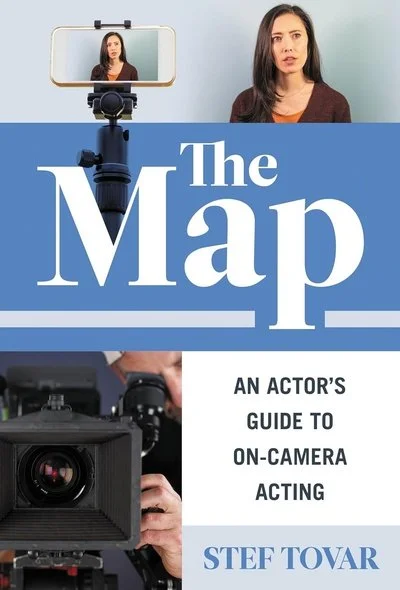
The Map: An Actor's Guide to On-Camera Acting by Stef Tovar (Routledge, 2021)
Working actor/teacher Stef Tovar (Chicago Med, Empire, Contagion) delivers an accessible roadmap-structured guide born from hard-won experience. Opening confession: left undergraduate program with solid theatre training, but never studied on-camera technique—two years auditioning in Los Angeles before booking first commercial because "didn't have the right technique." Eventually learned through "trial and (mostly) error." Now shares what he "wished someone had told me when I was in my twenties."
The MAP technique (trademark concept): what wins roles isn't memorising lines—everyone does that—but what you do between lines. "Great on-camera acting, all about watching you think." Create a map of beats using asterisks/plus signs marking script—active moments where the character shifts, decides, or discovers. "Not pauses but active thinking"—specific thoughts allowing the camera to catch them through the eyes. When analysed sides marked with beats look like an actual map.
Three essential beats every audition: (1) Need to Speak—moment before first line, giving reason to speak, drawing the casting into what you're thinking before dialogue begins. "Your audition should start with a beat." Prevents looking like an audition—can't answer "because I have first line." (2) Middle beat(s)—within scene where react, discover, shift. Write beats as unspoken dialogue, practice saying aloud with scripted lines, then think silently. (3) Button—final thought after last line showing character's reaction to what transpired, let casting know the audition has finished. "Every on-camera audition you do must have a button." Examples: 1997 Snickers "Who are the Chefs?" commercial—painter's final "Ehhh!" Breaking Bad "I am the one who knocks" scene—Anna Gunn gets a fifteen-second button showing the impact of Walter White's words on Skyler's face. "Your audition needs a button."
"The Box" concept—everything happens within the camera frame. James Gandolfini's teaching moment from Matthew Del Negro's 10,000 NOs: spinning around, creating a drunken feeling for the Sopranos scene, the student feels like a jackass spinning front crew. Gandolfini points matte box housing camera/lens: "All that matters is that fuckin' box." Box might be an iPhone, a television monitor, a movie screen thirty feet high—treat rules box as technical language, must learn to speak.
Less is more lesson learned the hard way. Tovar cast Employee of the Month (2004 Sundance, now cult classic) with Matt Dillon, Steve Zahn, and Christina Applegate. Bank robbery scene—Tovar's character thinks the alarm button terrible idea. No dialogue, just looks. Tovar is using face, hands showing "DON'T PUSH THE ALARM BUTTON!" Director Mitch Rouse: "You guys can bring it down." They go again, feeling great. Mitch: "Still too big." Third take Tovar, thinking "Matt's not doing anything. I need to do something more." Mitch stops, brings them the monitor. Tovar looked like "doing production Oklahoma! on Broadway—full on mugging with face, using big gestures, 'showing' everyone." Matt Dillon, using only his eyes, conveys the stakes perfectly in two seconds. Mitch: "Your face is going to be on screen thirty feet high. Anything you do will look huge." Andrea Bendewald remembered: "As if she could see him thinking—he was that clear with thoughts."
Thinking versus showing: "Great on-camera acting, really opposite showing. Don't need to show anything because the camera catches all." Actively thinking, not showing—tough balance. Theatre directors want good actors showing craft; on-camera directors want real people to play the role immediately. Extreme example: Tovar's Empire pilot audition for Lee Daniels—doing "absolutely nothing" technically (scratching face, breaking up line, barely audible voice) makes the director shake hand: "Now that was worth getting up for."
Additional practical coverage: understanding "type" and using advantageously, getting agents (commission-based, never pay out-of-pocket), reading breakdowns thoroughly, self-taping techniques, day player/co-star roles. Sample sides are annotated throughout, showing beat placement. Conversational accessible tone with personal failures/successes demonstrating techniques through lived experience rather than pure theory.