CATEGORY 7: MARKETING AND SELF-PROMOTION
Product Packaging and Placement; addressing artists' marketing resistance
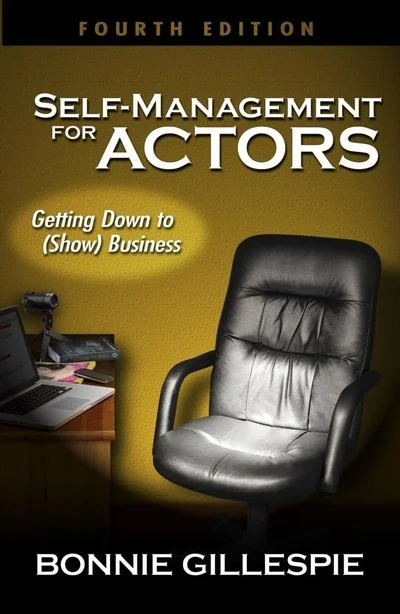
Self-Management for Actors: Getting Down to (Show) Business (Fourth Edition) by Bonnie Gillespie, Cricket Feet Publishing, 2016
Casting director, columnist, and author Bonnie Gillespie treats actors as small business CEOs managing their own careers across thirty-four systematic chapters. Core philosophy: actors must self-manage extensively before signing representation—' turn you into your future rep's dream client'.
Three Revolutionary Concepts. The Bullseye: brand clarity, identifying what you do effortlessly better than anyone else. Athletes in the zone sink half-court shots at the buzzer, looking like they do it every time—that effortless work is your bullseye. The Show Bible: career documentation tracking every contact, meeting, submission—action log proving investment when auditions feel sparse. Technique borrowed from Linda Buzzell's How to Make It in Hollywood: reminds you that seemingly uneventful coffees and lunches build careers. The Web of Trust: professional relationships visualised as spider-silk strands between you and industry people. Strength and thickness are analogous to how good the relationship is, how much trust exists. Opportunities to develop synergistic trust happen by chance; taking advantage doesn't.
Launch at 85 Per Cent. Partner Keith Johnson taught Gillespie a critical lesson: if you wait for everything to be perfect, you'll never start. Nothing will ever be perfect. Launch imperfect, learn iteratively. Perfection paralysis kills more careers than imperfect action.
Effort-to-Reward Ratio. Early career requires a 1000:1 ratio—expend one thousand units of effort for one measly unit of reward. Eventually becomes a 1:1 ratio, ultimately 1:1000 when established. Therefore, find reward in something other than booking jobs. Keeping score wastes energy. Keeping score is for wannabes.
Rejection Doesn't Exist. Paradigm shift required: every time you're invited to submit a headshot, asked to audition, requested for a callback, you're being included, not rejected. Being rejected would mean hearing, 'You're not an actor! Go away!' Casting someone else after you made final callbacks isn't rejection.
Casting Director Insider Perspective. When asked what single most important factor for getting called in was, CSA soap opera casting director Mark Teschner responded: 'Shirt colour!' What colour? 'Blue.' The joke summarises how casting directors feel about minutiae that actors emphasise. Reality: gut instinct trumps analysable factors. Gillespie over-schedules prereads by 20 per cent because flakes always occur—averages 20 per cent no-show rate despite careful pre-screening. Schedules 125 actors when the director wants to see 100.
Community-Building Ethos. Open source approach: share information freely; your success doesn't threaten others. A generation that hits the share button rather than hoards information. My jobs are my jobs—nobody steals them by knowing how to format a CV or organise a show bible.
Thirty-four chapters cover: costs of acting, premature moves, targeting buyers, business plans, training, headshots, CVs, reels, online presence, agents/managers, casting office protocols, becoming a booking machine, auditions, on-set behaviour, content creation, money management, union membership, when to quit, life as a hyphenate. Downloadable resources at smfa4.com. Became a textbook worldwide.
How to Work a Room: The Ultimate Guide to Making Lasting Connections—in Person and Online (25th Anniversary Edition) by Susan RoAne, HarperCollins, 2014
Networking classic transforms professional events from anxiety-inducing ordeals into opportunities for genuine connection. The author provides practical strategies for every stage: preparing mentally before arrival, entering rooms confidently, starting conversations with strangers, maintaining engaging dialogue, gracefully exiting conversations, and following up to build lasting relationships. Twenty-five years after the original publication, the updated edition addresses virtual networking alongside face-to-face events.
The Five Roadblocks. Childhood warnings sabotage adult networking. 'Don't talk to strangers'—made sense when mothers said it to us, but it doesn't make sense at trade shows or professional association meetings where contacts are standing around the room. 'Wait to be properly introduced'—Scarlett O'Hara wouldn't have got far at a company retreat, batting eyelashes, waiting for proper introductions. 'Good things come to those who wait' (Prom King/Queen Complex)—grey hair comes to those who wait, sometimes varicose veins if waiting is done standing up. 'Better safe than sorry'—risking rejection puts ego on line, but without risk, you never make new friends or contacts. 'Mangled and mixed messages confuse us'—a warm, friendly manner might be misconstrued as a liaison invitation.
Shyness is Universal. Ninety-three per cent of adults identify themselves as shy. The figure increased from earlier decades due in part to technology. Dr Philip Zimbardo calls it 'situational shyness'—certain situations make all of us feel reticent. Unlike introverts who feel energised being alone, shy people want to be with others. Leaders have learnt to overcome shyness—they don't wait, they reach out. RoAne interviewed one hundred great conversationalists (coined term 'ConverSENsations'): 75 per cent still thought of themselves as shy. Not one denigrated small talk—saw it as a way to find common ground.
Bring Your OAR. Three-part rescue system for conversational quandaries. Observe: look around the room, what's happening, does the crowd seem good, traffic difficult, what do people have in common? Observations should be upbeat, unusual, pique interest—avoid negative comments. Ask: questions should be relevant, open-ended enough to encourage response, but not invasive. 'What's been the best benefit of joining this group?' 'How would you suggest I become involved?' Reveal: share something about yourself creating reciprocal exchange. The magic is in the mix.
Three Graceful Exits. Exit One: wait until you've finished commenting, smile, extend a hand for a closing handshake, summarise the conversation in a short sentence showing you listened. Visibly move one quarter of the room away—underscores you really had someone to see, didn't leave from boredom. Exit Two: if conversation is neither open nor enjoyable, say 'I hope you enjoy the rest of the...' Move a quarter room away. Exit Three: take them along—introduce your new acquaintance to others. When we help people meet others, they remember our kindness.
Authentic Connection Over Manipulation. Successful networking comes from a genuine interest in others, offering value without immediate expectation of return, and building real relationships rather than collecting business cards. Small talk leads to big business. Don't use business cards to play power games. Follow-up essential—without it, the card is useless.
CATEGORY 8: BUSINESS AND ENTREPRENEURSHIP
Actors as creative freelancers running one-person businesses

7 Deadly Sins The Actor Overcomes: Business of Acting Insight by Kevin E. West, ShutUp n' Play Productions, 2016
Practical business guide from the founder of The Actors' Network (24 years, 5,000+ members) applying 30 years of Hollywood experience to career traps. Each deadly sin (Lust, Greed, Gluttony, Sloth, Wrath, Envy, Pride) contains five traps followed by five corresponding solutions. Foreword by TV writer/producer Roger Wolfson (The Closer, Saving Grace) establishes tone: 'Blood. Sweat. Tears. That's what goes into having a career in this industry.'
Actor Pie: Time Management Tool. Start with 112 hours weekly (eight hours sleep daily leaves sixteen waking hours). First, compute Life Pie—survival job, commute, errands, relationships, health. Remaining hours become Actor Circle split into Show (four slices: classes, auditions, rehearsals, bookings) and Business (four slices: research, administration, online submissions, networking). Most actors discover that only four hours are left for the business side. Reveals uncomfortable truth: for most actors, the business of acting is a hobby. West believes you need 20-30 weekly hours for the business side. 'You are the only boss to govern the pursuit of your acting career, and you're not about to fire yourself from being an actor, even if you may deserve it.' Time-honoured Kevin'ism: 'You can't get fired from a job you don't have.'
5-3-1 Game Plan: Macro Lens. The one-year plan contains immediate actions and short-term monthly goals. Three-year goals reflect similar categories but with marked improvements—a more recognisable actor, better representation, and Los Angeles. Five-year timetable: 50 per cent career goals, 50 per cent lifestyle elements (escape survival job). Borrowed from Franklin Planner and 7 Habits methodologies. Think of it like grocery shopping—you may like all the choices, but can't afford them all. Requires professional discipline, prevents wholesale changes whilst allowing annual tweaking.
Dating Metaphor Throughout. Used since 1991 as a perfect metaphor for the pursuit of show business. Applies to mental state, not craft. Think about the principled difference between casual sex and a long-term relationship. Actor LUST: 'yeah, I'm doing the acting thing'—casual attitude that diminishes consistent effort. Dream versus fantasy distinction: a dream has plan and effort; a fantasy lives in the mind, growing more improbable daily. West's test: 'If you knew you'd run into them on Sunday at a hip coffee shop, would you treat them like that?'
C.P.S. Standards. Contemporary Professional Standards acronym helps actors evaluate demo reel material—don't hoard everything you've ever shot. Weekly Game Plan complements the macro 5-3-1 approach with immediate weekly tasks. Master Contacts List system prevents reactive chasing-tail behaviour.
CATEGORY 9: ACTORS' LIFESTYLE AND SUSTAINABILITY
Managing energy, finances, mental health for long-term career
How to Be a Working Actor: The Insider's Guide to Finding Jobs in Theatre, Film, and Television (Fifth Edition) by Mari Lyn Henry and Lynne Rogers, Back Stage Books, 2008
Comprehensive survival manual for professional actors—not about acting technique, but about WORKING as an actor. Fifth edition updated for the post-9/11 world and digital age. Authors establish sobering reality: 200,000 professional performers (AEA/SAG/AFTRA members), only 20 per cent earn more than $10,000 yearly, eight per cent earn more than $25,000 yearly, and 2,000 earn more than $100,000 yearly. Ben Gazzara's warning: 'Don't do it. Unless you're insane, unless you love it so much you cannot live without it.' Paul Newman's advice to Actors Studio students: one word—'Tenaciousness'.
Six-Month 'No Squeeze' Budget. Revolutionary concept permits actors not to earn during the establishment period, reducing desperation that sabotages auditions. Complete budget includes: NYC studios $2,200+ monthly, LA $750+ with roommate; utilities $90-150 per two months; LA transportation requires car $500-700 monthly rental plus $1,200 yearly insurance, NYC subway $24 weekly; phones $50-120 monthly; food $120+ weekly for two; 'schmooze factor' $150 monthly incidentals. Kim and Ryan Shively's NYC-to-LA transition advice is included throughout.
Hollywood Studio System History. Columbia Pictures' hairstylist Helen Hunt described Rita Hayworth's painful year-long electrolysis forehead redesign: each hair removed individually, follicle deadened with electric charge. Treatments cost fifteen dollars each. Joan Crawford on professional presentation: 'Any actress appearing in public without being well groomed is digging her own grave.' Studio system created stars' images—teeth straightened, jaws realigned, strict diets prescribed, eyebrows reshaped.
Colour Psychology. Colour triggers memory faster than names. Casting directors make notes during auditions, record the colours worn. 'I really liked the girl in the purple jacket' or 'Remember that guy with the red vest?' Red equals passion, but intimidating—choose reds with more blue (cranberry, raspberry) or brown (brick, terra-cotta) for interviews. Green calming, nonthreatening. Blue equals trust, loyalty—corporate executives inspire confidence in navy. Purple is associated with artists, creativity—Michelangelo kept purple stained glass in the studio whilst sculpting. Yellow causes anxiety. White reflects, upstages face. Black drains vitality. Twenty-two-chapter structure covers financial planning, personal presentation, tools, industry players, training, job search, cyberbiz, survival strategies, unions, regional markets, showcasing talent, and auditions.
Twenty-two systematic chapters provide granular survival logistics. Perfect complement to Gillespie's marketing mindset—where Gillespie teaches systems, Henry/Rogers provide survival specifics. Brutally honest: doesn't promise stardom, acknowledges 80 per cent unemployment rate, yet provides systematic pathway for 20 per cent who DO earn livable income through knowledgeable job-seeking.
The Outstanding Actor: Seven Keys to Success (Second Edition) by Ken Rea, Methuen Drama/Bloomsbury, 2021
Ken Rea, Professor of Theatre at London's Guildhall School of Music & Drama, trained over 2,000 actors in forty years, including Ewan McGregor, Daniel Craig, Damian Lewis, and Lily James. The book distils what those twenty who became internationally famous were doing that others were not. Identifies seven qualities distinguishing outstanding actors from competent but unmemorable ones: Warmth, Generosity, Enthusiasm, Danger, Presence, Grit, and Charisma.
Growth Mindset Foundation. Stanford professor Carol Dweck's research: 'fixed mindset' believes talents are set in stone—interprets failure as a threat, avoids challenges, plays it safe. 'Growth mindset' regards talent as a starting point for development through effort—embraces failure as an acceptable step towards success, and cheerfully learns from rejection. Outstanding actors take risks, comfortable with failure. Example: graduate Gold Medal winner, four months without a job, confidence draining, pub manager noted 'when he started the job he glowed with presence and charisma, but slowly all that had drained away.' A fixed mindset makes you concerned with how you'll be judged; a growth mindset makes you focus on improving.
Underarm and Overarm Energy. Lily James's foreword: 'countless times before important meetings or auditions where I have connected to my "underarm energy", and it truly gives strength to move mountains (and hopefully win me the job!).' Stood in wings connecting to 'ki energy' before terrifying steps onto the stage. Overarm energy uses higher gestures with palms up—creates excitement but can overwhelm. Underarm energy uses lower gestures with palms down—calms, draws unconsciously into more vulnerable energy, producing subtler, more nuanced acting choices.
Dangerous, Exciting Actor Exercise. Rea challenged students: Be a dangerous, exciting actor. If other students became bored by your endeavour, they could simply turn their backs. 'Desperation and utter chaos ensued. There's still a dent in the wall from where my classmate Dave threw his chair against it!' Purpose: risk looking silly to access openness, making audiences empathise. That 'silliness' when focused in the service of text engages the audience, transports them, and releases your individuality.
Excellence Plus Individuality. Being outstanding means achieving a level of excellence and a degree of individuality, setting you apart from average actors. Outstanding actors exude higher levels of confidence and energy, demonstrate greater detail, giving freshness and uniqueness, tremendous drive concealed by surface effortlessness—make it look easy. Sum produces charisma, making the actor magnetic. Qualities don't just rely on innate talent—consciously develop them through adopting new habits and values.
Second edition provides Vimeo links to video recordings demonstrating key exercises with former students, plus SoundCloud links for audio files—' gives impression of sitting in on workshops'. Proven techniques help nurture openness, warmth, generosity, playfulness, and risk-taking. Researched extensively: interviews with directors Rufus Norris, Nicholas Hytner, casting directors, agents, Judi Dench, Jude Law, and numerous Guildhall alumni.
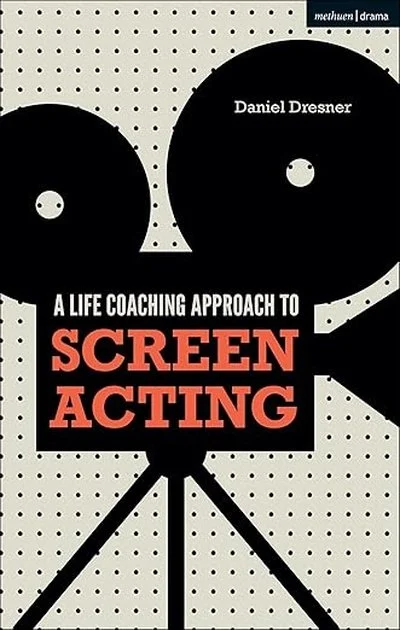
A Life-Coaching Approach to Screen Acting by Daniel Dresner, Methuen Drama/Bloomsbury, 2019
Daniel Dresner integrates professional life-coaching methodologies with screen acting development, treating actor's career as holistic system requiring both craft mastery and personal growth. Drawing on coaching principles—goal-setting, values clarification, limiting belief identification, accountability structures—Dresner shows how actors sabotage careers through unconscious patterns: perfectionism preventing action, fear masquerading as wisdom, inability to self-validate creating desperate neediness in auditions.
The Saboteur Personified. Many actors have saboteur who sounds rational, logical, mainly unthreatening—seems to have your best interests at heart but job is keeping you in same place, preventing forward movement. Saboteur phrases: 'It's not realistic', 'I'll never be able to do that', 'There are a thousand people up for the role'. Three steps to manage: recognise you have one, notice how often they speak, then ignore/dismiss/laugh at them rather than fighting. Personify them—give shape or embodiment. Examples: one client uses ex-husband as saboteur, puts him in wet room he installed before divorce. Another named saboteur after reality TV judge who berated her, mentally puts them in garbage truck driving past. Dresner's personal gremlin: Droopy cartoon character printed out as warning on wall.
Impostor Syndrome. Seventy per cent of all people feel like impostors or frauds at some time, 40 per cent of successful people consider themselves so. A-list actors—Meryl Streep, Emma Watson, Kate Winslet, Michelle Pfeiffer, Don Cheadle, Matt Damon—talked about feeling like no-talent shams, living with fear of being found out and fired. Originally presented 1978 by clinical psychologists studying high-achieving women who believed despite evidence to contrary they would be discovered as frauds, success purely luck or fooling others. Exercise: list fifty things you do well (whistling, accents, horse-riding, cooking), then list fifty achievements from last two months (getting out of bed on time to being cast). Re-read before auditions.
Perfectionism as Obstacle. Nothing in universe is perfect—try thinking of one thing truly perfect, even most beautiful diamond has flaws. Fixing unreasonable, unattainable goals sets up disappointment, impossible to enjoy journey when destination all that matters. Perfectionism creates inertia, opposite impact than intended—if can't do perfectly, won't do at all. Alternative: break plan into bite-sized manageable chunks. Mountain climbing metaphor—first buy boots, tent, pitons, climbing axe, hire Sherpa/guide, reach base camp, scale mountain inch by inch. Concept of 'good enough'—US Army advertising says 'Be all that you can be', not 'be perfect soldiers'. Make finishing line achievable, learn enough and accept it's enough to begin.
Values Clarification Exercise. Identify values by analysing what's important: two people you most admire (integrity, dedication, hard work?), what brings joy (creativity, variety, family?), what motivates you (recognition, achievement, fun?). Don't pick values to impress others—be honest with list. Rank top ten, score 1-10 how well you honour each, identify one thing to increase score by one point. Example: creativity value only 5/10 because working as understudy never getting on stage, hanging around dressing room. Increase score: download script with character you'd like to play, work backstory, learn lines.
Wheel of Life exercise divides life into career, money, health, friends/family, relationships, personal development, fun/recreation, home environment—score each section, incrementally increase. Vimeo links provided for sample values clarification sessions. Captain exercise: accessing inner strength through guided meditation, asking captain questions from body not head.
The Gift: Creativity and the Artist in the Modern World (25th Anniversary Edition) by Lewis Hyde, Vintage Books, 2007
Lewis Hyde's profound meditation explores the fundamental tension between art as gift (spiritual calling, intrinsic creative impulse, freely given to community) and art as commodity (sellable product, exchange value, market transaction). Drawing on anthropology, mythology, and literary analysis, Hyde examines how creative work operates simultaneously in two economies requiring different logics.
Indian Giver Concept. When Puritans landed in Massachusetts, they discovered curious Indian feelings for property. Thomas Hutchinson's 1764 history: 'An Indian gift is a proverbial expression signifying a present for which an equivalent return is expected.' Carved stone peace pipe traditionally circulated among lodges, staying in each place temporarily but always given away again. When an Englishman received a pipe as a gift, he took it home for the mantelpiece. Neighbouring tribe leaders visited, expecting to smoke and receive a pipe. An Englishman invented the phrase 'Indian giver' to describe people with a limited sense of private property. Opposite would be 'white man keeper'—a person whose instinct is to remove property from circulation, putting it in a warehouse or museum. Cardinal property of gift: whatever we've been given is supposed to be given away again, not kept. Gift must always move.
Tribal Wisdom. Commonly, tribes distinguish between gifts and capital. Among Uduk in northeast Africa: 'One man's gift must not be another man's capital.' Any wealth transferred between subclans—animals, grain, money—is gift nature, should be consumed, not invested for growth. If goats received as a gift are kept to breed or buy cattle, a general complaint follows: so-and-so's getting rich at someone else's expense, behaving immorally by hoarding gifts, therefore being in severe debt. Expected they would soon suffer storm damage. Folk tales worldwide show person who tries to hold onto a gift usually dies.
Gift Economy Principles. Gifts circulate in circles, not reciprocal two-person exchanges. Kula ring in South Sea islands: ceremonial armshells and necklaces move continually around the wide island ring—necklaces clockwise, armshells counterclockwise. Each participant has gift partners in neighbouring tribes. Two ethics govern exchange, ensuring no equilibrium: first, discussion is prohibited—' he conducts his Kula as if it were barter' is criticism. Second, the equivalence of the counter-gift left to the giver cannot be enforced. Circular giving means no one receives from the same person he gives to. Gift goes around the corner before coming back—must give blindly, feel blind gratitude.
Market Versus Gift Logic. Cash exchange depends upon the abstraction of symbols of value from substances of value. The farmer doesn't move produce until paid, exchanges embodied worth (wheat, oats) for symbolically valuable but substantially worthless paper. Both market exchange and abstract thought require alienation of the symbol from the object. Gift exchange requires no symbol of worth detached from the body of the gift as given away. When gifts are sold, they change nature as much as water changes when it freezes.
Hyde shows artists inhabit both economies simultaneously—creative work flows from gift logic (muse to artist to audience in cycles of reciprocity) whilst survival requires market logic (selling work for money). Understanding this structural contradiction validates discomfort about marketing, enabling integration rather than destructive splitting between 'pure artist' and 'sellout'. Professional relationships in creative fields operate through a gift economy—reputation for generosity and collaboration matters more than aggressive self-promotion.

The Richest Man in Babylon by George S. Clason, Various publishers, 1926 (original pamphlets), 1955 (collected edition)
George Clason's parables set in ancient Babylon transform dry financial advice into timeless wisdom. Rather than modern budgeting lectures, Clason presents Arkad—the richest man in Babylon—revealing how he rose from poverty through principles that prove "money is governed today by the same laws which controlled it when prosperous men thronged the streets of Babylon, six thousand years ago."
Arkad's origin story provides the book's foundation. As a young scribe earning barely enough to survive, he struck a bargain with Algamish, an elderly moneylender: finish copying the Ninth Law by sunrise, and Algamish would reveal how to acquire wealth. Arkad worked through the night. At dawn, Algamish delivered the revelation: "I found the road to wealth when I decided that a part of all I earned was mine to keep."
This simple truth—pay yourself first—underpins Clason's "Seven Cures for a Lean Purse" which Arkad teaches to one hundred students. Save one-tenth of earnings ("start thy purse to fattening"). Control expenditures so the remaining nine-tenths covers necessities and pleasures. Make gold multiply through wise investment. Guard treasures from loss by seeking counsel from those experienced in handling money. Own your dwelling. Insure future income. Increase your ability to earn.
The most visceral section follows Dabasir, a camel trader who fell into slavery through debt and reckless living. Starving in the Syrian desert after escape, he faced the fundamental question: "Have I the soul of a slave or the soul of a free man?" Choosing freedom, he returned to Babylon and created a systematic debt repayment plan, documented on clay tablets showing monthly accounting: ten per cent to savings, seventy per cent for living expenses, and twenty per cent distributed fairly among all creditors until debts were paid. Month by month, the tablets record his progress, creditors' reactions, and growing self-respect.
Clason's parable format gives ancient Babylon's exotic setting—ziggurats, caravans, money lenders in colourful robes—emotional power that spreadsheet advice cannot match. The consistency across stories reinforces core principles: wealth follows universal laws, determination finds the way, and financial discipline liberates rather than restricts.
For actors navigating the profession's irregular income and long dry spells, Clason's system provides a sustainable foundation. The ten per cent savings create emergency funds for lean periods. The seventy per cent spending limit prevents debt spirals during flush times. The debt repayment system offers an escape from financial desperation that forces soul-crushing survival choices. Most crucially, the principles work regardless of income level—Arkad started as a poor scribe, Dabasir rebuilt from slavery. The path remains available to any actor willing to follow it.
Making a Living Without a Job: Winning Ways for Creating Work That You Love (Revised Edition) by Barbara J. Winter, Bantam, 2009
Barbara Winter champions the "joyfully jobless"—those who've escaped employment without becoming conventional entrepreneurs. Her 1993 classic, updated in 2009, dismantles the security-through-employment myth and provides practical frameworks for portfolio careers. Winter's central concept: Multiple Profit Centres (MPCs)—several self-directed revenue streams rather than single employment. "Chase Revel, founder of Entrepreneur magazine, pointed out that it's easier to earn $1,000 a month from ten little businesses than $10,000 from one big source."
Winter compares MPCs to a juggler spinning plates: start one, build momentum, move to the next. She distinguishes "Clustered" businesses (Rick Steves's Europe Through the Back Door—books, TV, gear, tours unified by travel) from "Eclectic" operations (Blair Hornbuckle balancing online marketing, Web design, African drumming). Breaking $10,000 annual targets into weekly $200 goals makes profit centres manageable. Some require intensive launch effort, others eventually "spin by themselves"—royalties, rental income, consumables requiring repeat purchase.
The philosophy extends beyond money. Winter quotes Peter Hawken: "Being in business is not about making money. It is a way to become who you are." Her survey found self-bossers' top benefit: freedom—control over time and life direction. "Should you decide to make a living without a job," she writes, "you'll be part of an old tradition—and on the leading edge of a new working movement." At America's founding, nine of ten citizens were self-employed; by 1900, that had reversed. Winter advocates returning to entrepreneurial roots through one-person operations—often home-based, technology-enabled, internationally accessible despite geography.
Starting small proves advantageous: master business fundamentals, make mistakes cheaply, shift quickly, and provide high-touch service impossible for large companies. Winter began The Successful Woman, with a handmade logo cut from construction paper, typed promotional materials, and strategic publicity pursuit. "Nothing that teaches you about your business is unimportant or trivial." She quotes Robert Stephens: "In the absence of capital, creativity flourishes."
For actors, this addresses survival income without soul-crushing day jobs. Traditional waiting tables or temping drains energy, offers zero career synergy, and prevents audition availability. Winter's MPCs enable monetising transferable skills—voice coaching, accent reduction, self-tape services, audition reading, corporate training, private coaching—creating flexible income supporting rather than sabotaging creative work. The portfolio approach provides financial resilience, enabling selectivity about projects rather than desperation for any paid work.
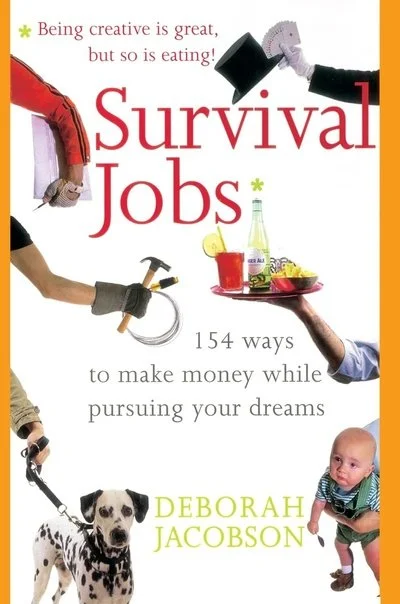
Survival Jobs: 154 Ways to Make Money While Pursuing Your Dreams by Deborah Jacobson, Ballantine Books, 1998
Deborah Jacobson's exhaustively practical catalogue addresses the survival income crisis facing creative professionals with uncommon specificity. Having held 25+ survival jobs herself whilst pursuing acting in New York and Los Angeles, Jacobson interviewed working practitioners to compile 154 jobs meeting crucial criteria: flexible scheduling (essential for auditions), decent hourly pay (minimising hours needed), transferable skills (building useful capabilities), and tolerable environments (preserving creative energy). Each entry provides a distinctive structure: catchy tagline, detailed description, realistic pay ranges, benefits/pitfalls assessment, contact sources with phone numbers, requirements, and practitioner testimonial.
The entertainment-specific chapter proves particularly valuable. Casting session camera operator ($100-$150 daily, 10 a.m.-6 p.m.) offers automatic auditions for appropriate spots plus intimate networking—though Jacobson warns: "You may have to keep reminding casting directors that you are an actor as well." Extra work pays $45 daily non-union, $65 SAG, $99 in New York. Stand-in work earns $20-$21 hourly AFTRA scale; Katherine Newell credits years standing in for Sigourney Weaver and Nicole Kidman for learning "technical aspects involved in filming and how important continuity is." Box office positions ($6-$12 hourly) provide orchestra seats for free theatre. Choir work pays $50-$100 per service, including Thursday rehearsal plus Sunday performance—requiring sight-reading proficiency. Cruise ship individual acts earn $1,000 weekly plus room and board for two hours performing weekly. Personal assistant to celebrities ($400-$1,500 weekly): Lisa Todd notes, "I spend most days running errands, which allows me to stop for auditions whilst I'm at it."
Beyond entertainment work, Chapter 1 entrepreneurial ventures require minimal capital: apartment managing, factory go-between (Jacobson's husband made "$100+ an hour" repping Midwest headshot printer), mobile auto detailing. Chapter 2 shift work avoids standard office hours: airline employment with free standby travel, casino surveillance as "eye in the sky" ($11.25-$17 hourly), catering accessing events like the Oscars, club bartending ($200 nightly at popular venues), upscale hotel bellhops ($800 weekly). Chapter 4 active jobs include aerobics instruction, massage therapy (Carlo Bruno credits book for career shift leading to Pacific Athletic Club recognition). Chapter 6 office work covers temp agencies, word processing services. Chapter 7 features pet care, house-sitting, baby-sitting—all flexible around auditions.
Jacobson's entrepreneurial sensibility permeates recommendations: barter services to spread word, apprentice rather than take costly classes, work multiple part-time jobs rather than one trapping position. Her pet care business started distributing flyers during "peak dog-walking hours" and at "doggie parks," building an immediate clientele requiring hired assistance.
The testimonials provide authentic detail. Ryan Lee's box office work enabled experiencing "opera, symphonies, ballet" previously "inaccessible." Whitney McKay delivered food for a Boulder restaurant whilst transitioning from disenchanted LA writing to Colorado children's work. These aren't generic success stories—they're specific practitioners navigating survival work strategically, maintaining creative identity whilst generating flexible income around unpredictable audition schedules.
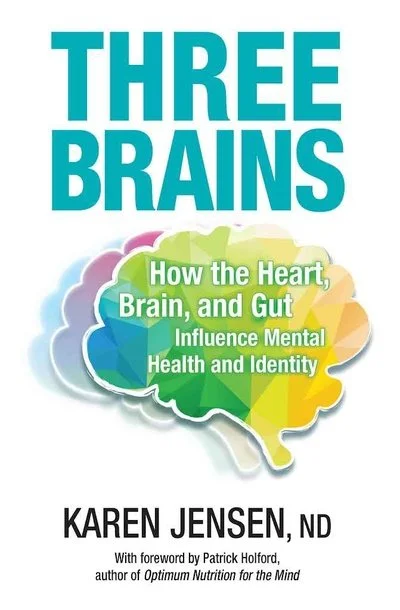
Three Brains: How the Heart, Brain, and Gut Influence Mental Health and Identity by Karen Jensen, ND, Mind Publishing, 2016
Karen Jensen's clinical naturopathic guide examines three neural networks—head (cephalic brain), heart (cardiac brain), gut (enteric brain)—through a mental health, nutrition, and biochemistry lens. A naturopathic doctor, Jensen focuses on physical and chemical factors affecting brain function rather than consciousness development, treating the brain as an organ requiring proper nutrition and care. Foreword by Patrick Holford (Optimum Nutrition for the Mind) establishes Jensen's standing amongst respected naturopathic practitioners helping people "regain mental and physical health."
The four-section structure provides a comprehensive clinical framework. Section 1 (The Amazing Brain) covers anatomy, neurotransmitters, electrical impulses, blood-brain barrier, gut-brain axis, and neurocardiology. Jensen explains 90-95% of the body's serotonin resides in the gut, not the brain—depression "could perhaps be regarded as a mental disorder of the gut brain." Scientists remain uncertain whether decreased serotonin contributes to depression or if depression causes serotonin decrease. The gut microbiome harbours "nearly 100 trillion bacteria that are essential for health," playing a "significant role in how the gut and head brains communicate." Stress influences microbiota composition; gut microbiota affects stress reactivity of the hypothalamic-pituitary-adrenal axis. Depressive episodes are associated with HPA axis dysregulation; stress-induced microbiota changes increase inflammation, contributing to depression, dementias, and other brain disorders.
Section 2 (Factors Influencing Three-Brain Health) addresses inflammation, food allergies and sensitivities, gluten and dairy intolerance, sugar, stress, adrenal dysregulation, thyroid disorders, toxins, heavy metals, electromagnetic fields, and prescription medications. Jensen details how common medications deplete critical nutrients: statins lower CoQ10 (essential for neurotransmitter production); oral contraceptives, aspirin, and antacids deplete B vitamins (critical for mood regulation); antibiotics deplete all B vitamins plus beneficial gut bacteria. The FDA released safety information stating "cognitive impairment, disorientation, and confusion have been reported by some statin users."
Section 3 (Achieving Optimal Three-Brain Health) provides Mediterranean diet guidance, omega-3 fatty acids, magnesium, twelve power-booster foods, key supplements, BDNF (brain-derived neurotrophic factor), exercise, and early childhood nutrition. Jensen emphasises blood sugar stabilisation: "The human brain is highly metabolically active and it depends on a constant supply of glucose to meet its energy needs. In fact, the brain uses at least 25% of total body glucose despite representing only 2% of adult body weight." Refined sugars cause "rapid fluctuations in blood sugar, resulting in mental symptoms including depression, anxiety, irritability, dramatic mood swings, confusion or forgetfulness, and difficulty concentrating." PGX fibre supplement stabilises blood sugar, preventing metabolic disorders contributing to mental health conditions.
Section 4 (When Three-Brain Orchestra Out of Tune) addresses mood disorders (depression, anxiety, bipolar), ADHD in children and adults, sleep disorders and insomnia, memory disorders and dementia. Supplement protocols target specific conditions. Jensen warns against overreliance on pharmaceuticals, noting stimulants and antidepressants' effects on developing brains, advocating nutritional intervention when possible.
For actors, Jensen provides a scientific foundation for getting fit and staying fit. Demanding schedules, irregular eating, stress, and sleep deprivation compromise three-brain health, affecting performance quality. The camera reads physical health—fatigue, inflammation, and hormonal imbalance visible on the screen. Nutritional protocols support sustained energy, emotional stability, and cognitive clarity required throughout the 21-step journey. Gut-brain axis understanding explains anxiety and depression common in the acting profession—chronic stress damages the microbiome, affecting neurotransmitter production. Supplement guidance addresses specific challenges: omega-3s for emotional regulation, magnesium for stress response, and blood sugar stabilisation for sustained focus during long shoot days. Sleep disorder protocols support maintaining performance quality under pressure. ADHD sections applicable to concentration and script memorisation challenges. However, a purely clinical approach lacks integration with creative and spiritual dimensions that other resources provide—best used alongside consciousness-focused texts, not a replacement.