CATEGORY 1: FOUNDATIONAL ACTING TECHNIQUE
Universal craft foundation underlying all acting media
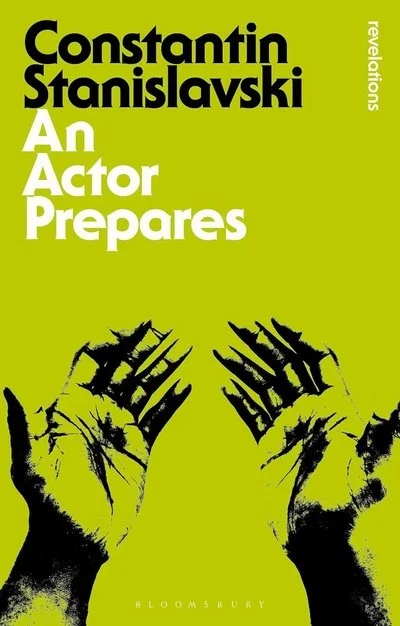
An Actor Prepares by Konstantin Stanislavski (Translated by Elizabeth Reynolds Hapgood), Theatre Arts Books, 1936
Stanislavski's foundational text presents his System through fictional diary entries chronicling young actor Kostya's training. This pedagogical device transforms theory into experiential learning—we witness Kostya's failures and breakthroughs, making abstract concepts concrete.
Central technique: the Magic If. Rather than forcing emotion, actors ask, "What would I do if I were in these circumstances?" This simple question shifts focus from feeling to doing, generating an organic response. Combined with Given Circumstances—playwright's facts about situation—the Magic If creates truthful behaviour without manufacturing emotion.
Concentration exercises are built through expanding circles of attention. Small circle: immediate objects within arm's reach. Medium circle: entire stage. Large circle: including the audience. Actors learn to control focus radius, creating public solitude whilst exposed to spectators.
Communion describes an actor-to-actor connection. Tortsov distinguishes genuine exchange from mere imitation of contact. True communion involves an invisible spiritual current flowing between partners—actors must send and receive, not simply wait for cue lines. Self-communion explores internal dialogue. Communion with imaginary objects addresses apparitions, memories, and absent characters.
Emotion Memory mines personal experience for authentic feeling. Recalling sensory details from analogous life situations awakens genuine emotional response without forcing or indicating. However, Stanislavski emphasises the indirect route—recreate physical circumstances surrounding emotion rather than attacking emotion directly.
Units and Objectives structure scene work. Dividing the role into manageable units, each with a specific objective (what character wants), prevents actors from drowning in the overwhelming whole. Objectives must be active verbs—not "to be sad" but "to convince," "to escape," "to charm."
Physical Actions became Stanislavski's later emphasis. Simple, truthful physical tasks—pouring tea, buttoning a coat, searching a drawer—ground performance in concrete doing, generating psychological truth through the body rather than beginning with psychology. This reversal proved revolutionary: authentic feeling follows authentic action.
The System offers a practical toolkit transforming vague artistic instinct into reproducible technique, making inspiration accessible through craft.
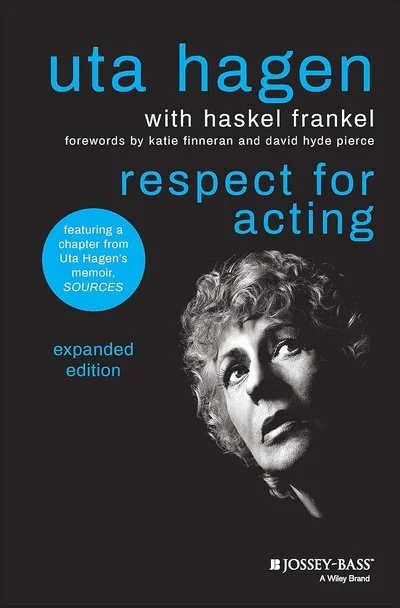
Respect for Acting (Expanded Edition) by Uta Hagen with Haskel Frankel, Wiley, 2009
Hagen's masterclass begins with a crucial distinction: Representational versus Presentational acting. Representational actors imitate character behaviour from outside, watching themselves execute predetermined form. Presentational actors reveal human behaviour through understanding themselves, trusting that form emerges from identification with a character's actions. Her example: Sarah Bernhardt swearing virtue with rising vibrato passion—the audience cheered. Eleonora Duse swore virtue softly twice, then silently placed her hand on her son's head whilst looking at her husband—audience wept. Hagen declares: "Duse moves you; she is more modern than tomorrow."
Core technique: Substitution. Actors replace the play's fictional elements with personally meaningful equivalents from their own experience, making circumstances genuinely affect them. Not literal parallels—psychological equivalents. Young actress playing humiliated student couldn't make torn chemise matter until asked: What if Lynn Fontanne held your soiled underwear? Immediate authentic embarrassment. Substitution applies broadly: time, place, relationships, objects, events.
Object Exercises develop sensory connection to the environment. Fourth Wall Exercise places specific objects (mirror, window, bookshelf) on an imaginary wall, establishing precise spatial relationships. Outdoor Exercise recreates nature—physical adjustments to sand, grass, rocks; psychological responses to sunlight, horizons, distances. The actor brings outdoors onstage through remembered sensations, not the designer's suggestions alone.
Identity work explores: Who am I? What time is it? Where am I? What surrounds me? What are the given circumstances? These questions ground the actor's understanding before attempting the character.
Hagen emphasises private preparation. No director can supply an actor's substitutions since the director hasn't lived the actor's life. Finding what makes fictional circumstances personally real remains entirely private homework.
Warning against performing the substitution itself rather than connecting it to the stage partner—tears streaming down the face whilst disconnected from the scene's action. Substitution is complete only when synonymous with this actor, these circumstances, this moment, producing spontaneous action now.
Practical daily training: sense memory exercises, relationship work, character exploration through self-discovery. Technical mastery serving moment-to-moment truthful experience.
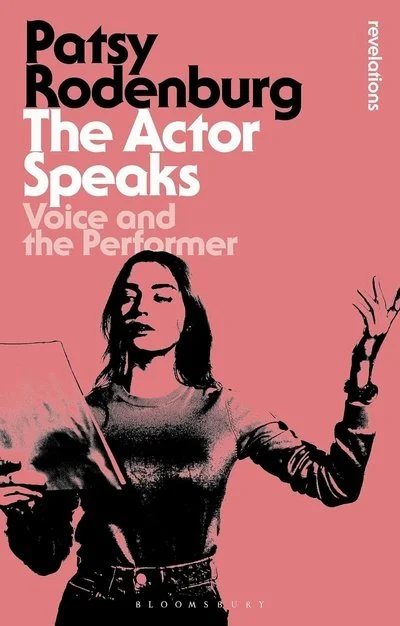
The Actor Speaks: Voice and the Performer by Patsy Rodenburg, Methuen Drama, 2020
Rodenburg's comprehensive voice training begins with a fundamental principle: natural breath supports free voice. The body should take the breath needed for any task—speaking, surviving, space, thought, and feeling. Larger physical activity, space, feeling, and thought require greater breath. Ribs swing open at the sides and the back of the cage, the diaphragm moves abdominal muscles, creating a column of air providing vocal power support. The equation is simple: "We speak on the breath." No shoulder lift, no upper chest tension. Suspension moment between inhalation and exhalation—gathering power like a swing, hovering before a downward plunge.
Voice emerges when breath vibrates vocal folds in the larynx, sound travelling up through the open throat and out through the mouth. Most people today hold or block voice—only partial sound releases, causing inaudibility. Free voice shouldn't be felt inside the body—no grip, lock, or swallowing sound in the throat or jaw. Resonance through the chest, throat, mouth, nose, and head amplifies and enriches tone.
Three Circles of Energy define presence and focus. First Circle: speaking to yourself, imagination internal. Second Circle: speaking directly to one person or group—genuine connection. Third Circle: speaking at people without real content—generalised energy. Characters may be stuck in one circle or shift between them moment to moment. Boring performances stay confined to a single circle throughout. Soliloquies work best in the Second Circle, directly engaging the audience. Prayer might be any circle, reflecting a relationship with the deity.
Rodenburg addresses habits blocking natural voice—tensions triggering other tensions throughout body, breath, voice chain. Speaking Shakespeare demands particular rigour: honouring verse structure whilst maintaining emotional truth, breath carrying thought's architecture through line endings.
The work integrates physical centring, breath capacity, vocal freedom, and textual analysis. Not merely technique but reconnecting head to heart—voice as expression of the whole person. Practical exercises develop awareness: where is energy focused? Which circle am I inhabiting? Is breath flowing freely?
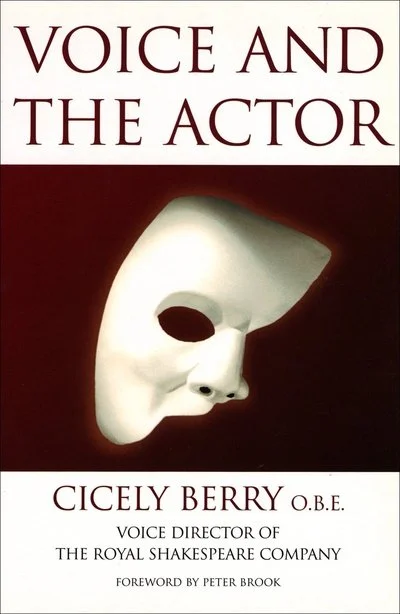
Voice and the Actor by Cicely Berry, Virgin Books, 1973
Peter Brook's foreword establishes Berry's philosophy: technique as myth—no such thing as correct voice, only a million wrong ways denying what would otherwise be affirmed. The work isn't how to do but how to permit. Setting voice free requires understanding that speaking is an expression of inner life, inseparable from emotion.
Berry insists on poetry for voice training. Good verse strikes echoes, awakening portions of deep experience seldom evoked in everyday speech. Never waste time on second-rate text—better text opens more possibilities. Words rooted in breath, not achieved through meaningless patter exercises. Shakespeare's "Fear no more the heat o' the sun" becomes a practical training text: breathe after every second line, feeling breath descend completely, sound springing from the diaphragm. Often time-lag exists between getting breathing working and sound actually rooting there.
Three-stage foundation: relaxation, breathing, and increased muscularity of lips and tongue. These free actors make the voice more responsive. Floor work is particularly valuable—lying down, speaking text, using the floor to feel ribs open and voice vibrating against the surface. This physical feedback develops awareness, breathing and resonance can't be provided alone.
Size for theatre involves three elements: partly volume, partly attitude (reaching out to the audience, taking time), partly firmness of sound carrying distance. Important: the audience is only interested in actors talking to each other, never performing at them.
Resonance depends entirely on breath and complete freedom. Voice is incredibly sensitive to feelings of unease—basic fear triggers defence mechanisms, creating tension, particularly neck and shoulders. An actor's knowledge of vocal demands itself creates tension requiring systematic release.
Berry rejects rigid rib-reserve breathing systems. Instead, the diaphragm and rib movements work together naturally. Separation is only a temporary awareness exercise, never a performance technique.
Voice teacher involved in all theatre's work—cannot separate the sound of words from the living context. Growth in voice work manifests as growth in human relationships, not isolated technical accomplishment.
The Actor and the Text by Cicely Berry, Applause Books, 1992
Berry's companion volume advances beyond vocal technique into making language organic. Words aren't merely sounds shaped by lips and tongue—they possess physical roots and movement. The challenge: getting inside words, responding freely, then presenting that response to the audience. Actors often treat words as belonging either to reason or emotion, making them only literal/logical or only emotional. Instead, words must become thoughts in action, always shifting and changing, resulting from both thought and feeling.
Physical preparation proves essential for text work. Words themselves constitute movement—subtle but vital awareness. An actor's whole physical self must engage to release imaginative possibilities within language. Berry employs exercises speaking text whilst moving, lying down, and standing, to root words physically through breath rather than merely understanding them intellectually.
Shakespeare's work serves as supreme training for all texts. Not because classical verse represents the highest art form, but because its richness demands total investment. Working Shakespeare tunes the ear to language in modern writing, making the actor alert to colloquial rhythms and patterns.
Monosyllables carry particular weight in verse. Single-syllable words create a strong rhythmic drive—the audience cannot hurry them because the rhythm won't permit it. Information comes through rhythm itself, not just meaning. Berry demonstrates this through Bottom's "I have had a most rare vision"—the formal rhythm of the opening line juxtaposed against colloquial speech, language always knocking against expectations.
Making text your own requires repetition until physically on the tongue, not merely memorised. The imaginative process often becomes ordinary at the moment of speaking because actors grow tentative, unsure how far they can explore language boldly without seeming unreal.
Berry's mission: expanding awareness of language—its roots, physical seat and vibration, associations. Voice work ultimately concerns growth in human relationships, not isolated technical accomplishment. Words require flexibility and range by their nature; voice responds to what text demands.
The Complete Stanislavsky Toolkit (New Edition) by Bella Merlin, Nick Hern Books, 2014
Merlin bridges Stanislavsky's often-muddy writings into accessible contemporary practice. Her mission: rescuing Stanislavsky from poor translations, cranky phrasing, and academic distortion. She argues his hands-on notions became atrophied, whilst attractive alternatives (Mamet's muscularity, Chubbuck's sleekness) all use Stanislavsky, whether acknowledging it or not.
Central concept: psycho-physicality. Physical action carries inherent psychological resonance. Rather than chasing emotions or cranking into performative states, actors appeal directly to body—muscular memory proves reliable where emotional memory fragments. This doesn't mean external character quirks (latex noses, limps). Instead: constructing role through physical dimensions whilst remaining psycho-physically open to internal sensations those dimensions trigger.
Six Fundamental Questions structure preparation: Who? When? Where? Why? For what reason? How? These prevent floundering in generalisation when facing an audience or camera. Answering these questions grounds the actor in concrete circumstances rather than vague feelings.
Merlin emphasises a constant state of inner improvisation. Even within tight staging and letter-perfect text delivery, the actor remains imaginatively alive and playful. This requires saying yes to whatever partner or director offers—adapting moment-to-moment whilst maintaining structure.
Toolkit includes: inner psychological drives (what drives character to act), logic and sequence (actions following believable progression), active analysis (moving rehearsal process away from endless table discussions toward active exploration), and tempo-rhythm (speed and intensity patterns affecting both movement and speech).
Relaxation here means psycho-physical release, not merely bodily tension reduction. Quality of ease, combining imaginative playfulness with physical freedom. Creative energy—performance-related adrenaline—springboards into the character's inner life rather than an obstacle requiring suppression.
Merlin was trained in the Russian tradition, where every discipline employed similar vocabulary, making psycho-physical integration constantly evident. Voice-overs and ballet exercises both emphasised the body-voice-soul-psyche connection. Western tendency segregates disciplines: now tap, now Shakespeare, now dialects. Stanislavsky's approach treats the performer as a unified psycho-physical instrument requiring holistic development.
A Practical Handbook for the Actor by Melissa Bruder, Lee Michael Cohn, Madeleine Olnek, Nathaniel Pollack, Robert Previto, Scott Zigler, Nick Hern Books, 1986
Developed from David Mamet's Atlantic Theater Company training, this handbook strips acting to essentials: living truthfully under imaginary circumstances. The technique rejects psychological complexity in favour of playable physical actions. An actor's job becomes translating whatever is given into simple, actionable terms.
Core principle: feelings aren't within control, so never say "I must feel this certain way." Instead: "This is what I'm doing in the scene, and I'll do it irrespective of how it makes me feel." Physical action becomes a foundation—something doable with personal investment, giving the actor something more important to attend to than performance success or failure.
Action and moment constitute the two areas. Action: what you go onstage to do—pursuing a specific goal (objective). Moment: what's actually happening as you play it. Every moment is ideally based on the moment preceding it. Acting, therefore, means dealing truthfully with other actors whilst pursuing a specific goal.
Given circumstances include anything set by the writer or director requiring adherence: location, dialects, costumes, scenery, specified physicality (limps, hunchbacks), blocking, and emotional moments. The director may supplant the playwright's circumstances with their own ideas—the actor simply accepts the director's changes as new given circumstances.
Common sense, bravery, and will form essential requirements. Common sense translates material into actionable terms. Bravery throws yourself into the play's action despite obstacles. Will adheres to ideals even when difficult.
Acting resembles carpentry—a craft with definite skills and tools. Assiduously applying will to acquiring these skills makes them habitual. Once the technique becomes habitual, the actor need no longer concentrate on it. Developed craft works automatically, allowing free operation within its bounds. Voice work example: once you've worked long and hard on voice, you're free to attend to the scene's action rather than being heard.
The handbook's muscular simplicity attracted many practitioners seeking relief from psychological indulgence plaguing some actor training. See also Mamet’s True and False.
The Actor's Art and Craft: William Esper Teaches the Meisner Technique by William Esper and Damon DiMarco, Anchor Books, 2008
Esper trained directly under Sanford Meisner at Neighbourhood Playhouse, worked alongside him for fifteen years, then founded his own studio. This book documents his teaching, preserving Meisner's progression through dialogue between Esper and students over a two-year training cycle.
Foundation: reality of doing. Actors must genuinely perform actions, not pretend or indicate. Esper demonstrates this through simple exercises—count letters in your name, recall yesterday's meals, listen for distant sounds. Whether you succeed doesn't matter; whether you genuinely attempt it does. This distinguishes real doing from representation.
Repetition Exercise forms the technique's cornerstone. Two actors face each other, repeating observations about their partner back and forth: "You're wearing blue." "I'm wearing blue." "You're wearing blue." Seemingly absurd, this exercise trains actors to truly hear their partner rather than preparing the next line. Moment-to-moment response becomes habitual. Students repeat for months until mechanical self-consciousness dissolves, leaving only authentic connection.
Independent Activity adds complexity. Actor performs difficult physical task with genuine personal investment (threading a needle, folding a fitted sheet, assembling a puzzle) whilst partner interrupts through repetition. Task must be genuinely challenging—requiring complete concentration—so the actor experiences authentic conflict between wanting to complete the task and responding to the partner's provocations.
Emotional Preparation develops the capacity to bring a specific inner life to the scene. Not manufacturing feeling but creating private circumstances that genuinely affect the actor, allowing emotion to exist before entering the scene rather than forcing it during performance.
Esper emphasises living truthfully under imaginary circumstances through doing, never indicating. The technique produces actors working spontaneously moment-to-moment, responsive to partners rather than performing pre-planned results. Training requires extraordinary patience—students repeat seemingly simple exercises for months before progressing. This methodical progression builds a foundation where genuine impulse replaces self-conscious performance.
Mamet's foreword praises Esper's preservation of Meisner's rigorous approach against dilution by impatient practitioners seeking shortcuts.
On the Technique of Acting by Michael Chekhov (Edited by Mel Gordon), Harper Perennial, 1991
Michael Chekhov, nephew of playwright Anton Chekhov, developed a technique emphasising imagination and physicality over psychological realism. His approach differs radically from uncle Konstantin Stanislavsky's psychological method, instead activating creativity through body and artistic imagination.
Psychological Gesture forms the technique's cornerstone. Actor finds single archetypal movement encapsulating character's entire inner life—thrusting forward aggressively, pulling back defensively, opening expansively, closing protectively. This gesture, practised repeatedly with specific qualities (strength, ease, beauty, form), awakens corresponding psychology. Rather than thinking way into character, the actor moves way into it. The gesture's tempo reveals the character's life rhythm—a fast, driven tempo versus a slow, contemplative pace fundamentally alters psychological experience.
Imaginary Body technique allows an actor to step outside their own physical limitations. Imagine inhabiting a body completely different from your own—taller, heavier, lighter, more contracted or expanded. This imaginary physicality generates authentic psychological transformation without relying on personal emotional memory.
Atmosphere work addresses space's psychological quality. Every scene possesses atmosphere—oppressive, joyous, mysterious, foreboding. An actor doesn't create atmosphere individually but rather receives it, allowing it to influence actions. Training involves exercises sensing different atmospheric qualities, learning to function within them rather than imposing predetermined choices.
Radiation describes energy flowing outward from the actor's centre, creating presence and connection with the audience. Not physical tension but imaginative sending—projecting the character's inner life into space. Weak radiation results in disconnected, lifeless performance regardless of technical proficiency.
Higher Ego represents the actor's creative individuality—artistic conscience guiding choices toward truthfulness and beauty. Distinguishes genuine artistic impulse from ego-driven showing off or mechanical technique application.
Chekhov trained actors at Moscow Art Theatre before emigrating, eventually teaching in America, where students included Gregory Peck, Marilyn Monroe, and Clint Eastwood. His technique offers an alternative to naturalistic approaches, particularly valuable for heightened theatrical styles, fantasy, and period work requiring physical transformation beyond contemporary realism's bounds.
The Michael Chekhov Handbook: For the Actor by Lenard Petit, Routledge, 2010
Petit studied under Deirdre Hurst du Prey, Chekhov's student and secretary for twenty years. His handbook translates Chekhov's intangible concepts into repeatable exercises, developing concentration and imagination simultaneously. The missing spiritual element from Chekhov's published writings—present person-to-person in teaching—becomes accessible through Petit's structured approach.
Life-Body concept forms the foundation. Actors learn by experiencing movement energetically without moving the visible body. Exercise: lift the physical arm whilst feeling the inner arm lifting first, establishing an energetic connection preceding physical action. This awakens a sensation of inhabiting the body beyond injury, illness, distress—feeling form from inside rather than observing externally.
Timeline Exercise develops radiation. Stand, extend left arm forward into tomorrow, next week, next year—sending energetic rays beyond the room's wall. Right arm reaches backwards into yesterday, last week, last year. Line runs through the present moment. Lower physical arms, leave life-body arms projecting, walk forward into the future, backwards into the past. This teaches moving energetically beyond physical confines.
New Eyes Exercise places imaginary eyes on the shoulder blades. Walk backwards, looking through new eyes without turning your head. Negotiate around obstacles, people, and walls through energetic seeing. This delivers genuine three-dimensional spatial awareness, connecting the actor to the backspace—place of power and consequence.
Quality transforms action. How something's done separates kiss from kick, seduction from murder. Petit emphasises finding qualities (tender, strong, sluggish, vibrant) in the world around us—objects, images, people—then applying discovered qualities to movements. Quality speaks directly to feelings, provides how where technique provides what.
Spy Back reflection follows each exercise. After completing work, little intellect examines what happened, what worked, and how it worked. This satisfies the analytical mind whilst keeping it away from the creative process itself, which remains intuitive, impulsive, and physical.
Petit structures tools separately from principles, making reference easy. The application section uses edited class transcripts showing students working together, dialogue about exercises, and making abstract concepts concrete.
The Intent to Live: Achieving Your True Potential as an Actor by Larry Moss, Bantam Books, 2005
Moss's comprehensive acting guide emerged from thirty-plus years of coaching Oscar winners Helen Hunt and Hilary Swank. The title captures his core philosophy: great actors don't seem to be acting but actually living. When young Moss watched Kim Stanley's torrential tears in The Far Country, he witnessed a performance transcending artifice—trauma audiences shouldn't witness, yet were compelled to watch.
Given Circumstances forms Moss's foundation—everything the writer tells you about character and situation. These irrefutable facts constitute performance bedrock; interpretation builds atop this ground. Moss demands meticulous script reading: actors saying they only read their scenes earn his scorn.
Superobjective—the dream driving character through the entire story—operates as the performance spine. Individual scene objectives serve as ribs connected to that spine. This system of wants mirrors daily life: from waking to sleeping, wants propel action. Understanding personal want-systems helps actors identify character desires.
Emotional justification distinguishes technical understanding from passionate performance. Superobjective must affect the actor powerfully: thinking about it produces tears, rage, or joyous gratitude. Not intellectual exercise but visceral necessity. Blanche's superobjective isn't merely finding a safe place—the actress must justify why losing it means madness.
Point of View exercise structures character psychology: "My name is [character], and the world is [six descriptive words]." This specificity grounds actors in how characters perceive reality before entering scenes.
Van Gogh's fence metaphor crystallises interpretation: the artist observes a simple fence and paints each slat a different brown shade—lightest beige through darkest near-black. Individual vision transforms ordinary objects through specific choices. Actors similarly interpret scripts through personal artistic vision whilst honouring the writer's facts.
Moss's journey validates the technique's power. The first musical teacher declared he possessed "the worst singing voice" ever heard. Sanford Meisner told him he lacked truthful ability. Yet desire exceeded humiliation; practising voice two to four hours daily, Moss achieved a Broadway career whilst continuing to learn.