Why the Camera Knows You're ‘Acting’ (And What to Do About It)

You've done the preparation. You've broken down the script, worked out your character's objectives, and made your choices. You walk onto set, the camera rolls, and you deliver what you believe is a solid performance. But the director gives you a note you weren't expecting: "You're not in the moment." Or simply: "Do less." You're confused because, from the inside, it felt like you were doing everything right.
If you've ever had the chance to watch yourself back in a workshop — which is one of the best ways to learn what the camera actually sees — you'll know the shock of recognising it. The performance that felt truthful in the moment looks effortful on screen. You can see yourself working. The camera has caught something you couldn't feel from the inside.
This is one of the most common problems in screen acting, and one of the hardest to explain — because from the inside, it feels like you're doing everything right.
The Driving Lesson
Think about learning to drive a car.
Before you ever sat behind the wheel, you thought you more or less understood how it worked. You'd watched people drive your whole life. How hard could it be? That was unconscious incompetence — you didn't know what you didn't know.
Then you had your first lesson, and everything happened at once. Clutch, mirror, signal, gear, steer, brake — too many things to process simultaneously. You stalled at junctions, forgot to check your mirrors, and crunched the gears. Now you were consciously incompetent: you knew what you were supposed to do, but you couldn't do it.
Then, with practice, you got to a stage where you could manage all of it — but only with concentration. Every action required deliberate thought. You could drive, but it took all your attention. You were consciously competent.
And then one day, you drove home from work and realised you couldn't remember the journey. The gears, the mirrors, the indicators — all of it had become automatic. You were thinking about what to have for dinner, not about how to operate the car. You'd reached unconscious competence.
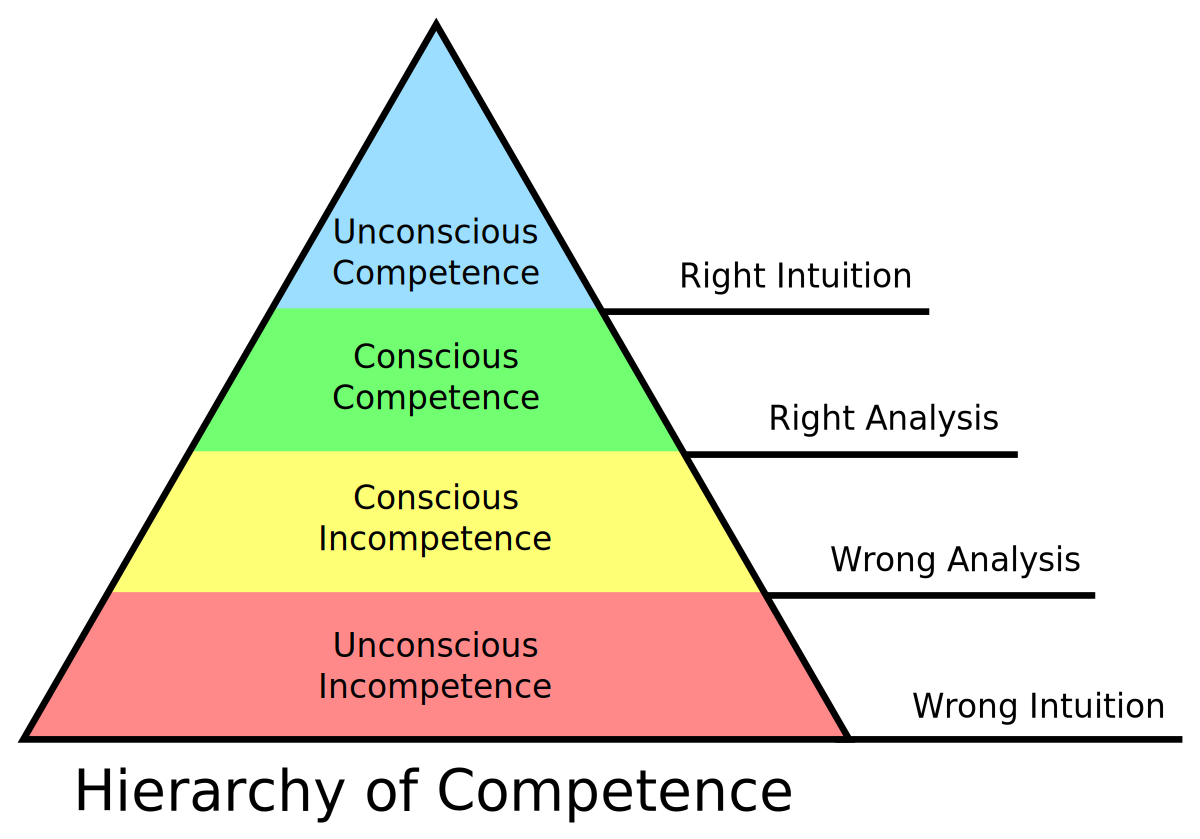
This is exactly how a screen performance develops. And most actors who struggle on camera are stuck in the middle stages.
The Stage That Fools You
Conscious competence is a dangerous place for a screen actor because it feels like success. You know your lines. You've made your choices. You can hit your mark, find your light, and deliver the performance you've planned. From the inside, it feels prepared. Professional. Ready.
But the camera sees something different. It sees the effort. It sees you remembering your next line a fraction of a second before you say it. It sees you executing a choice rather than living a moment.
On stage, you can get away with this. The audience is far enough away that conscious competence reads as a polished performance. The theatre's scale forgives the gap between thinking about the character and being the character.
The screen forgives nothing. A camera two feet from your face will catch every flicker of calculation, every moment where you step outside the character to monitor your own performance. It doesn't just see what you're doing — it sees you deciding to do it.
About the Character vs As the Character
Here's the distinction that matters, and it's one I've had to explain to actors on set many times.
When I tell an actor they're not in the moment, they often reply, "But I am thinking about the character." And that's the problem. Thinking about the character puts the character outside of you. It means you're observing, analysing, managing — standing beside the character and operating them like a puppet. The camera sees the puppeteer.
Thinking as the character is something completely different. It means the character's thoughts have become your thoughts. Their responses are your responses. You're not deciding what the character would do — you're doing what feels necessary, because you've so thoroughly absorbed the character's situation that their instincts have become yours.
The difference is the difference between describing an emotion and feeling it. Between planning a reaction and having one. Between acting and being.
Why This Is Harder Than It Sounds
If it were simply a matter of deciding to think as the character rather than about them, every actor would do it. The difficulty is that conscious competence feels like the destination. You've done the work, you know the material, you can deliver — what else is there?
What's left is the hardest part: letting go of the controls. Trusting that your preparation has done its job and that if you simply commit to the character's situation — really commit, without monitoring yourself — the performance will be there.
This is why preparation matters so much for screen work. Not as an intellectual exercise, but as the groundwork that makes unconscious competence possible. The more thoroughly you've absorbed the character's world, their relationships, their needs, the less you have to think about any of it when the camera rolls. It becomes — like driving — something you do without conscious effort, freeing you to actually be present in the scene.
The Moment It Works
You'll know when it happens, because it feels like nothing. That's the paradox. The best screen performances don't feel like performances to the actor delivering them. There's no sense of effort, no awareness of technique, no internal commentary. You're simply there, in the scene, responding to what's happening in front of you.
It's the same feeling as that drive home you can't remember. You weren't unconscious — you were completely engaged. You just weren't monitoring yourself. The skills were there, operating beneath your awareness, doing what they'd been trained to do.
When an actor reaches this point on camera, the result is unmistakable. The performance has an ease and a truth that no amount of technical skill can manufacture. The camera stops seeing an actor and starts seeing a real character. That's the goal.
Getting There
There's no shortcut to unconscious competence. You can't skip the earlier stages — they're necessary. You have to learn the technique before you can forget it. But understanding the stages helps, because it tells you where you are and what's actually required to move forward.
If you're struggling on camera and you can't work out why, ask yourself this: Am I thinking about my character, or am I thinking as my character? If the honest answer is about, you've identified the problem. And identifying the problem is the first step toward solving it.
The Alchemy of Screen Acting: Building a Sustainable Career in 21 Steps will be published soon as a complete guide. Each step builds on the previous one, taking you from wherever you are now to working professionally with casting directors actively seeking you out for suitable roles.
Subscribe at https://thealchemyofscreenacting.substack.com/subscribe to receive further screen acting insights and be the first to get access when the book becomes available.
Header image: Keenan Constance on Pexels
In-article diagram: Competence Hierarchy adapted from Noel Burch by Igor Kokcharov (Wikimedia Commons)